Figuring out your ideal CBD dosage is more of a personal art than an exact science, but you don't have to go in blind. While there's no one-size-fits-all number, a solid starting point for most adults is somewhere between 5 and 25 mg per day. This gives you a safe, conservative baseline to work from as you tune into your body's response.
Finding Your Personal Starting Dose
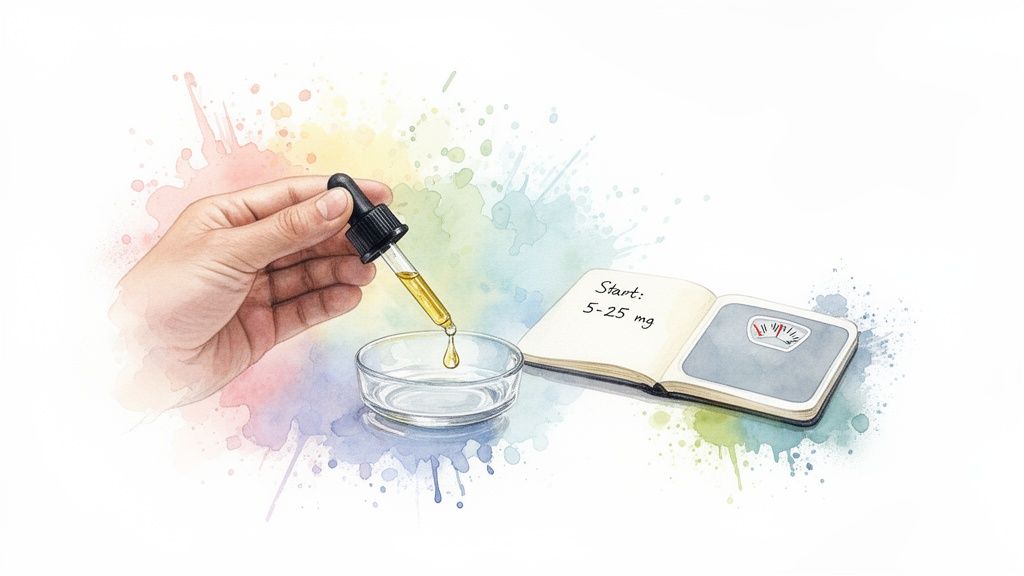
The old advice to "start low and go slow" is absolutely correct, but it doesn't give you much to work with. To really understand how much CBD you should be taking, it helps to look at a few key factors right from the start. Your body chemistry is unique, which is why a universal dose just doesn't exist.
The wide 5 to 25 mg starting range is influenced by your body weight, what you're hoping to achieve, and your individual metabolism. For instance, someone looking for a bit of daily balance might do well starting at 5 mg, while a person dealing with more significant discomfort might begin closer to 25 mg.
The Role of Body Weight and Chemistry
Your body weight is one of the most practical starting points for estimating a dose. It makes sense: a heavier person generally needs a bit more than a lighter person to feel the same effects, simply due to differences in body mass and how they process compounds.
But chemistry is the real wild card. Two people of the exact same weight can have completely different reactions to the same amount of CBD. This is precisely why your first dose is just a starting line, not the finish. The best strategy is always a patient and observant one.
The ultimate goal is to find your Minimum Effective Dose (MED). This is the smallest amount of CBD that gives you the results you're looking for. Sticking to your MED ensures you get the benefits without overdoing it, which makes your routine both sustainable and more affordable.
Here’s a practical table to help you estimate a starting point based on your weight. These are just suggestions, so remember to listen to your body and adjust as needed.
Sample CBD Starting Doses By Body Weight
| Body Weight | Low Strength Starting Dose (mg) | Medium Strength Starting Dose (mg) |
|---|---|---|
| Under 130 lbs (59kg) | 5 – 10 mg | 10 – 15 mg |
| 130-230 lbs (59-104kg) | 10 – 15 mg | 15 – 25 mg |
| Over 230 lbs (104kg) | 15 – 20 mg | 25 – 30 mg |
These numbers provide a reasonable range to begin your journey. Start at the low end for your weight class and see how you feel after a few days before considering an increase.
The Power of Titration
The key to dialing in your perfect dose is a process called titration. It’s a simple but powerful method: you start with a low dose and make small, steady increases over time, all while paying close attention to how you feel.
This methodical approach lets you zero in on the precise amount that works for you without any guesswork.
You might, for example, start with 10 mg a day for a week. If you're not quite where you want to be, you could bump it up to 15 mg for the following week. This patient process empowers you to find your unique "sweet spot" safely. For those looking to support better rest, specific titration schedules can be particularly helpful, as detailed in our guide on using CBD for sleep in the elderly.
Key Factors That Influence Your CBD Dosage
Figuring out your ideal CBD dose isn't about finding a magic number on a generic chart. It’s a personal journey, and the right amount for you depends entirely on your own body and the product you’re using. To get it right, you have to consider a few critical variables that make your situation unique.
Four factors really stand out: your body weight, why you're using CBD in the first place, your personal tolerance, and the strength of the product you choose. Getting a handle on these is the first step toward building an effective wellness routine that actually works for you.
Your Body Weight and Metabolism
Your body weight is the most common starting point for estimating a dose, and for good reason. Just like with many other supplements, a person with a larger body mass often needs a bit more to feel the same effects as someone smaller. Think of it as a baseline—a logical place to begin before you start fine-tuning.
But weight is only half the story. Your metabolism, which is how quickly your body processes things, is just as important. If you have a fast metabolism, you might burn through CBD more quickly. This could mean you need to take it more often or in slightly larger amounts to keep the effects consistent. This is exactly why two people who weigh the same can have completely different results from the exact same dose.
The Specific Reason For Use
What are you hoping to achieve with CBD? This question is a major piece of the puzzle. The dose for general, everyday wellness looks very different from the amount you might need for more targeted, specific support.
- General Wellness: If you're just looking to maintain a sense of balance, a lower dose is often plenty. Many people find that 5-15 mg is a great starting point for daily support.
- Targeted Support: For tackling more significant issues like poor sleep or nagging physical discomfort, you'll likely need a more robust dose. Starting with 15-30 mg or even more might be necessary to feel a real difference.
It's a lot like staying hydrated. Someone sitting at a desk all day doesn't need nearly as much water as an athlete training for a marathon. Your CBD needs will scale with the intensity of your wellness goals.
Be honest with yourself about your objectives. Are you after subtle, daily support, or are you looking for more noticeable relief? Knowing the answer will point you toward a dosage range that actually makes sense for what you’re trying to do.
Individual Tolerance and Body Chemistry
This is a big one that people often forget. Your personal tolerance to cannabinoids plays a huge role. If you have experience with cannabis, you might already have a higher tolerance and need a larger dose to notice anything. On the other hand, if you're brand new to cannabinoids, your system will be much more sensitive, and starting with a very small dose is the smartest way to go.
This all comes down to your unique endocannabinoid system (ECS). This is the complex network of receptors in your body that CBD interacts with. How your ECS is tuned will determine how you respond. Some people are just naturally more receptive and discover that a tiny amount works wonders for them.
Product Potency and Type
Last but not least, the product itself is a critical factor. CBD comes in a massive range of concentrations, and learning to read the label is absolutely essential for dosing accurately and safely.
The potency of a tincture, for example, is usually listed in milligrams (mg) of CBD per bottle and sometimes per milliliter (mL). A 30mL bottle with 1500mg of CBD is way more concentrated than a 30mL bottle with only 500mg. The stronger the product, the less liquid you'll need to take.
The type of CBD extract in the product also makes a difference. You’ll see CBD isolate, broad-spectrum, and full-spectrum options. Full-spectrum products contain a wide array of cannabinoids and terpenes that create what's known as the "entourage effect." This synergy sometimes means a smaller dose can be more effective than a much larger dose of pure CBD isolate. To really get a grasp on this, you can learn more about the differences between full-spectrum vs. broad-spectrum extracts in our guide. This knowledge is key to picking a product that truly fits your strategy.
How To Titrate Your Dose For The Best Results
So, you’ve figured out a potential starting dose. That’s a great first step, but it’s just that—a start. The real magic happens with a patient, methodical process called titration. It’s just a fancy word for starting with a small amount and slowly increasing it over time until you find what works perfectly for you.
Think of it as fine-tuning a radio. You make small adjustments until the signal comes in crystal clear. This "start low and go slow" approach lets you listen to your body's response without overwhelming your system. The goal is to find the lowest effective dose that gets you the results you want, which is key for a sustainable and positive experience.
Create A Simple Titration Schedule
Putting a little structure around this process takes out all the guesswork. Consistency is your best friend here. You want to give your body enough time to adjust to each new dosage level before you change things up again. One of the most common mistakes I see is people rushing the process, which only leads to confusion or taking more than they actually need.
Here’s a practical, real-world example of what this could look like:
- Week 1: Start with your initial calculated dose (let’s say 10 mg) once a day. Try to take it at roughly the same time to keep things consistent.
- Week 2: If you aren't feeling the desired effects yet, bump it up by a small amount, like 5 mg. Your new daily total is now 15 mg.
- Week 3 & Beyond: Keep increasing your daily dose by 5 mg each week until you hit that sweet spot where you feel a clear benefit. Once you find it, stay there. There's no need to keep increasing.
This method is the gold standard for a reason. A 2021 research review noted that effective daily doses can be anywhere from 10 mg to 900 mg—a massive range. A sensible titration plan, like starting with 20-40 mg daily and adding 5 mg weekly, helps you safely explore that range to find your personalized dose without side effects. You can find more general information about finding the right CBD dosage with this method.
The Power Of A Dosage Journal
How do you know when you’ve found your "sweet spot"? Simple: you track it. Keeping a small journal is probably the single most effective tool you can use. This doesn't have to be a leather-bound diary; the notes app on your phone or a small notebook works perfectly.
For each dose, just jot down a few key details:
- Dose Taken: The exact amount of CBD in milligrams.
- Time of Day: When did you take it?
- How You Feel: Note any changes—good or bad—in your mood, sleep, or whatever symptom you're targeting. Using a simple 1-10 scale can be incredibly helpful here.
After just a week or two, you'll start to see clear patterns emerge from your notes. You'll be able to directly connect a specific dose to a specific feeling or result. This empowers you to make decisions based on your own data, not just guesswork.
This simple flowchart shows how the main factors—your body, your goals, and your product—all play a role as you make these adjustments.
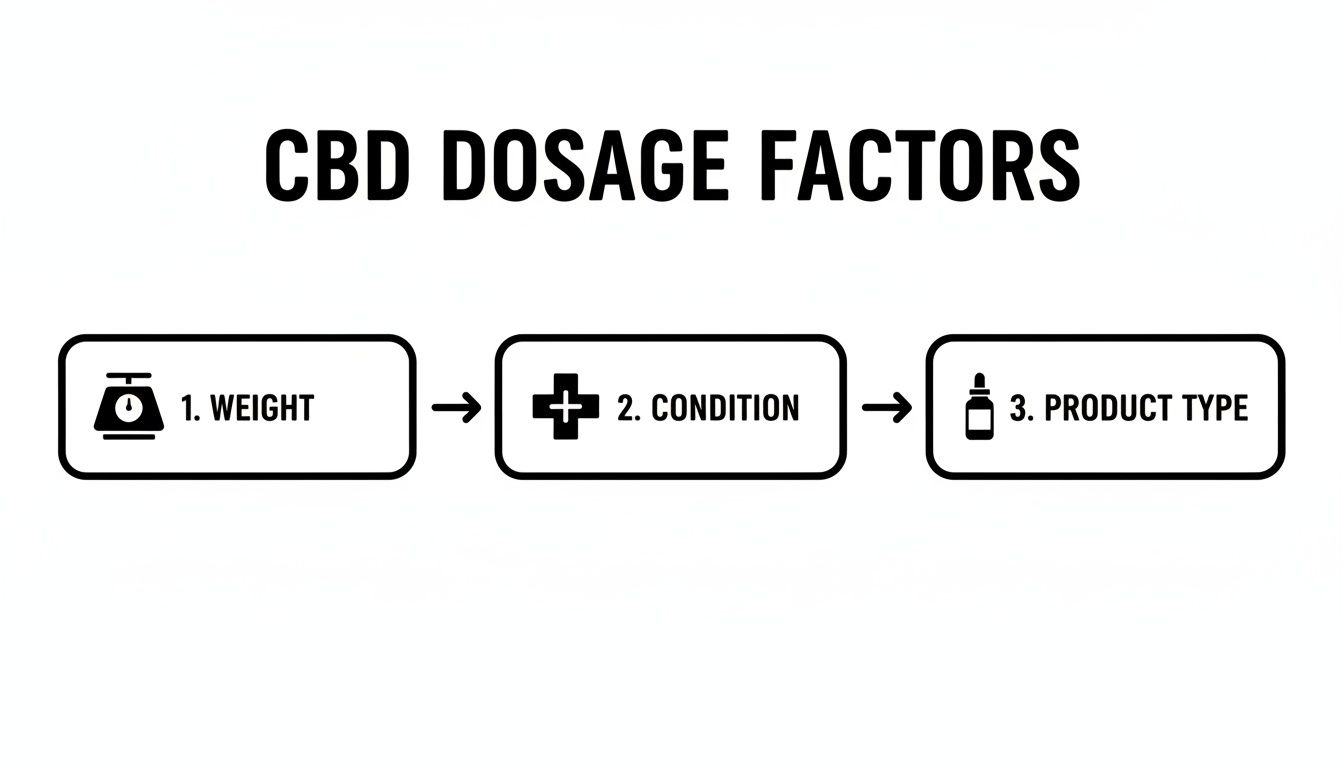
As the graphic shows, your weight, your condition, and the type of product you're using are all interconnected pieces of the dosage puzzle.
Sample Titration Plans For Different Goals
Your titration schedule should also reflect what you're trying to achieve. The timing and frequency of your doses can make a huge difference. Let's walk through a couple of common scenarios.
Example 1: For Better Sleep Quality
If you're aiming for more restful nights, your plan might look something like this:
- Initial Dose: Start with 15 mg of CBD taken about 60-90 minutes before you plan to go to sleep. Stick with this for the first week.
- Journaling: Each morning, rate your sleep quality on that 1-10 scale. Did you fall asleep faster? Did you wake up less? Note it down.
- Adjustment: If your sleep hasn't improved after a week, increase the evening dose to 20 mg. Continue this weekly 5 mg increase until you find the amount that helps you sleep soundly through the night.
Example 2: For Daytime Calm
For someone looking to manage feelings of unease during a busy day, the strategy would be a bit different:
- Initial Dose: Try splitting your dose. Start with 5 mg in the morning and another 5 mg in the early afternoon.
- Journaling: Throughout the day, make a quick note on your phone about your mood or tension levels.
- Adjustment: After a few days, if you feel you need a bit more support, try increasing the morning dose to 10 mg but keep the afternoon dose at 5 mg. This split-dosing approach can help provide more consistent, stable effects all day long.
Calculating Your Dose From Product Labels
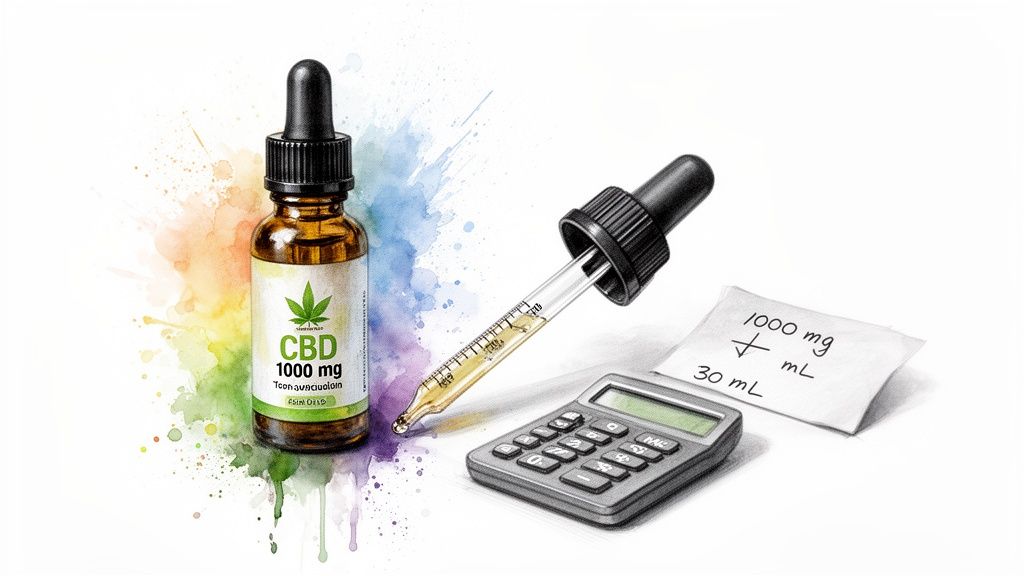
Before you can even think about a titration plan, you need to know exactly what’s in your bottle. Getting a handle on your product's concentration is the foundation of accurate dosing. Without it, you're just guessing. Let's break down how to read those labels and calculate your dose with confidence, whether you're using an oil, tincture, or capsule.
Decoding Tincture and Oil Potency
When you look at a bottle of CBD oil, you'll see two crucial numbers: the total amount of CBD in milligrams (mg) and the bottle's size in milliliters (mL). These two figures are everything you need to figure out the product's strength and measure your dose precisely.
Let's walk through a real-world example. Say you have a 30mL bottle of CBD oil that says it contains 1000mg of CBD.
First, you'll want to find out how much CBD is in each milliliter. The math is simple:
Total CBD in Bottle (mg) ÷ Total Volume in Bottle (mL) = CBD per mL (mg)
For our example bottle, that looks like this: 1000mg ÷ 30mL = 33.3mg of CBD per mL.
This means a full 1mL dropper will deliver about 33.3mg of CBD. Most droppers come with handy measurement markers (like 0.25, 0.50, 0.75, and 1.0mL) to make life easier. So, if your target dose is 15mg, you’d just fill the dropper to a little under the 0.5mL line.
Understanding this simple calculation transforms you from a passive user into an informed one. It's the difference between guessing how much CBD you should take and knowing exactly what you're putting into your body.
It’s worth noting that while most people take between 0-100 mg of CBD daily, 23% report using over 200 mg. That's a massive range. This highlights just how personal dosing is, and it's also why accuracy matters—especially since studies show mislabeling can occur in 7-13% of products. Using lab-tested products from trusted resources like RSOhelp.com and knowing how to calculate your dose is your best defense against unintended high doses. For more on this, check out these general CBD usage statistics and safety.
To make this even easier, here are a few common calculations worked out for you.
CBD Tincture Dosage Calculation Examples
This table shows how to calculate the CBD content per drop and per 1mL dropper for common tincture potencies, helping you measure your dose accurately.
| Total CBD in Bottle (mg) | Bottle Size (mL) | CBD per 1mL Dropper (mg) | Approx. CBD per Drop (mg) |
|---|---|---|---|
| 500 mg | 30 mL | 16.7 mg | 0.83 mg |
| 1000 mg | 30 mL | 33.3 mg | 1.67 mg |
| 1500 mg | 30 mL | 50 mg | 2.5 mg |
| 2500 mg | 50 mL | 50 mg | 2.5 mg |
Having these numbers handy can save you time and help you dose with much greater precision, especially when you're just starting out or adjusting your intake.
Calculating CBD Per Drop
What if you're microdosing and need a much smaller amount? Knowing the CBD content per drop is incredibly helpful. It's not perfectly precise because drop sizes can vary slightly, but a standard 30mL tincture bottle contains roughly 600 drops.
Let’s use our 1000mg bottle example one more time:
Total CBD in Bottle (mg) ÷ Total Drops in Bottle = CBD per Drop (mg)
So: 1000mg ÷ 600 drops = 1.67mg of CBD per drop.
This is powerful information. If you've determined your ideal starting dose is 5mg, you’d simply take three drops (3 x 1.67mg = 5mg) to get right on target.
Spectrum Type and the Entourage Effect
Finally, remember that the type of CBD matters, too. Whether your product is full-spectrum, broad-spectrum, or an isolate can influence the dose you'll need. Full-spectrum products, like RSO, contain a whole host of other plant compounds like cannabinoids and terpenes.
These compounds work together in a synergy known as the "entourage effect," where the whole is greater than the sum of its parts. Many people find they can achieve the same relief with a smaller dose of a full-spectrum product than they would need from a CBD isolate. It’s a perfect example of why understanding what you’re using is just as important as how much you take.
Special Considerations For RSO Dosing
While the basic idea of "start low and go slow" holds true for most cannabis products, a highly concentrated, full-spectrum extract like Rick Simpson Oil (RSO) is in a league of its own. Dosing RSO requires a far more cautious and deliberate hand. It’s a completely different ballgame than dosing with a standard CBD oil, mainly because you're working with the whole, unadulterated power of the plant.
RSO is packed with the full spectrum of cannabinoids, terpenes, and other natural compounds. This creates a powerful synergy, often called the entourage effect, that can feel quite intense, especially if you’re new to it. Because of this, the standard advice is to begin with a dose that's a tiny fraction of what you might take with a typical CBD product.
The Grain of Rice Method
The most common and trusted starting point for RSO is a dose about the size of half a grain of rice. Yes, that small. It might seem like an insignificant amount, but it’s an essential safety measure. This initial microdose gives your body a chance to get acquainted with the potent effects of a full-spectrum extract without feeling overwhelmed.
This careful start is critical because RSO’s effects are significantly more pronounced than those of isolated CBD. The entire goal is to gently introduce these powerful compounds into your system so you can accurately gauge your own sensitivity and how your body responds. One of the biggest mistakes people make is rushing the process, which often leads to an uncomfortable experience.
When working with RSO, patience isn't just a virtue—it's a necessity. The gradual titration schedule is more than a suggestion; it’s a core part of the process designed to help you find your therapeutic sweet spot safely and effectively.
For a deeper look at the specific protocols and history behind this potent oil, you can find more information in Rick Simpson’s cannabis oil guidelines. Knowing where the method comes from provides valuable context for your own journey.
A More Gradual Titration Schedule
The timeline for increasing your RSO dose is also much slower and more methodical. With a standard CBD tincture, you might increase your dose weekly. With RSO, the protocol often requires you to stick with the same small dose for several days before even thinking about an adjustment. This gives your body plenty of time to adapt.
A typical RSO titration plan might look something like this:
- Days 1-4: Start with a dose the size of half a grain of rice. Take this two or three times a day (morning, afternoon, and evening).
- Days 5-8: If you're tolerating the initial dose well, you can double it to the size of a full grain of rice for each dose.
- Ongoing Increases: From here, you can continue to double the dose roughly every four days, but always pay close attention to how you feel.
This slow and steady progression is the entire secret. You stop increasing the dose when you've hit that point where you're getting the benefits you want without any unwelcome side effects. This endpoint is completely unique to you and can only be discovered through this kind of patient and observant process.
Seeking Professional Guidance
Given the sheer potency of RSO and its unique dosing demands, working with a professional is something we strongly recommend. This is particularly important if you have pre-existing health conditions or are taking other medications, as you need to be mindful of potential interactions.
A knowledgeable practitioner can help you map out a personalized plan that fits your specific health goals. They can offer support, answer your questions, and guide you in making smart adjustments, ensuring your experience is both safe and productive.
Here at RSOhelp.com, our goal is to connect you with trustworthy resources that can guide you responsibly. We are firm believers in an informed approach to wellness, where safety and education always come first. The right guidance takes the guesswork out of the equation, empowering you to use these potent products with confidence.
Common Questions About CBD Dosing
Even with the best plan in hand, you're bound to have questions when starting something new. That's a good thing. When it comes to figuring out your CBD dose, a few key questions pop up again and again. Getting clear answers to these will help you move forward with confidence and sidestep some common rookie mistakes.
Let’s walk through some of the most frequent things people ask, from how long it takes to feel something to whether you should take it with your morning toast.
How Long Does It Take For CBD To Work?
This is probably the most common question I hear, and the answer comes down to one thing: how you're taking it. Your consumption method is the single biggest factor determining how quickly CBD gets into your system and starts working.
If you’re using a sublingual tincture, for instance, you’ll hold the oil under your tongue for about 60-90 seconds. This gives it a direct route into the tiny blood vessels there, bypassing digestion. With this method, you can generally expect to feel the effects within 15 to 45 minutes.
Capsules and edibles, however, have a much longer path to travel. They have to go through your digestive system and get processed by your liver first. Because of this, you’ll likely be waiting anywhere from 60 to 90 minutes—sometimes a bit longer—to notice anything. The trade-off is that while they take longer to kick in, the effects from edibles often last quite a bit longer than from a tincture.
The most common mistake I see beginners make is getting impatient. They take a dose, don't feel anything right away, and take another. Wait the full onset time before even thinking about taking more—you’ll avoid taking way more than you actually need.
Can I Take Too Much CBD?
It's understandable to worry about this, but you can rest easy. CBD is widely considered safe, even in very high amounts. In fact, many organizations have stated that CBD shows no potential for abuse or dependence.
That said, it is possible to overdo it. While it's not dangerous, taking a dose that’s way too high for your system can lead to some mild, temporary side effects. Usually, this looks like:
- Drowsiness or feeling really tired
- An upset stomach
- Diarrhea
- Changes in your appetite or weight
This is exactly why the "start low and go slow" approach is so crucial. By methodically increasing your dose, you can pinpoint your minimum effective dose—the smallest amount that gives you the relief you’re looking for. This helps you dodge any unpleasant side effects and keeps the whole experience positive.
Should I Take CBD With Food?
This is a fantastic question, and the answer is a definite yes. Taking your CBD with a meal, especially one containing some healthy fats, can make a huge difference in how well your body absorbs it.
CBD is a fat-soluble compound, meaning it breaks down in fat, not water. When you take it with dietary fats, your body can absorb it far more efficiently. This whole process is called increasing bioavailability, and it simply means more CBD makes it into your bloodstream to do its job.
You don’t need to eat a heavy meal, either. Just pairing your dose with some simple, healthy fats will do the trick. Think things like:
- Avocado
- A handful of nuts or seeds
- Olive oil
- Fatty fish like salmon
- Full-fat yogurt
By simply timing your dose with a meal or a snack, you make your CBD work smarter, not harder. You might even find you can get the results you want with a smaller dose.
How Do I Know If My CBD Dose Is Working?
This one can be tricky. Unlike a painkiller, the effects of CBD are often subtle, not a sudden, dramatic shift. You're looking for a gradual easing of symptoms and a quiet return to balance, which can be hard to notice day-to-day.
The absolute best way to know if it’s working is to track everything. Before you even start, establish your baseline. On a scale of 1 to 10, rate the main things you're trying to address—maybe it’s daily discomfort, sleep quality, or general feelings of unease.
Then, as you begin your CBD routine, keep a simple journal. All it takes is a minute each day to note:
- The dose you took (in mg)
- The time of day you took it
- Your symptom ratings for that day
After a week or two, you can look back and spot real, objective patterns. You might see that your average discomfort rating has dropped from a 7 to a 4, or that you're consistently sleeping better. This data-driven approach takes all the guesswork out of the process and shows you exactly how your body is responding.
At RSOhelp.com, our goal is to give you clear, reliable information to support you on your wellness journey. If you're looking for personalized guidance or need help finding verified, lab-tested products, we invite you to see what we offer.
Connect with us for a free consultation and find trusted RSO sources at RSOhelp.com