
When individuals discuss the "Rick Simpson book," they are almost always referring to his self-published work, Phoenix Tears: The Rick Simpson Story. The book is part personal narrative and part instructional guide, walking readers through his health journey and the specific method he developed for creating a potent, full-spectrum cannabis oil—now widely known as RSO.
Unpacking the Phoenix Tears Book
It is helpful to consider Phoenix Tears as a foundational text in the patient-led cannabinoid movement. It is not a clinical medical journal but rather an influential document that details one man's reported experience with a homemade cannabis extract. Its primary impact was introducing this information to a global audience long before legal, regulated cannabis markets were established in most regions.
The story is deeply personal, originating from Rick Simpson’s own significant health challenges, which he states motivated him to experiment with cannabis concentrates. In the book, he outlines his entire process for making the oil and shares his own observations, alongside anecdotes from others who reportedly used it.
A Modern Examination of Its Contents
How does this book hold up in 2026? This article aims to provide a clear-eyed, modern analysis of the contents within Phoenix Tears. We will carefully distinguish the anecdotal stories from current knowledge based on scientific research, offering the context needed to understand this topic responsibly.
This article is designed as a structured review of the information presented in the book. It is for educational purposes only and is not a substitute for professional medical advice. We are examining the historical context of the book and the protocol it describes, but it's important to recognize that individual results may vary, and further research is needed.
It is critical to approach the book as a historical account of a patient-led movement rather than a clinical guide. Its contents inspired significant interest and subsequent scientific inquiry into cannabinoids.
For those new to this subject, understanding the basics of the oil is a good starting point. You can learn more about what RSO oil is in our detailed guide. This article will build upon that foundation by diving deep into the book that initiated this conversation. We will dissect its key sections, offering a balanced perspective that is grounded in safety and informed by contemporary research.
The Personal Story Behind the Book
To fully comprehend Rick Simpson's book, Phoenix Tears, one must first understand the man behind it. The book is not a dry medical text; it is a deeply personal story born from his own health crisis and his search for an alternative when he felt conventional medicine was not providing relief.
The story begins in 1997. Simpson, a Canadian power engineer, was working in a hospital boiler room containing asbestos insulation. He reported collapsing from the fumes, striking his head, and subsequently developing a severe head injury, post-concussion syndrome, and a persistent ringing in his ears known as tinnitus.
A Catalyst for a New Path
In the years that followed, Simpson grew increasingly frustrated. He found that the prescribed treatments did little to ease his debilitating symptoms. This experience is what reportedly drove him to seek solutions independently.
He then turned his attention to cannabis, which he claimed provided him with the first significant relief he had experienced in years. This journey—from a workplace accident to self-experimentation with cannabis—is the core of his book and the global discussion it sparked. You can get a more complete picture of who Rick Simpson is and his full story to better understand his background.
By framing his experience as a case review of his own "reported outcomes," we can analyze the book's contents while maintaining a necessary clinical and evidence-aware perspective.
Understanding this history helps to contextualize the book's passionate, advocacy-driven tone. It was written by someone who believes he found a solution after exhausting other options. Our goal is to respect his personal conviction while evaluating the information against today's scientific and medical standards—a key distinction for anyone seeking to responsibly navigate the topic of RSO.
The RSO Protocol from the Book
Rick Simpson's book, Phoenix Tears, did more than tell a compelling story. It laid out a specific plan. At its heart were two key components: a recipe for making a particular type of cannabis oil and a high-dose protocol for its administration. Let's examine the protocol as he described it, focusing on its structure and rationale.
The book outlines a method for creating a full-spectrum oil, meaning the objective is to capture as much of the original plant's chemical profile as possible. This is distinct from modern distillates or isolates that target single compounds. However, what truly captured public attention was the dosing schedule.
The "60 Grams in 90 Days" Schedule
The protocol has become known under one simple banner: "60 grams in 90 days." The core idea is built around a slow and steady increase in dosage, a process known as titration. This approach is designed to help the body build a tolerance to the oil’s potent psychoactive effects, which come primarily from its high THC content.
This method can be compared to training for a marathon. An individual would not attempt to run the full distance on the first day. Instead, they would start with a shorter distance and gradually increase it over many weeks. This allows the body to adapt and build the stamina required. The RSO protocol works on a similar principle, starting with a very small amount.
The book recommends starting with a dose about the size of half a grain of rice, taken three times a day. From there, the goal is to double this dose roughly every four days until a total of one gram per day is reached.
Once a person can comfortably tolerate one gram of the oil daily, they are to maintain that dose. Following this escalation, consuming 60 grams would take approximately 90 days. It is important to remember this is a summary of the protocol as described in the book and is presented here for educational purposes only.
The infographic below illustrates the personal journey that reportedly motivated Rick Simpson to develop and share this process.
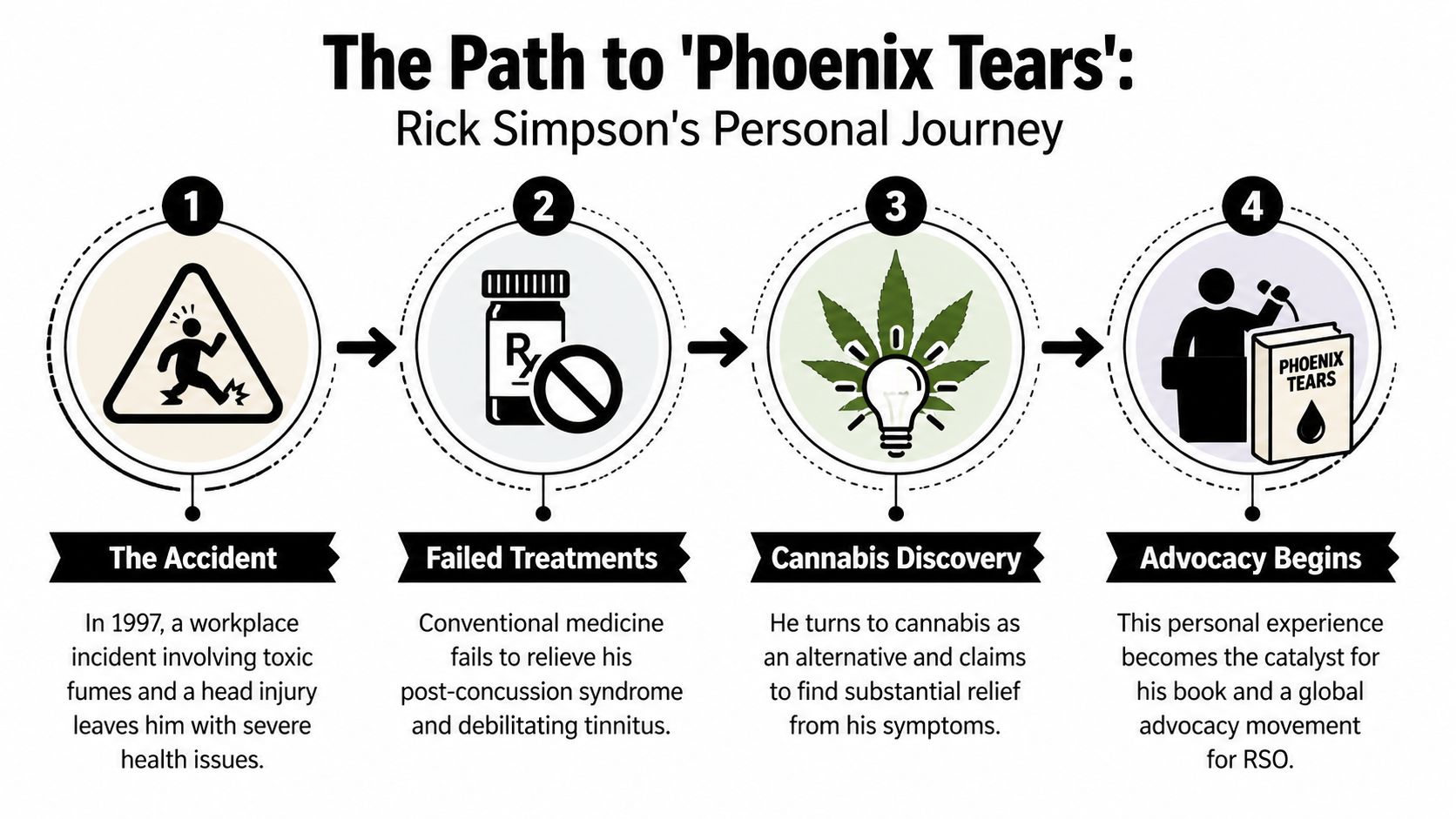
As shown, his advocacy and the Phoenix Tears book were born from his own health challenges and his reported frustration with the options available to him at the time.
Book Protocol vs. Modern Dosing Strategies
The protocol described in the book is intense. To put it in perspective, let’s compare it to a modern microdosing approach, which is often used by individuals seeking more subtle effects with minimal impairment.
| Aspect | Book Protocol (60g/90 days) | Modern Microdosing Approach |
|---|---|---|
| Primary Goal | Rapidly achieve a very high daily dose (1 gram) for a sustained period. | Find the lowest effective dose for symptom management with minimal psychoactivity. |
| Starting Dose | Half a grain of rice (approx. 12-25mg of cannabinoids), three times daily. | 1-2.5mg of THC, once or twice daily. |
| Titration Speed | Aggressive; double the dose every 4 days. | Very slow; increase by small increments (e.g., 1mg) weekly, if needed. |
| Psychoactivity | Significant psychoactivity is expected and managed through tolerance building. | The goal is often to remain "sub-perceptual," meaning without a distinct "high." |
| Total Consumption | High volume (60 grams or more over 90 days). | Very low volume; often less than a single gram over several months. |
This comparison clarifies how demanding the original protocol is. While Simpson's method is about pushing the body's tolerance, other strategies focus on finding a gentle, sustainable balance.
Managing Psychoactivity and Individual Variation
According to the book, the slow, methodical increase in dosage is the only practical way to manage the oil's intense psychoactive effects. By starting small and moving up incrementally, the body has a chance to acclimate, making the full one-gram daily dose more tolerable over time.
This is an aggressive regimen. How an individual responds will vary dramatically based on their metabolism, past experience with cannabis, and overall health. For a more detailed breakdown, you can learn more in our guide to the Rick Simpson protocol.
Anyone considering an adjunctive protocol of this nature should conduct thorough research and, most importantly, consult with a licensed medical professional. A doctor can provide personalized guidance that a book or an article cannot.
Evaluating the Book's Claims in 2026
When Rick Simpson first shared his story, the field of cannabinoid science was still in its early stages. Today, in 2026, we have a much clearer and more nuanced understanding. While the Rick Simpson book remains a landmark piece of patient advocacy, its claims must be viewed through the lens of modern, evidence-aware research.
The book is built on powerful personal stories—anecdotes that have inspired many. These individual accounts are important, as they often serve as the catalyst for formal scientific investigation. However, they are not a substitute for controlled clinical trials. It's a classic case of separating compelling narratives from scientifically validated facts.
For instance, the book details dramatic health turnarounds. With today's science, we can begin to explore the potential mechanisms behind these reported outcomes. Researchers are now investigating these very ideas in preclinical studies, which are conducted in laboratories on cells or animal models. Please remember, this article is for educational purposes and is not medical advice.
How Might It Work? A Look at Preclinical Research
What are scientists actually investigating? They are exploring several ways cannabinoids interact with the body, which could one day help explain some of the outcomes people describe. Two of the most studied areas in preclinical research are apoptosis and angiogenesis.
Apoptosis: This is the body's natural process of programmed cell death that helps clear out old or damaged cells. Some early lab studies suggest certain cannabinoids might encourage this process in aberrant cells.
Angiogenesis: This is the body’s way of creating new blood vessels. It is crucial for healing, but uncontrolled angiogenesis can supply tumors with the resources they need to grow. Preclinical research is exploring whether some cannabinoids may act as angiogenesis inhibitors, potentially disrupting these "supply lines."
These scientific concepts provide a potential, though still unproven, bridge between the stories in the Rick Simpson book and what might be happening at a cellular level. It’s absolutely vital to discuss any health decisions with a qualified medical professional.
"Phoenix Tears" can be viewed as the starting point for a global conversation. It brought patient experience to the forefront, but the scientific journey to confirm any of its claims is a separate, methodical process that requires large-scale human trials.
Why Clinical Proof Is Still Needed
Personal stories are moving, but they do not meet the standard for medical proof. For any therapy to be widely accepted as safe and effective, it must undergo years of rigorous testing, including the gold standard: placebo-controlled, double-blind human trials.
To date, RSO has not passed through this kind of vetting for the conditions Simpson discusses. This is why you will not hear any credible expert making claims of a "cure" or a guaranteed result. Instead, the use of RSO is best framed as a potential adjunctive approach—something to be used alongside conventional care and discussed openly with your entire medical team. Individual results will always vary, and more research is essential.
For families seeking guidance on this complex topic, resources like RSOhelp.com offer a responsible, evidence-aware starting point. They provide educational content and consultations designed to help facilitate more informed conversations with doctors and caregivers.
The Legacy and Market Impact of Phoenix Tears
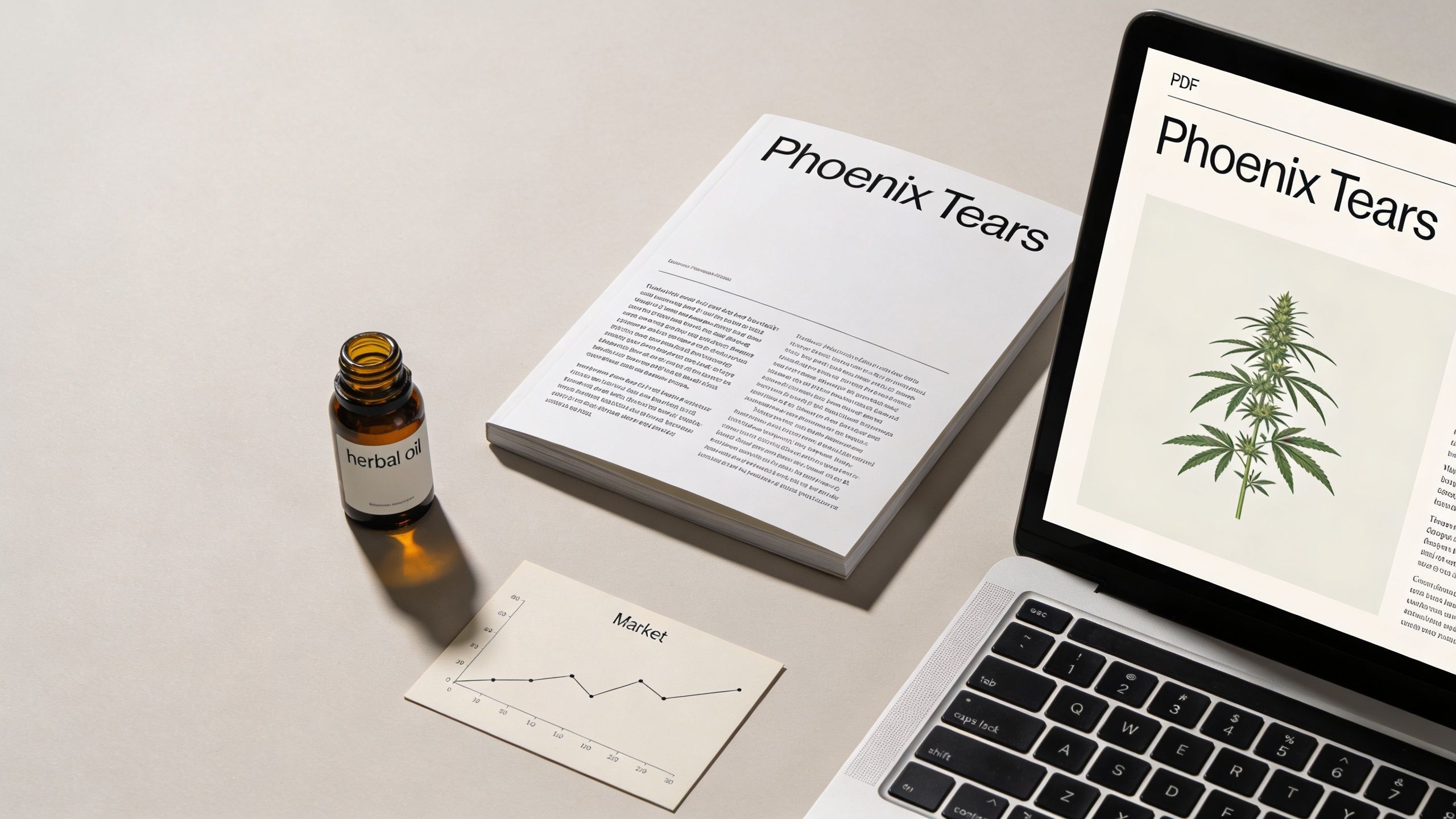
When Rick Simpson published his story, it was more than a book release—it was the catalyst for an entirely new, patient-driven corner of the cannabis world. Long before legal dispensaries were common, Phoenix Tears created a massive grassroots movement. A significant part of this resulted from the book being shared freely online as a PDF, bypassing traditional publishers and delivering the information directly to people who were actively looking for other options.
This created a powerful wave of demand from the ground up. Patients and their families, now armed with the book’s instructions, began asking for a product that did not officially exist in nascent legal markets. They were not seeking branded edibles or specific flower strains; they simply wanted "the oil from the book." The force of this patient-led demand was something the emerging legal cannabis industry could not ignore.
From DIY Guide to Dispensary Staple
As state-legal markets began to take shape, producers recognized the demand. They started creating a product that fit the book's description—a dark, thick, full-spectrum cannabis oil—and labeled it "RSO." It was a direct acknowledgment of the man and the book that started the movement.
This was a fascinating example of consumer demand shaping a commercial industry. Rick Simpson's Phoenix Tears: The Rick Simpson Story was a landmark publication, with its second edition from around 2014 being downloaded millions of times after being shared as a free PDF. You can read the second edition of The Rick Simpson Story here to see the original text that inspired this phenomenon. By 2023, this grassroots product had become a market force, with RSO sales in major US markets like California and Florida reported to be over $100 million annually.
Navigating Quality and Safety Concerns
However, this explosive growth came with a serious downside. The same word-of-mouth environment that helped the book go viral also created a market filled with risks. For every lab-tested RSO product available in a licensed shop, there are countless untested or low-quality versions sold through unregulated channels.
This market duality highlights a critical need for consumer education. The legacy of the Rick Simpson book is not just the oil itself but also the complex, often confusing market it helped create.
This is precisely why trustworthy educational resources are more important than ever. Knowing how to read a lab test, identify a reputable source, and understand the difference between a quality product and a poor one is essential for safety. For families seeking clear-headed, unbiased guidance, resources like RSOhelp.com offer the kind of structured, evidence-aware support needed to navigate this landscape and make informed choices.
Frequently Asked Questions About the Rick Simpson Book
It is natural to have questions when first learning about Rick Simpson and his book. There is a great deal of information available, and it can be difficult to separate fact from speculation. This section addresses some of the most common questions to provide a clearer picture.
This information is for educational purposes only. Always consult a licensed medical professional before making any health decisions.
What is the official Rick Simpson book?
The primary book is titled Phoenix Tears: The Rick Simpson Story. It is a self-published work that is part memoir and part instructional guide. In it, Rick Simpson shares his personal story, what led him to cannabis extracts, and the specific method he developed. It should be viewed as a foundational text for the patient-led cannabis movement rather than a formal scientific paper.
Where can I find a copy of the book?
Finding a new, physical copy of Phoenix Tears can be difficult, as its distribution has historically been informal. The book gained widespread attention through free PDF downloads, which is how most people have read it. This grassroots sharing is a significant part of its history. If you are interested in the historical context, you can explore the history of RSO here.
Does the book claim to cure cancer?
This is a critical point of clarification. The book is filled with powerful personal stories and anecdotal reports from individuals who used the oil for serious health conditions. Rick Simpson wrote it from the perspective of a passionate advocate. However, these are personal accounts, not scientific proof. The book does not contain clinical trial data, and its contents have not been validated by regulatory agencies. It is best to view the book as a collection of case reports that sparked significant research interest, not as a guarantee of any specific outcome. Individual results may vary.
How is RSO different from other cannabis oils?
The oil described in the Rick Simpson book, now known as RSO, is distinct from many other cannabis oils, particularly the CBD oils commonly found on the market.
- Full-Spectrum: RSO is made with the intention of capturing the full profile of the cannabis plant, including all cannabinoids, terpenes, and flavonoids. This is different from distillates that isolate THC or broad-spectrum oils that remove it.
- High Potency: RSO is a thick, dark, and highly concentrated oil. Its primary feature is a high concentration of THC.
- Extraction Method: The book describes a solvent-based extraction method. While modern lab-produced RSO uses professional-grade equipment and purification techniques, the fundamental principle is similar.
Is it safe to make RSO at home using the book's recipe?
No, attempting to make RSO at home with the methods described in the book is not recommended and can be extremely dangerous. The process involves flammable solvents like alcohol, which pose a serious fire and explosion risk outside of a professional laboratory with proper ventilation and safety equipment. Furthermore, without the right equipment to properly purge the final product, residual solvents could remain, which may be harmful to consume. For safety, it is always advised to acquire lab-tested RSO from a licensed, reputable source.
At RSOhelp.com, our mission is to provide clear, responsible education on this complex topic. Families seeking guidance can schedule a consultation to better understand how to approach RSO as a potential adjunctive therapy in a safe and informed manner.