You may be reading labels, forum posts, and product pages that make delta-10 vs delta 8 sound simple. One is presented as calming. The other is framed as clear-headed and uplifting. For a patient or caregiver trying to make a careful decision, that shorthand isn't enough.
The harder question is whether either compound is a sensible fit for a therapeutic goal, especially if you're already familiar with Rick Simpson Oil, full-extract cannabis preparations, or route-dependent dosing. In practice, the decision isn't just about effects. It involves manufacturing method, evidence quality, dosing uncertainty, purity, and whether a single semi-synthetic cannabinoid is the right tool for the job.
That matters most when someone is trying to reduce discomfort, preserve function, support sleep, or avoid adding more variability to an already complex care plan. A product can sound gentler and still be poorly made. A product can feel more stimulating and still have very little clinical data behind it. Those are not small details.
This article is for educational purposes only. Individual results may vary. Further research is needed. Consult a licensed medical professional.
Introduction Navigating the Landscape of Novel Cannabinoids
Patients usually arrive at this topic from one of two places. They either saw delta-8 helping someone with rest, appetite, or body discomfort, or they found delta-10 marketed as a daytime option that might feel lighter and less impairing. Both pathways create the same problem. The labels move faster than the science.
For a therapeutic user, the useful comparison isn't hype versus hype. It's evidence versus uncertainty, and manufacturing consistency versus variability. Delta-8 and delta-10 are both part of the wider THC family, but they don't occupy the same place in the evidence base. Delta-8 has at least some human use data and an older potency benchmark. Delta-10 remains much less studied, with major gaps around toxicology, dose equivalency, and therapeutic reliability.
A patient familiar with RSO will also notice something else right away. These compounds are typically sold as isolated or highly refined hemp-derived products, not as whole-plant extracts. That changes the conversation. Instead of asking only, "How does it feel?" it's more useful to ask, "How was it made, what else is in it, and can I predict the result from one batch to the next?"
The practical aim is straightforward. If you're considering one of these products for symptom support, you need to know where the evidence is stronger, where it is thin, and why many clinicians remain more comfortable discussing established full-spectrum approaches than newer semi-synthetic cannabinoids.
| Feature | Delta-8 THC | Delta-10 THC |
|---|---|---|
| Origin in plant | Occurs naturally in trace amounts | Not naturally found in cannabis |
| Typical commercial production | Usually converted from hemp-derived CBD | Produced via chemical conversion from hemp-derived CBD |
| Research depth | Limited, but more established than delta-10 | Very limited, with no controlled human studies on effects or toxicology noted in available material |
| Reported effect profile | Relaxing, sedating, appetite-supporting | More alerting, energizing, daytime-oriented |
| Practical concern | Dose still needs careful titration | Greater uncertainty around both effect and manufacturing consistency |
For therapeutic use, the first screen shouldn't be "Which one sounds better?" It should be "Which one can I evaluate more safely?"
The Chemistry and Legality of Delta-8 and Delta-10
A patient who has used RSO for symptom control usually asks a practical question first. "If these are all forms of THC, why are delta-8 and delta-10 treated so differently?" The short answer is chemistry, then manufacturing, then law.
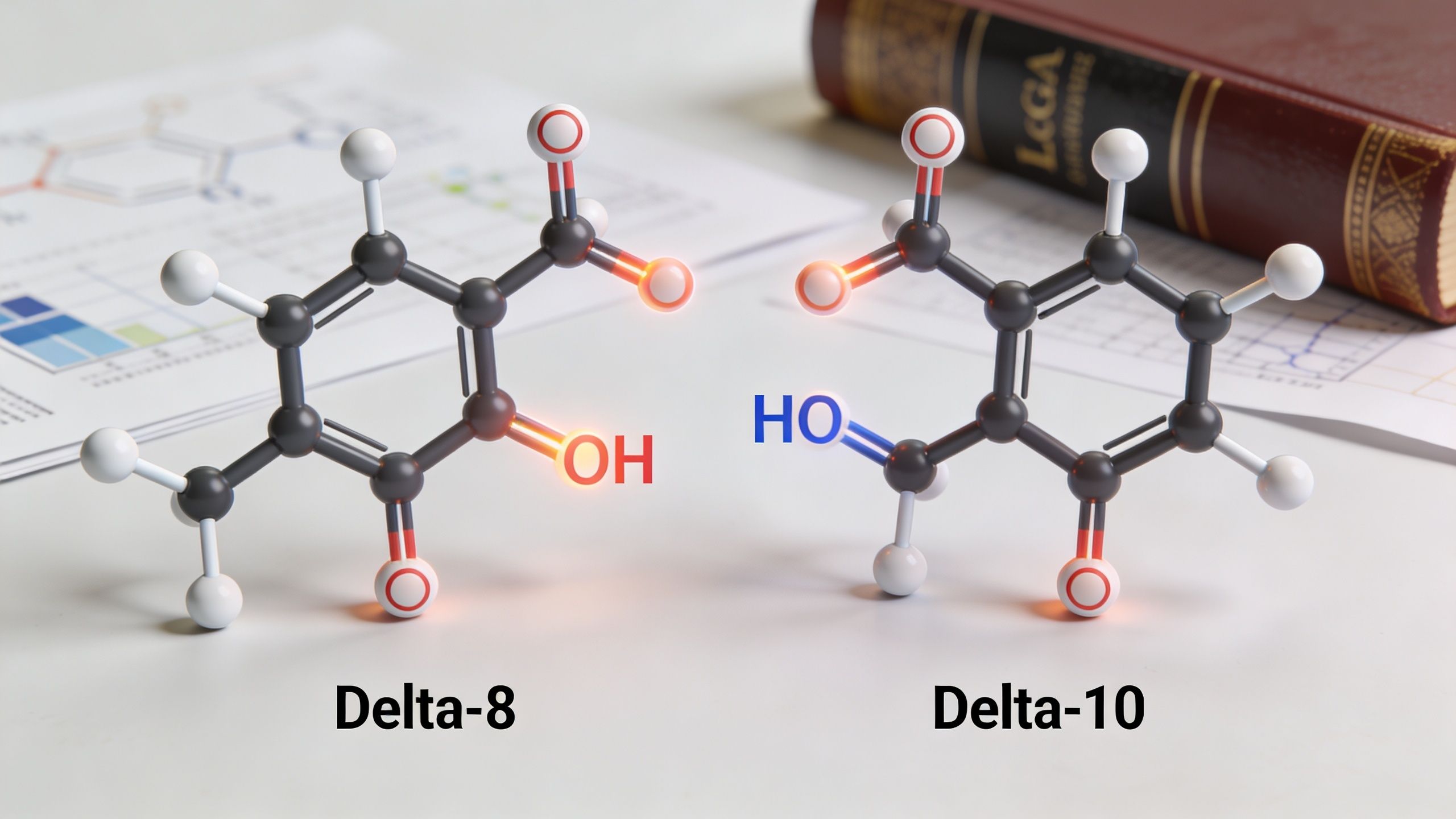
Delta-8, delta-9, and delta-10 are THC isomers. Their carbon framework is similar, but the double bond sits in a different position on each molecule. That small structural shift can change receptor binding, psychoactive intensity, and how predictable the effect is from one product to another. For a therapeutic user, the more important point is not the textbook chemistry. It is that delta-8 and delta-10 sold in stores are usually not produced the way a traditional full-spectrum extract is produced.
Production method changes the risk profile
Commercial delta-8 and delta-10 generally start with hemp-derived CBD, then undergo chemical conversion to create a target THC isomer. Delta-10 deserves extra caution because available background material describes it as especially difficult to manufacture cleanly, with higher potential for inconsistent composition, as discussed in this review of delta-8 and delta-10 manufacturing variability.
That matters for patients trying to use cannabinoids with a therapeutic goal. A converted isolate can contain reaction byproducts, residual solvents, or a different cannabinoid profile than the label suggests if the processor cuts corners or the lab testing is incomplete. In practice, I would place more weight on a current certificate of analysis from an accredited lab than on the front label, especially for delta-10.
RSO sits in a different category. It is still a concentrated cannabis product and still requires careful dosing, but its value is usually discussed in the context of a broad plant profile rather than a narrowly manufactured isomer. That difference does not make RSO automatically safer for every patient. It does mean the clinical conversation is different. With delta-8 or delta-10, manufacturing quality becomes part of the therapeutic risk assessment.
Legal status depends on more than the label
These products gained market access through the hemp rules created after the 2018 Farm Bill. If a product is derived from hemp and remains under the federal limit for delta-9 THC, sellers often market it as federally lawful.
State law can still block sale or possession. Rules change often, and some states restrict delta-8, delta-10, or both. Store availability should not be treated as proof of legality, product quality, or medical usefulness.
Drug testing creates a second legal and practical problem. Hemp-derived THC products can still trigger a positive screen, which is why patients with employment, custody, pain-management, or probation concerns should review whether hemp products can show up on a drug test before trying either compound.
What this means in clinical use
For therapeutic decision-making, three points matter.
- The chemistry is close. The manufacturing path is not. Delta-8 and delta-10 on the retail market are usually converted cannabinoids, not simple whole-plant extracts.
- Delta-10 carries more uncertainty. It is harder to produce consistently, and that raises the bar for lab verification.
- Legal sale does not answer the safety question. A product can fit a hemp framework and still be a poor choice if purity, labeling, and batch consistency are unclear.
For a patient familiar with RSO, that is the main contrast to keep in mind. Delta-8 and delta-10 are usually marketed as isolated solutions. RSO is usually considered for its broader cannabinoid and terpene profile. If the therapeutic goal depends on consistency, traceability, and a plausible entourage effect, that distinction matters.
Comparing Subjective Effects and Therapeutic Potential
The most common summary is also the most incomplete. Delta-8 is usually described as relaxing. Delta-10 is usually described as energizing. That general split is useful, but only if it's paired with a clear warning that the evidence quality is uneven.

What patients report with delta-8
Delta-8 has the more developed therapeutic reputation of the two. The verified material states that a 2023 study of delta-8 users found about 50% used it medically for panic attacks, stress, depression, bipolar disorder, and chronic pain, and a 2022 survey of 521 users also reported fewer adverse effects than traditional cannabis according to this GoodRx review of delta-10 and delta-8.
The same body of material describes delta-8 as a less intense substitute for delta-9, with users often reporting reduced anxiety, more body relaxation, sleepiness, and appetite stimulation. For a patient dealing with evening discomfort, poor rest, or a low tolerance for standard THC intensity, that profile can make practical sense.
Reported pattern: Delta-8 is generally the one patients consider when they want a milder THC effect without the full intensity of delta-9.
That doesn't make it simple or universally appropriate. Sedation may be helpful at night and unhelpful during the day. Appetite stimulation may be welcome for one patient and unwanted for another. The same "gentler" profile can still interfere with concentration if the dose is too high.
What users say about delta-10
Delta-10 is different mostly in description, not in strong human evidence. The verified material says anecdotal evidence positions delta-10 as less potent than delta-8, with people reporting alertness and daytime productivity rather than couch-lock, while there are no controlled human studies on delta-10's toxicology or effects in the available evidence.
That means a patient may hear exactly what they want to hear. Better daytime function. Less heaviness. Less fog. The problem is that this picture rests largely on anecdote and market narrative, not on a developed clinical literature.
For some people, a more activating cannabinoid profile can be useful. For others, activation can become restlessness, a faster heartbeat, or difficulty settling. The lack of controlled data means it's harder to predict who lands where.
A practical side-by-side view
| Clinical question | Delta-8 | Delta-10 |
|---|---|---|
| Daytime vs evening fit | Often discussed more for evening or lower-stimulation use | Often discussed more for daytime use |
| Appetite and relaxation | More commonly associated with both | Less commonly emphasized |
| Evidence support | Limited, but stronger than delta-10 | Sparse |
| Predictability | Better, though still imperfect | More uncertain |
Patients who want a simpler comparison often find it helpful to review how delta-8 compares with CBD in therapeutic use, because that comparison highlights how psychoactivity changes symptom planning.
After you've read the basic comparison, this short overview is useful for hearing how the topic is commonly framed in plain language:
What tends not to work well
A common mistake is choosing delta-10 because "daytime" sounds safer. Stimulation isn't the same as therapeutic usefulness. If the goal is pain reduction, nausea support, or sleep preservation, a lighter, more alerting effect may not be the right match.
Another mistake is assuming delta-8 is automatically appropriate because it's "milder." A compound can be milder than delta-9 and still be too impairing at the wrong dose or from the wrong product.
If your therapeutic goal is specific, choose the compound based on that goal. Don't choose it based on branding language.
Potency Dosing Guidance and Administration Routes
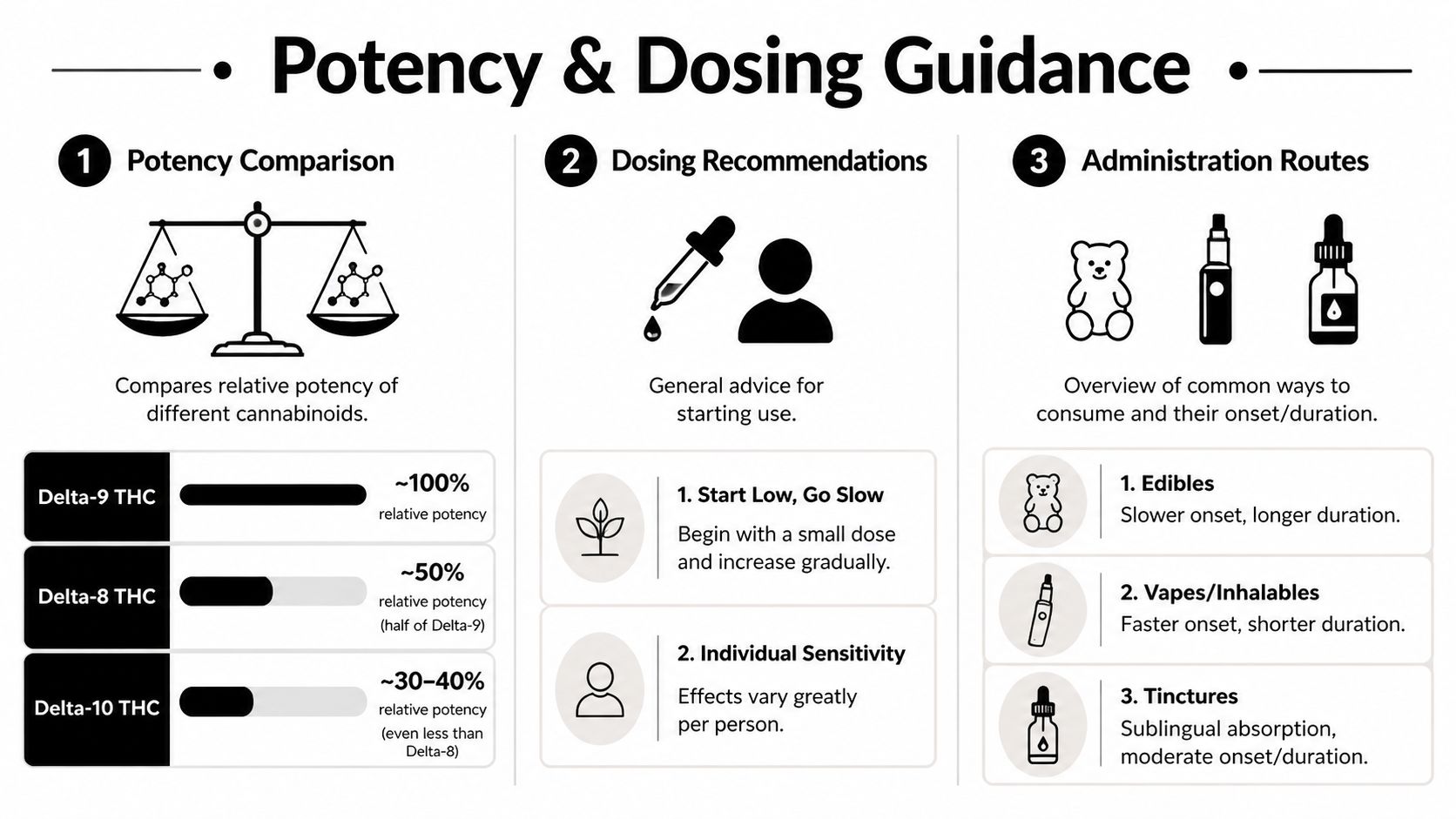
A patient who already uses RSO usually asks a practical question first. If a syringe of full-spectrum oil gives fairly consistent relief, how should a delta-8 or delta-10 product be dosed, and by which route? The honest answer is that delta-8 offers a little more orientation, while delta-10 requires more caution because the dosing literature is thin and product consistency is poor.
Delta-8 has at least some historical human data behind relative potency. Delta-10 does not have a comparable equivalency standard that clinicians can use with confidence. For therapeutic planning, that matters more than marketing terms like uplifting or clear-headed. If the goal is symptom control, an uncertain dose-response curve makes the product harder to use safely.
What potency means for a patient used to RSO
RSO users are often accustomed to working with a full-spectrum extract and then adjusting slowly based on pain, appetite, sleep, or nausea. That process is imperfect, but it has a logic. The product contains a broader cannabinoid and terpene profile, and many patients find that profile more therapeutically rounded than a semi-synthetic isolate.
Delta-8 and delta-10 are different tools. They are usually sold as isolates or isolate-dominant products, and route changes can shift the experience in ways that are less predictable than patients expect. Oral use involves first-pass metabolism. Inhalation produces a faster rise and shorter duration. Tinctures may behave somewhere in between, but onset and absorption still vary by formulation and by patient.
An ACS Laboratory overview on bioavailability gaps across exotic cannabinoids points to a larger problem. There is very little route-specific data for delta-10, so a label dose does not tell you much about how it will perform orally, sublingually, or by inhalation in a therapeutic setting.
A conservative starting approach
For either cannabinoid, start lower than the label makes you think is reasonable. This is especially important with gummies, capsules, and tinctures, where delayed onset leads patients to redose too soon.
Use a simple framework:
- Start with one route only.
- Keep the first dose low, especially if the product is oral.
- Wait long enough to judge the full effect before increasing.
- Track function. Record pain, sleep, appetite, nausea, anxiety, and mental clarity.
- Change one variable at a time so the result is interpretable.
Patients converting between oral products often do better with a basic tincture dosage chart for planning oral cannabinoid doses, especially if they are used to measuring RSO in rice-grain amounts rather than milligrams.
Route selection affects safety as much as effect
Inhaled products may feel easier to titrate because feedback is faster. That does not make them better for therapeutic use. Vapes can encourage repeated dosing, and with delta-8 or delta-10 the formulation quality matters as much as the cannabinoid itself.
Edibles and tinctures reduce that rapid redosing pattern, but they create a different problem. Patients may assume the product is weak, take more, and then become overmedicated once absorption catches up. I see this most often in patients who switch from a stable RSO routine to a novelty product with a very different onset pattern.
For delta-10, route uncertainty is a clinical limitation. For delta-8, it is a manageable issue if the product is clean, the dose is low, and titration is slow. Neither cannabinoid should be treated as a direct stand-in for RSO when the treatment goal depends on consistency over time.
A gummy, vape, and tincture can carry the same milligram number and still behave like three different products in the body. That is one reason I advise patients to treat these compounds as separate trials, not simple substitutes for a trusted full-spectrum oil.
Evaluating Safety Side Effects and Purity Concerns
The largest safety issue with delta-8 and delta-10 isn't just the cannabinoid itself. It's the manufacturing environment around the cannabinoid.
According to the verified material, both cannabinoids undergo synthetic conversion from CBD isolate through hazardous acid baths, creating a risk of residual solvents and heavy metals. The same source states that third-party COAs from unregulated markets show 10 to 20% higher outlier contaminant rates in delta-10 versus delta-8, and notes that the FDA has issued warnings about adulteration risks in this category, as summarized in this manufacturing and safety comparison.
Side effects patients should expect and monitor
The same verified material describes a different side effect pattern for each compound. Delta-8 is linked more with dry mouth and sedation. Delta-10 is linked to mild heart rate increases. Those differences matter for therapeutic planning.
A patient who already struggles with fatigue may not tolerate delta-8 well during the day. A patient with sensitivity to internal stimulation may not like delta-10, even if the label promises focus or uplift. Neither of these compounds should be treated as symptom-specific tools without close observation of unwanted effects.
How to read a COA without overcomplicating it
A Certificate of Analysis, or COA, is the minimum document worth reviewing before a patient considers one of these products. If a seller doesn't provide one, that should end the conversation.
Look for these items first:
- Cannabinoid profile: Confirm that the product contains the labeled cannabinoid and that the report isn't vague.
- Contaminant screening: The COA should include testing for residual solvents, heavy metals, and other impurities.
- Batch matching: The report should correspond to the exact lot or batch you are considering, not a generic sample.
- Readable lab identity: You should be able to tell that a real third-party lab generated the document.
A common problem is that patients check potency and skip contaminants. With semi-synthetic cannabinoids, that is backwards. A potent product can still be a poor product.
A clean-looking package doesn't tell you what happened in the conversion process. The COA is the closer thing to a safety checkpoint.
Drug testing and legal friction
Both cannabinoids can result in a positive drug test because they share relevant metabolites with other THC forms. For patients in regulated workplaces, on monitored programs, or in sensitive caregiving situations, that isn't a theoretical concern.
The verified material also notes that both cannabinoids may be federally compliant under hemp rules while still being banned in over 15 states. That creates a practical burden. Availability may change by location, and a patient's legal risk can differ from a retailer's marketing language.
Isolates vs Full-Spectrum A Comparison with RSO
A patient who does well on RSO often asks a practical question: can a delta-8 or delta-10 product fill the same role if access, cost, or tolerability becomes a problem? In clinic-style education, I treat that as a substitution question, not a branding question. The answer starts with formulation.
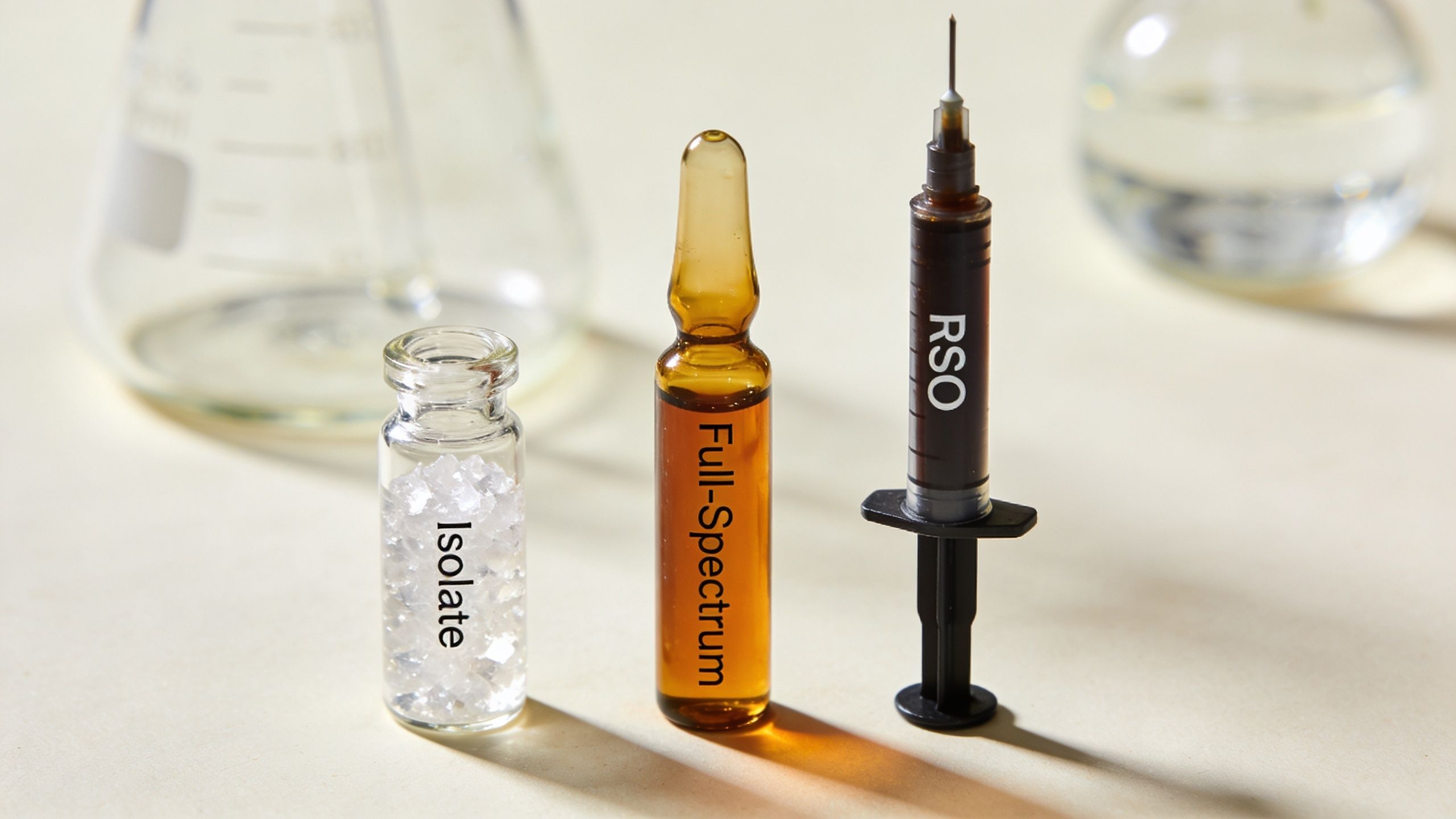
RSO is a whole-extract preparation. Delta-8 and delta-10 products are usually isolate-heavy products built around a converted cannabinoid. Those are different tools with different liabilities.
Why the distinction matters clinically
Patients familiar with RSO often value more than THC content alone. They are responding to a mixture of cannabinoids, terpenes, and other plant compounds that may shape tolerability, onset, and symptom coverage. That is the rationale behind the entourage effect. It remains a working concept rather than a guarantee, but it reflects a real-world observation: some patients report that broad extracts feel more complete than single-cannabinoid products.
That matters most when the treatment goal is layered. Pain plus sleep disruption. Appetite plus nausea. Anxiety plus poor tolerance of standard THC. In those situations, a narrow isolate may solve one problem and leave the others exposed.
A full extract also behaves differently pharmacologically. Multiple constituents may influence CB1, CB2, serotonin signaling, inflammatory pathways, and metabolism at the same time. An isolate-centered product gives a cleaner exposure, but it also strips away much of that complexity.
Where delta-8 and delta-10 fit, and where they do not
Delta-8 is usually the easier of the two to discuss in a therapeutic context. It has a more recognizable patient-reported pattern, often described as gentler than conventional delta-9 THC and more compatible with evening use. Delta-10 is less settled. Product consistency is a concern, and its proposed daytime or alerting profile comes from thinner evidence and heavier marketing.
Neither one should be presented as an RSO equivalent.
The main reason is not just effect profile. It is manufacturing. These products are commonly made through chemical conversion from hemp-derived CBD, and every conversion step creates opportunities for residual reagents, unintended byproducts, or misidentified cannabinoids if production controls are weak. With RSO, the central question is usually extract quality. With delta-8 and especially delta-10, the question expands to what else may be in the finished oil, gummy, or vape besides the named cannabinoid.
What often fails in a direct swap from RSO
Patients sometimes try to map their RSO routine onto delta-8 or delta-10. That usually creates disappointment or inconsistent results because the product category has changed.
Common problems include:
- Narrower symptom coverage. A single dominant cannabinoid may not address the same cluster of symptoms that a broad extract helped manage.
- Less predictable therapeutic feel. RSO users often recognize a familiar whole-plant effect. Isolate-forward products can feel flatter, sharper, or incomplete by comparison.
- Greater dependence on manufacturing quality. Small differences in conversion chemistry or cleanup can change how a product performs and how well it is tolerated.
- Poor route matching. An oral RSO routine does not translate neatly to a gummy, tincture, or inhaled delta product.
- Weaker clinical footing. There is very little high-quality therapeutic research to guide substitution, especially for delta-10.
For a patient with simple goals, a targeted cannabinoid may still have a role. For a patient using RSO because several symptoms interact, full-spectrum products remain a separate class, not a weaker or stronger version of the same thing.
A practical way to frame the decision
If the goal is to experiment with a narrower cannabinoid for a specific reason, delta-8 is usually the more discussable option. If the goal is to replace RSO in a therapeutic plan, caution is warranted. The gap in clinical data is large, and the manufacturing risk is not theoretical.
I advise patients to judge these products by the standard they would use for any high-stakes supportive therapy. Ask what symptom is being targeted, what is being lost by leaving a full-spectrum extract, and whether the manufacturer has earned trust beyond a potency claim. That is the comparison that matters.
Frequently Asked Questions for Patients and Caregivers
Can delta-8 or delta-10 replace RSO in a therapeutic plan
Usually, they shouldn't be treated as direct replacements. Delta-8 and delta-10 are generally narrower, semi-synthetic product categories, while RSO is a full-extract approach. Some patients may use a single cannabinoid product for a specific goal such as evening calm or daytime function, but that is different from replacing a full-spectrum protocol. Consult a licensed medical professional before changing any therapeutic routine.
Which is the more cautious choice for a beginner
If a patient is determined to explore one of these cannabinoids, delta-8 is usually easier to discuss because there is at least some potency and user-survey context behind it. Delta-10 has a thinner evidence base and more uncertainty around dosing and product consistency. Individual results may vary, and lower-intensity marketing language shouldn't be mistaken for safety.
Will either one affect conventional treatment planning
They can. Any psychoactive cannabinoid may affect sedation, appetite, daily function, and tolerability of other supportive medications. That doesn't automatically make them inappropriate, but it does mean they belong in an integrative discussion, especially for oncology patients, older adults, and those with polypharmacy concerns. Further research is needed, and medication review matters.
Are homemade conversions or DIY production ever appropriate
No. The conversion processes discussed around delta-8 and delta-10 involve chemistry that can leave behind unwanted residues or byproducts if performed poorly. Patients should not attempt to make these compounds themselves. For therapeutic use, product verification and contaminant review are basic safety requirements.
Do these products cross the blood-brain barrier
Psychoactive THC analogs are discussed clinically because they do affect the central nervous system, which implies meaningful brain exposure. That is one reason patients may experience sedation, stimulation, altered perception, or impaired concentration. For therapeutic planning, central effects are part of the decision, not a side note.
What should caregivers document when a patient is trialing one
Track the practical outcomes. Record dose, route, timing, symptom target, unwanted effects, and whether the patient could function better or worse afterward. Notes on sleep, appetite, discomfort, mood steadiness, and mental clarity are more useful than broad impressions like "worked well."
Patients and caregivers who want a more careful framework for cannabinoid extracts, dosing strategy, suppository education, and safe sourcing can review the educational guides at RickSimpsonOil.info. The site focuses on practical, evidence-informed RSO education and offers a confidential consultation option for those who need help evaluating full-spectrum products, administration routes, and lab documentation.