Determining if Tetrahydrocannabivarin (THCV) is legal can be a complex process. The answer depends primarily on two factors: the source of the THCV (hemp or marijuana) and the jurisdiction in which you reside. While the 2018 Farm Bill federally authorized hemp-derived products, state laws add significant complexity.
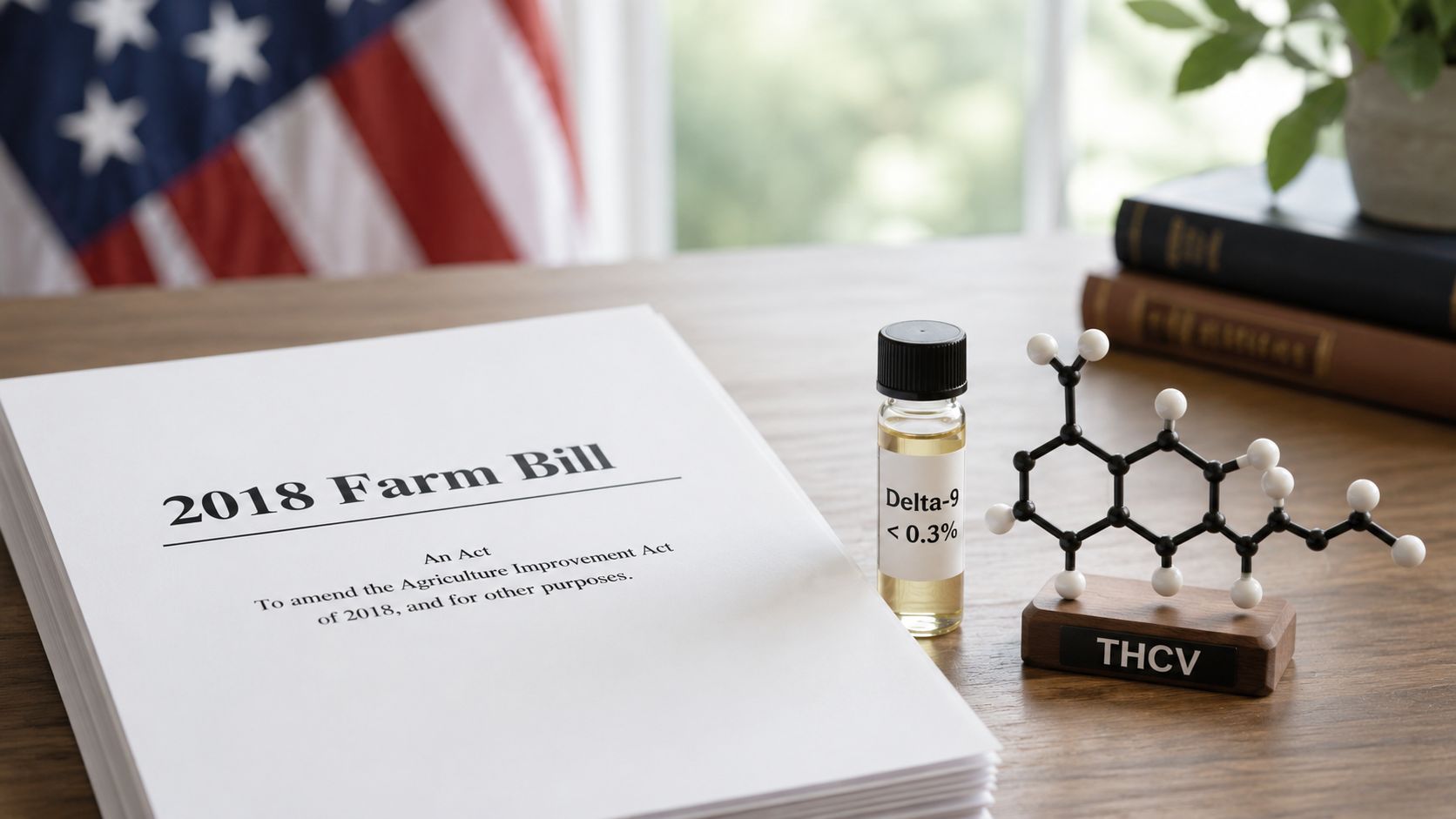
On a federal level, the 2018 Farm Bill established a clear guideline: hemp-derived products, including THCV, are permissible as long as they contain less than 0.3% Delta-9 THC. However, this is only the federal baseline. State laws often introduce stricter regulations, which can vary considerably from one state to another. This article is for educational purposes only and is not a substitute for professional legal or medical advice.
The Tangled Legal Status of THCV
The legal landscape for THCV exists in a gray area, positioned between broad federal guidelines and a complex patchwork of state laws. This means a THCV product that is legally available in one state may be entirely prohibited in a neighboring one.
The infographic below outlines the key factors that determine whether THCV is legal in a specific area.
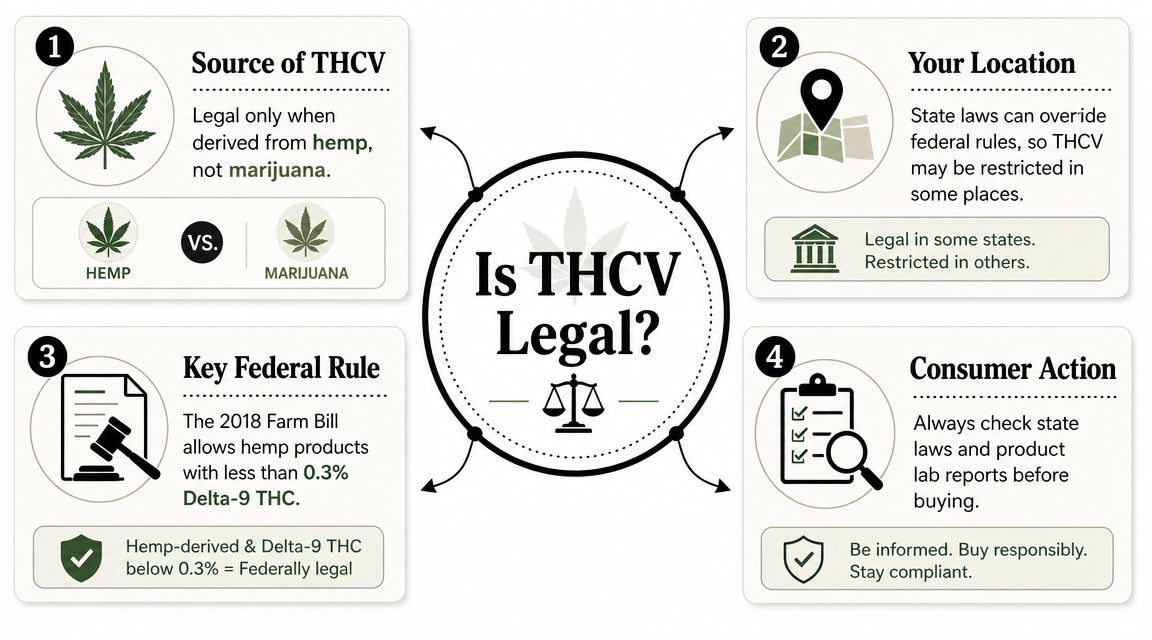
As illustrated, legality is contingent on the source of the THCV, its compliance with the critical 0.3% Delta-9 THC threshold, and local statutes. Ultimately, the responsibility rests with the consumer to conduct thorough due diligence.
Federal Rules vs. State-Level Reality
The 2018 Farm Bill was a significant piece of legislation that removed hemp from the list of controlled substances, reclassifying it as an agricultural commodity. By defining hemp as any cannabis plant with 0.3% or less Delta-9 THC by dry weight, the bill created a legal pathway for other cannabinoids. Because the law was specific about Delta-9 THC, it allows for the extraction and sale of compounds like THCV, provided they originate from compliant hemp.
However, this federal allowance does not guarantee legality nationwide. Many states have implemented their own regulations, with some banning or heavily restricting specific cannabinoids, including THCV. While hemp-derived THCV is federally permissible, a number of states have passed laws to limit or prohibit it. You can learn more about THCV's legal status to understand how these rules differ across the United States.
This legal complexity requires vigilance. A product's federal compliance does not ensure it is legal to purchase or possess in your state. Understanding local laws is as crucial as verifying a product's lab reports. For individuals seeking structured, evidence-aware information on cannabinoids, RSOhelp.com provides educational resources to help navigate these topics.
How the 2018 Farm Bill Changed the Game for Cannabinoids
To understand how a cannabinoid such as THCV can be legally sold, it is necessary to examine the 2018 Farm Bill. This legislation fundamentally altered cannabis regulations in the United States by establishing a clear legal distinction between hemp and marijuana.
Prior to 2018, federal law classified the entire Cannabis sativa L. species as a Schedule I controlled substance. The Farm Bill changed this by creating a specific legal definition for hemp. It defined hemp as any part of the cannabis plant containing no more than 0.3 percent Delta-9 tetrahydrocannabinol (THC) by dry weight. This established a clear, quantitative test for legality.
Why the Focus on Delta-9 THC Matters
The law's focus on Delta-9 THC is a critical detail. This cannabinoid was singled out as the sole determinant of a plant's legal status. The bill placed no federal restrictions on the dozens of other cannabinoids found in the plant, such as CBD, CBG, or, for the purpose of this discussion, THCV.
This specific language created a legal pathway for a new industry. Because the law only regulates Delta-9 THC, companies can legally cultivate hemp and extract other, non-restricted cannabinoids from it. As long as the final product is derived from a compliant hemp plant and remains below the 0.3% Delta-9 THC threshold, it is considered a legal hemp product at the federal level.
The primary takeaway is that a cannabinoid's legality is not based on its own chemical structure or effects. Instead, it is determined by its source plant and the final product's Delta-9 THC content. This is why "hemp-derived" is a key marketing and compliance term.
The Limits of Federal Law
By removing hemp from the Controlled Substances Act, the 2018 Farm Bill established a national baseline for legality. It permitted the interstate commerce of hemp and hemp-derived products, including those containing THCV. This federal action is the foundation of the modern cannabinoid market.
However, the federal government's authority ends where state authority begins. The Farm Bill also granted the U.S. Department of Agriculture (USDA) oversight of hemp cultivation and, importantly, allowed states to create their own regulatory programs. This detail is crucial, as it empowers states to enact stricter regulations than the federal government, and many have done so.
This article is for educational purposes only. The information provided is not a substitute for professional legal or medical advice. Consult a licensed medical professional before making any health decisions. Individual results may vary.
Why State Laws Create a Patchwork of Regulations
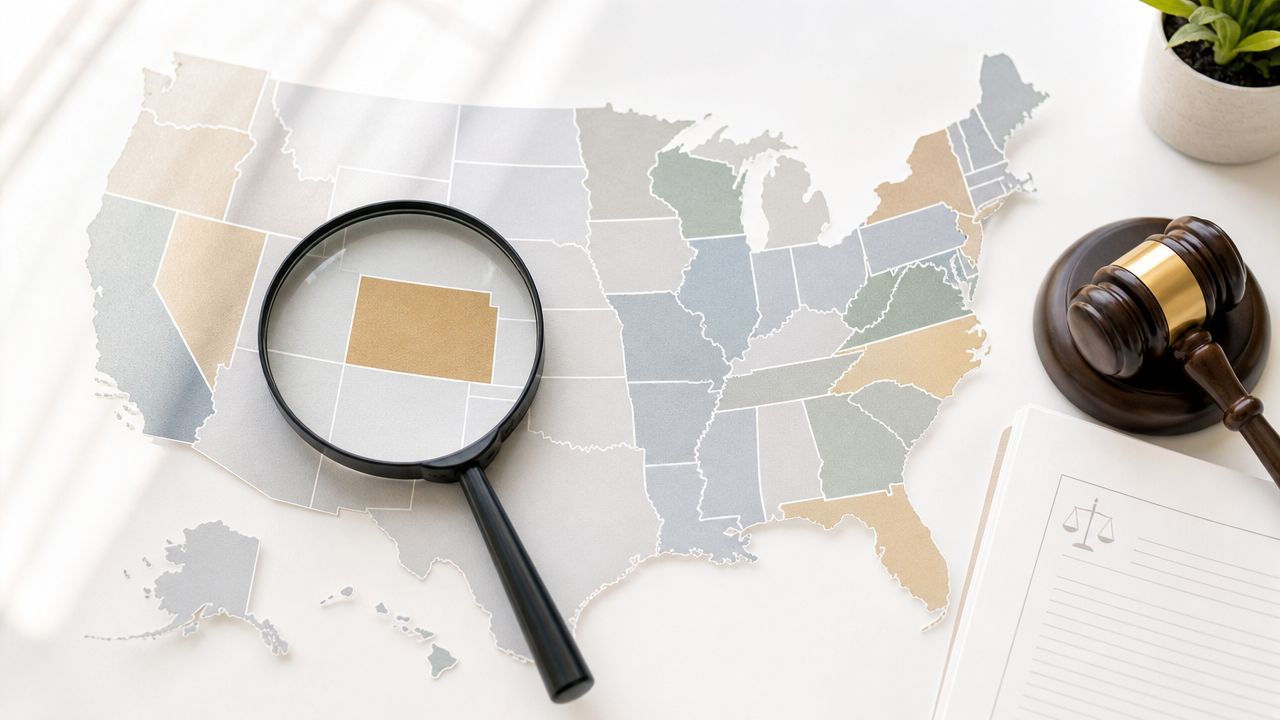
While the 2018 Farm Bill appeared to create a national market for hemp-derived cannabinoids, it included a significant provision. The bill did not establish a single, unified regulatory framework; instead, it delegated regulatory authority to individual states. This gave each state the power to create its own rules, which are often more restrictive than federal guidelines.
The result is a complex legal environment. A THCV product that is legal under federal law may be prohibited in an adjacent state. Therefore, when asking, "Is THCV legal?" the answer is almost always, "It depends on your location."
The Different Approaches States Take
This state-level authority is the source of the confusion. Some states have aligned their laws with the Farm Bill, permitting any hemp product that adheres to the 0.3% Delta-9 THC limit. However, many others have adopted a more restrictive approach.
State regulations on cannabinoids like THCV typically fall into several categories:
- Full Alignment: These states follow federal guidelines, creating a permissive market.
- Total THC Limits: Some states regulate "total THC," which includes not only Delta-9 THC but also THCA (a non-psychoactive precursor that converts to THC with heat). This can render many federally compliant products illegal within those states.
- Specific Cannabinoid Bans: An increasing number of states are specifically outlawing intoxicating or synthetically-derived cannabinoids. THCV is sometimes included in these bans, even when derived from legal hemp.
- Legal Gray Areas: In many jurisdictions, the laws are unclear. They have not been updated to address minor cannabinoids, leaving the status of compounds like THCV in legal limbo pending new legislation or court rulings.
The legal status of different product types can be equally complex. This constant state of flux underscores the importance of researching local regulations.
The Impact on Consumers
For the average individual, this regulatory landscape creates significant uncertainty. One cannot assume a product is legal simply because it is available for purchase online. For instance, while some reports indicate that THCV is available in a majority of states, the list of accessible states changes frequently, rendering such information quickly outdated. Furthermore, certain jurisdictions, like Idaho, have exceptionally strict rules that make legal possession of THCV nearly impossible, regardless of its origin.
This patchwork of laws places the responsibility squarely on the consumer. Before purchasing any THCV product, it is critical to research the specific laws in your state and municipality. Local statutes are the final authority, and a federally legal product can still lead to legal issues if it violates a local ordinance.
Understanding Hemp-Derived vs. Marijuana-Derived THCV
Regarding the legality of THCV, the source of the cannabinoid is the most critical factor. Although the THCV molecule is chemically identical regardless of its origin, the law creates a sharp distinction based on the plant from which it was extracted. This distinction determines whether a THCV product is a federally controlled substance or a widely available hemp derivative.
This all traces back to the plant's legal classification as either "hemp" or "marijuana," a line drawn by the 2018 Farm Bill.
Marijuana-Derived THCV
If THCV is extracted from a cannabis plant containing more than 0.3% Delta-9 THC by dry weight, it is considered "marijuana-derived." This form of THCV is subject to federal prohibition and is treated as a controlled substance.
Consequently, this type of THCV can only be legally purchased or possessed through state-licensed medical or recreational cannabis programs. These products are not sold online or in general retail stores; they are restricted to regulated dispensaries in states with legal cannabis markets.
Hemp-Derived THCV
Conversely, THCV sourced from a cannabis plant with less than 0.3% Delta-9 THC is classified as "hemp-derived." The 2018 Farm Bill legalized hemp and its derivatives, creating a legal pathway for hemp-derived cannabinoids like THCV to be sold across the country.
This legal nuance is why the vast majority of THCV products available for purchase are explicitly marketed as “hemp-derived.” The source is not merely a detail—it is the entire basis for the product's federal legal standing.
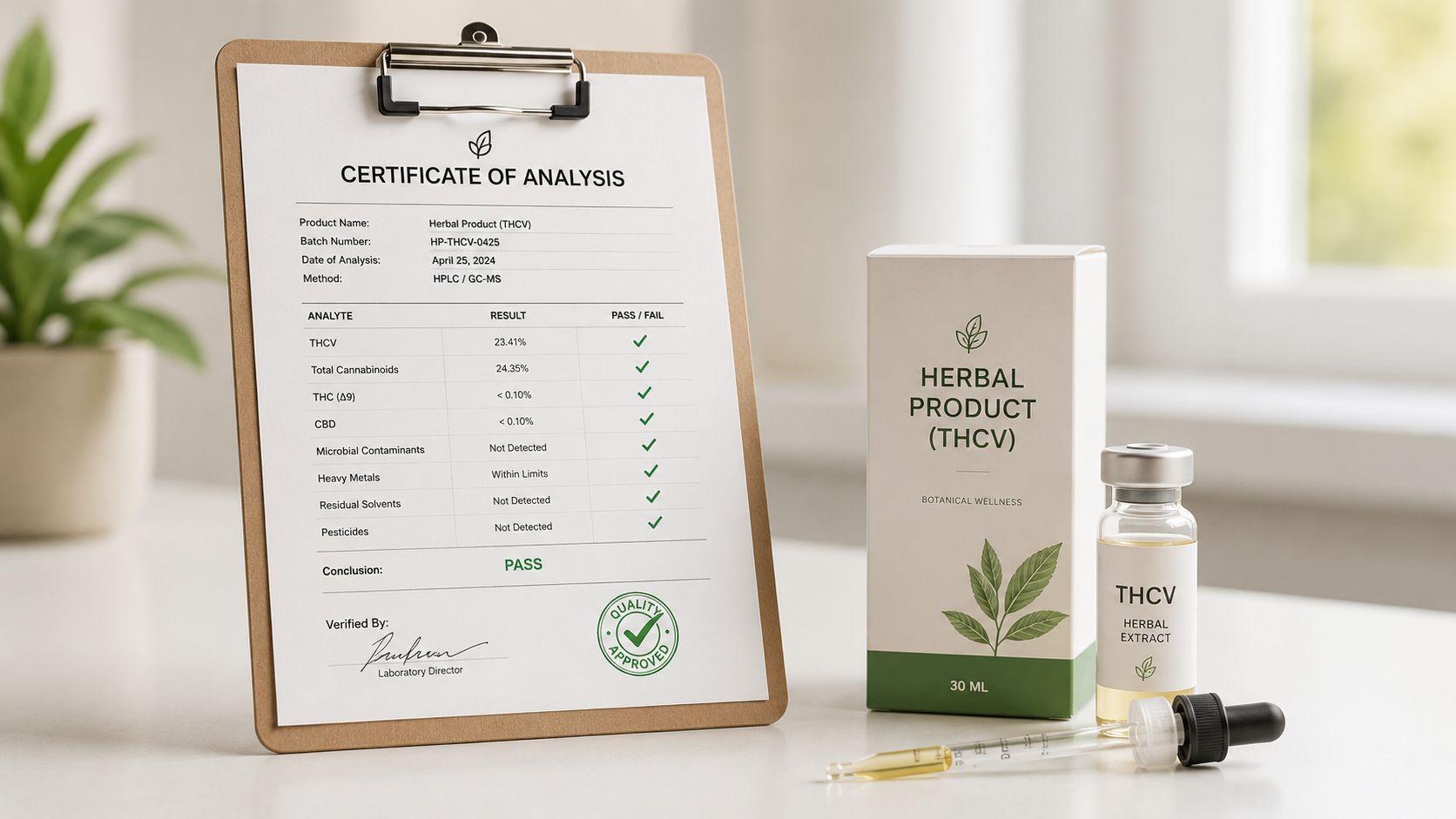
This is also why reviewing a product's Certificate of Analysis (COA) is essential. The lab report provides third-party verification that the product complies with the legal 0.3% Delta-9 THC limit, making it a vital step for ensuring legal safety.
Ultimately, while the THCV molecule itself is neutral, its legal status is defined entirely by its botanical origin. For consumers, the path to legally and safely acquiring THCV products begins and ends with confirming they are derived from compliant hemp.
How to Vet THCV Products for Safety and Compliance
In a loosely regulated market, the responsibility for verifying a THCV product's safety and legality falls to the consumer. It is a necessary aspect of the current landscape. One cannot simply rely on a product's label. Due diligence is essential to ensure that what you purchase is both safe and compliant with the law.
The most powerful tool for this verification is the Certificate of Analysis (COA). This is a detailed report from an independent, third-party laboratory that outlines a product’s exact chemical composition. Reputable brands make their COAs readily accessible, often via a QR code on the packaging or through their website.
Decoding the Certificate of Analysis
When reviewing a COA, a consumer does not need an advanced chemistry background to understand the critical information. The primary goal is to verify a few key data points to confirm the product's safety and legal status.
Key information to focus on includes:
-
Delta-9 THC Concentration: This is the most important factor for legal compliance. The report must show that the Delta-9 THC level is at or below the federal limit of 0.3% on a dry weight basis. If this value is exceeded, the product is federally illegal.
-
Cannabinoid Potency: The COA verifies whether the product contains the amount of THCV advertised on the label, ensuring accuracy and potency.
-
Contaminant Analysis: A comprehensive COA also screens for harmful substances. The product should pass tests for:
- Pesticides: Residual chemicals from the cultivation process.
- Heavy Metals: Contaminants such as lead, mercury, and arsenic.
- Residual Solvents: Chemicals potentially left over from the extraction process.
- Microbials: Contaminants like mold, mildew, and bacteria.
Beyond the COA: Signs of a Trustworthy Brand
While the COA is a non-negotiable starting point, other factors can indicate a trustworthy brand. Because many THCV products operate in a legal gray area, a company's transparency is a strong indicator of its credibility. If a product's documentation does not clearly demonstrate compliance with the 0.3% Delta-9 THC rule, its legality is questionable.
Look for brands that operate with transparency. They should be forthcoming about their hemp sourcing, extraction methods, and overall manufacturing standards. A strong reputation supported by positive customer reviews is another sign of a reliable company.
By learning to interpret a COA and identify the characteristics of a transparent brand, you can make informed decisions that prioritize safety.
FAQ: Common Questions About THCV Legality
This section addresses some of the most frequently asked questions regarding the legal status of THCV. Understanding these details is crucial for complying with the law.
Can I Travel With THCV Products?
Traveling with THCV, whether by air or across state lines, is not advisable due to the risk involved. Even if a product is federally compliant, state laws vary significantly. You could cross from a state where the product is legal into one where it is considered a controlled substance. Airport security personnel are unlikely to differentiate between federally legal hemp and illegal cannabis. To avoid potential legal complications, it is safest to leave cannabinoid products at home.
Will THCV Show Up on a Drug Test?
Yes, there is a strong possibility that it will. Most standard drug tests are not designed to differentiate between various THC isomers. They screen for THC metabolites, and because THCV is structurally similar to Delta-9 THC, it can trigger a positive result. If you are subject to drug testing for employment or any other reason, you should avoid THCV products.
Is It Legal to Buy THCV Online?
Purchasing THCV online is generally permissible at the federal level, provided the product is derived from hemp and contains less than 0.3% Delta-9 THC. However, the ultimate legality depends on your location. State and local laws are the final authority. Most responsible online retailers will block shipments to states where they know THCV is restricted. Nonetheless, the responsibility rests with the consumer to be aware of and adhere to local regulations before making a purchase.
The world of cannabinoids can be complex. For individuals seeking responsible, structured guidance on RSO and related topics, RSOhelp.com offers educational resources and consultations to support informed decision-making. Further information is available at https://rsohelp.com.