The whole FSO vs RSO conversation really boils down to two things: intent and refinement. Think of it this way: RSO is a very specific, potent, unrefined oil built for intensive therapeutic use, while FSO is a much broader category of refined, whole-plant extracts designed for general wellness with a wider variety of cannabinoid profiles. Which one is right for you depends entirely on your health goals and how you handle strong psychoactive effects.
Defining the Core Differences
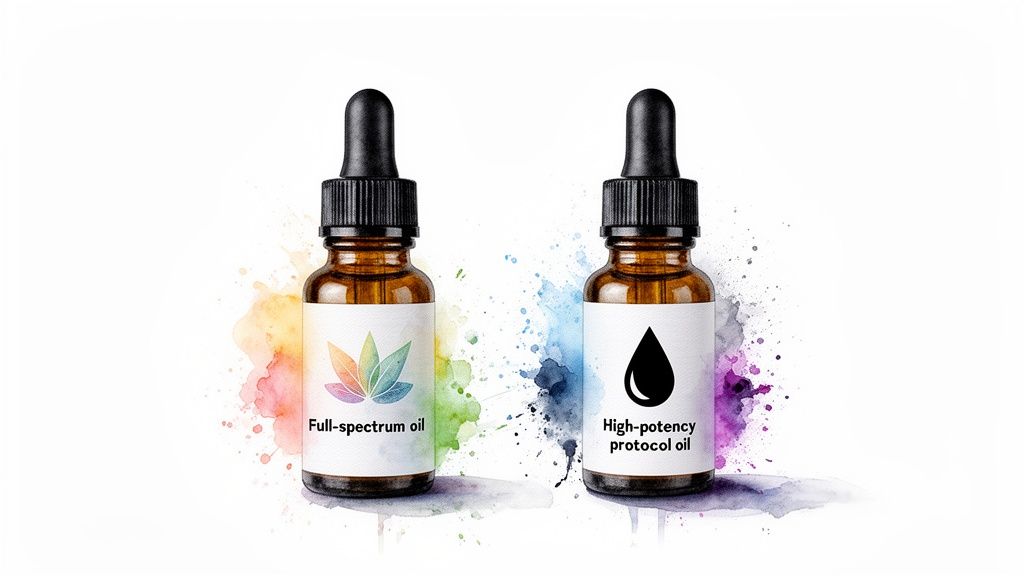
When you're exploring cannabis extracts, it’s easy to get lost in the terminology. But getting a handle on the difference between Full Spectrum Oil (FSO) and Rick Simpson Oil (RSO) is the first critical step for anyone serious about achieving a specific health outcome. While they are both technically full-spectrum extracts—meaning they contain a wide range of compounds from the plant—they are definitely not the same thing.
The real split comes from their production philosophy and what you're left with in the final product. RSO follows a very particular method, made famous by Rick Simpson himself, with one goal in mind: creating an incredibly potent, high-THC crude oil for health purposes. The process intentionally leaves in things like chlorophyll and plant waxes, which gives RSO its signature dark color and tar-like consistency.
FSO, on the other hand, is the result of a more modern and flexible take on whole-plant extraction. Producers today often use sophisticated methods like CO2 extraction to make a much cleaner, more refined oil. This preserves the valuable cannabinoids and terpenes without all the heavy plant matter, creating a product that can be tailored for a huge range of potencies and uses. If you want to dig deeper into this category, this guide on full extract cannabis oil does a great job of breaking down the finer points.
To give you a clear snapshot right from the start, this table lays out the main distinctions.
Quick Comparison FSO vs RSO at a Glance
This table provides a high-level summary of the fundamental differences between Full Spectrum Oil (FSO) and Rick Simpson Oil (RSO) to help you quickly understand their defining characteristics.
| Attribute | Rick Simpson Oil (RSO) | Full Spectrum Oil (FSO) |
|---|---|---|
| Primary Intent | High-potency therapeutic protocols for serious health concerns. | General wellness, daily support, and moderate symptom management. |
| THC Potency | Very High (typically 50-90% THC). | Varies widely (low, moderate, or high THC options available). |
| Extraction Method | Traditionally uses solvents like ethanol or isopropyl alcohol. | Often uses cleaner methods like supercritical CO2 or cold ethanol. |
| Final Appearance | Dark, thick, and tar-like due to retained chlorophyll and waxes. | Typically lighter amber or golden color and more fluid. |
| Refinement Level | Unrefined and crude to capture all possible plant compounds. | Refined to remove waxes and chlorophyll for a cleaner product. |
| Common Use Case | Targeted, high-dose regimens under careful guidance. | Flexible daily use for stress, sleep support, and general balance. |
As you can see, RSO is more of a specialized tool for specific situations, whereas FSO is a far more versatile option for a broader audience. Having these core differences in mind is key as we move on to explore how they're made, what's inside them, and the best ways to use each one.
Where Did These Oils Come From? A Tale of Two Philosophies
To really get to the heart of the FSO vs. RSO debate, you have to look at their backstories. They come from completely different places and were created for very different reasons. One was born out of a single person's desperate health journey, while the other grew from the collective knowledge of the wider cannabis community. These origins explain everything about how they're made and used today.
RSO is tied to one man: Rick Simpson. His story isn't one of lab coats and scientific grants; it's a tale of personal need and grassroots activism. Faced with a serious health situation, he created a potent, unrefined, high-THC oil for himself. That singular, urgent mission is what defines RSO.
His process was simple and meant to be copied, which is how his protocol spread like wildfire through word-of-mouth. This history solidified RSO's reputation as a heavy-hitter for people seeking maximum therapeutic intensity, often when other options haven't worked.
The Personal Crusade Behind RSO
Rick Simpson Oil was created as a direct answer to a personal health crisis. Back in 2003, Canadian activist Rick Simpson developed a homemade cannabis concentrate to support his own health journey. This single event kicked off a global movement championing high-THC extracts, even without the support of major clinical trials. You can find more insights about the history of FSO versus RSO and their differing potencies online.
This backstory is crucial because it tells you the one and only goal of RSO: create the absolute strongest concentration of cannabis compounds, especially THC, for a very specific therapeutic purpose. The focus was never on flavor, appearance, or refinement—it was all about raw potency and effect.
RSO is fundamentally about a high-dose protocol born from one individual's specific need. That's why it's more of a specialized tool than a general wellness supplement.
FSO: A Belief in Whole-Plant Harmony
Full Spectrum Oil (FSO), on the other hand, doesn’t have a single inventor or a dramatic origin story. It represents the natural evolution of whole-plant medicine as extraction science got more sophisticated. Think of FSO less as a rigid recipe and more as a philosophy.
The main idea behind FSO is to capture the complete, natural fingerprint of the cannabis plant—all the cannabinoids, terpenes, and flavonoids—while gently removing the less desirable stuff like chlorophyll and waxes. This makes FSO a much more versatile and approachable category of oil.
This versatility is exactly where FSO shines. Producers can select different strains and use various extraction techniques to craft oils with unique cannabinoid ratios. You might find FSOs with balanced THC:CBD profiles or those with lower, more manageable THC levels perfect for daytime use. This adaptability makes FSO a fit for a huge range of needs, from daily wellness support to managing moderate symptoms without the overwhelming psychoactivity of RSO.
Ultimately, the intent behind each oil is what guides its use. RSO is the result of a focused, high-stakes mission, delivering a powerful, specialized concentrate. FSO comes from a community-wide effort to bottle the entire plant in a more refined and flexible form, creating a versatile tool for ongoing health.
Production Methods and Final Product Quality: What's Inside the Syringe?
The vast differences you see, feel, and experience with FSO and RSO trace right back to how they're made. One method is a raw, grassroots technique designed to capture absolutely everything from the plant, while the other employs modern science for a more polished and versatile product. Grasping this core distinction is the first step in deciding which oil is right for you.
RSO: The Traditional, Unfiltered Approach
RSO is defined by its classic, full-immersion solvent extraction. The philosophy is straightforward: pull every last compound from the plant material, leaving nothing behind. This unfiltered process is precisely why RSO contains components like plant waxes and a heavy dose of chlorophyll, which you won't find in FSO.
This is what gives authentic RSO its signature look and feel—a dark, almost black color with a thick, tar-like consistency. While this unrefined nature is central to the RSO philosophy, it also means the quality of the starting cannabis and the maker's skill are absolutely critical. For those interested in the process, information about traditional methods is widely available.
The numbers tell a story, too. The classic RSO ethanol soak—using 1kg of flower—typically yields 60-100g of oil, operating at about 70% efficiency. This method intentionally retains the chlorophyll and other raw plant materials.
FSO: A Modern, More Refined Process
Full-Spectrum Oil, by contrast, is usually made with more advanced extraction technology. Methods like supercritical CO2 or chilled ethanol extraction are far more selective, allowing technicians to precisely target and pull out the desirable cannabinoids and terpenes while leaving heavier, unwanted plant matter behind.
This refinement leads to a fundamentally different product:
- Purity: FSO is a much "cleaner" oil, free from the chlorophyll and waxes that characterize RSO.
- Appearance: It's typically a much lighter golden or amber color and has a more fluid, manageable consistency.
- Taste: The flavor is often smoother and less bitter than the intense, earthy punch of RSO.
This cleaner profile makes FSO more palatable for daily use and more versatile for different ways of taking it.
In comparison, FSO's common supercritical CO2 method can achieve 80-90% efficiency, yielding a cleaner, golden-hued oil. While Rick Simpson's low-tech method (developed back in 2003) empowered individuals to make their own wellness products, commercial FSO production has scaled up in professional labs. This controlled environment also reduces residual solvent traces to under 10ppm, a significant drop from the 50ppm maximum often seen in RSO.
The core difference really comes down to philosophy. RSO is designed to capture everything—including the raw plant matter—for maximum unrefined potency. FSO aims to capture the essential chemical profile in a cleaner, more purified form.
Why Lab Testing is Non-Negotiable
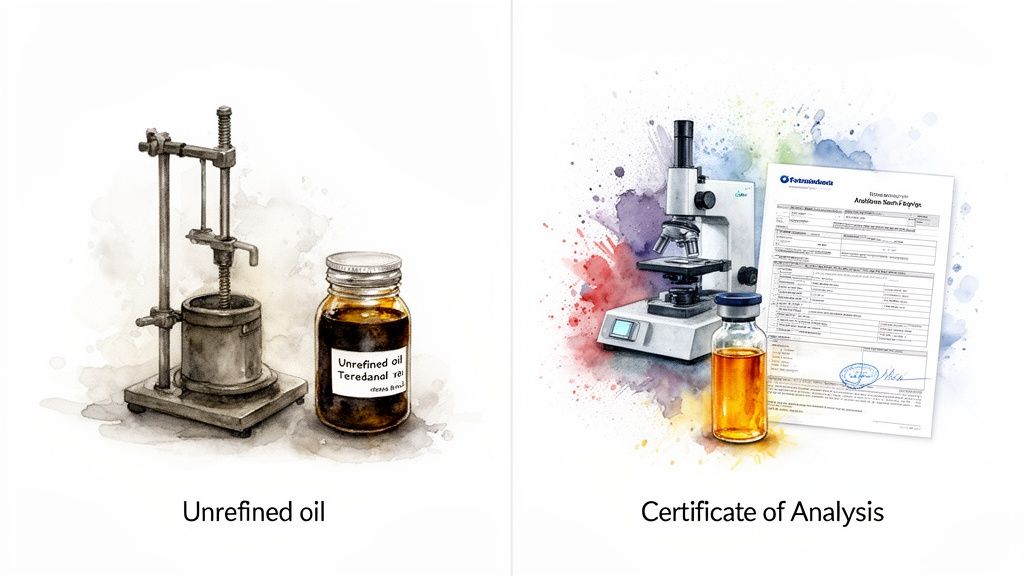
No matter which oil you choose, the single most important factor for your safety and success is third-party lab testing. A Certificate of Analysis (COA) is the only real proof you have that the oil is both potent and pure. It's crucial not to take a company's word for it.
A comprehensive COA will verify several critical pieces of information:
- Cannabinoid Profile: It confirms the exact potency of THC, CBD, and other minor but important cannabinoids.
- Terpene Profile: This shows the spectrum of aromatic compounds that influence the oil's effects and therapeutic potential.
- Purity Analysis: Most importantly, it screens for harmful contaminants like residual solvents, pesticides, heavy metals, and microbes.
For any person focused on health, demanding a recent and complete COA isn't just a good idea—it's essential. It moves the FSO vs. RSO debate from theory to a practical decision based on verified quality, ensuring the product you use is both safe and effective for your specific needs.
Analyzing Potency and Cannabinoid Profiles
When we get down to the chemical makeup of these oils, the FSO vs. RSO debate gets very real for anyone with a specific health goal in mind. This isn't just about how "strong" an oil is; it's about the unique symphony of compounds working together in every single drop. Learning to read this music is the key to matching the right oil to your personal needs.
RSO is built for one thing and one thing only: maximum potency. Its profile is intentionally loaded with incredibly high concentrations of THC, typically falling somewhere between 50% and 90%. This makes it an intensely psychoactive and formidable option, best suited for serious therapeutic protocols where a high dose is the entire point.
The crude, unrefined extraction method used for RSO also pulls in a very particular set of compounds beyond just THC. You’re getting other cannabinoids, of course, but also things like plant waxes and chlorophyll, which all contribute to its signature dark, thick consistency and distinct effects.
The High THC Concentration of RSO
The chemical signature of RSO is its overwhelming THC content. This isn't a bug; it's a feature. The entire philosophy behind its creation is to concentrate this one cannabinoid to the highest level possible. It’s why RSO has become the go-to for individuals pursuing aggressive wellness strategies.
That said, this extreme THC level demands respect and careful management. It's absolutely not for beginners or anyone with a low tolerance for psychoactive effects. The experience can be completely overwhelming if not dosed correctly, which underscores the importance of the "start low and go slow" mantra.
RSO’s core principle is unapologetic potency. It trades refinement and flavor for the singular goal of delivering a massive dose of THC and other raw plant compounds, making it a highly specialized tool.
In stark contrast, Full Spectrum Oil presents a much more diverse and flexible chemical landscape. It isn’t defined by a single cannabinoid but by the balance and synergy of the entire plant profile.
The Balanced and Versatile Profile of FSO
Unlike RSO, FSO comes in a massive array of potencies and cannabinoid ratios. This is its greatest strength, offering the adaptability needed for a much broader range of wellness goals. You can easily find FSO products with moderate THC, balanced THC:CBD ratios, or even formulas that are heavily CBD-dominant.
This versatility makes FSO a much better fit for several scenarios:
- Daily Wellness: Perfect for those seeking general balance and support without the intense psychoactivity.
- Beginners: Anyone new to cannabis can start with a low-THC FSO to gently gauge their tolerance.
- Sensitivity to THC: People who are sensitive to THC's effects can still find gentle yet effective support with a well-formulated FSO.
The potency gap is a defining factor in this discussion. RSO often packs a punch with an ultra-high THC content of 50-90% total cannabinoids, and some batches made from potent strains can hit 70% THC on its own. Its crude ethanol extraction pulls over 90% of the plant’s compounds, including minor cannabinoids like CBN. FSO, on the other hand, offers a more balanced profile of 20-60% cannabinoids and typically has a richer terpene profile thanks to cleaner CO2 extraction methods. Looking at lab data across countless samples, RSO averages around 65% THC, whereas FSO lands at a more moderate 35% THC, making it far more suitable for daily use.
How to Read a Lab Report
The best way to empower yourself is to learn how to read a Certificate of Analysis (COA), or lab report. Think of this document as a transparent window into the exact chemical makeup of your oil—it removes all the guesswork. Whether you land on RSO or FSO, never use a product without a recent, comprehensive COA from a third-party lab. For those curious, we have a great resource that gets into the nitty-gritty of what full spectrum THC truly means.
When you pull up a lab report, here's what to look for:
- Cannabinoid Potency: This section lists the percentage of THC, CBD, CBG, CBN, and other cannabinoids. For RSO, you’ll expect to see a sky-high THC number. For FSO, you’re more likely to see a balanced distribution.
- Terpene Profile: Terpenes are the aromatic compounds that heavily influence the oil's effects and therapeutic benefits (the "entourage effect"). A rich, diverse terpene profile is a hallmark of a high-quality, full-spectrum product.
- Purity Testing: This is your safety check. It confirms the oil is clean and free from harmful contaminants like pesticides, heavy metals, or residual solvents left over from extraction.
By getting comfortable with these profiles, you can move beyond simple product labels and make a truly informed choice based on hard data that aligns perfectly with your health goals.
Matching the Right Oil to Your Health Goals
Deciding between FSO and RSO isn’t about which oil is “better”—it’s about which one is better for you. This choice hinges entirely on your personal health goals, your history with cannabis, and the level of support you really need. By looking at a few practical, real-world scenarios, it becomes much clearer where each oil shines and how to pick the right tool for your journey.
The heart of the fso vs rso decision really boils down to two things: potency and intent. Are you looking for an aggressive, high-dose therapy for a serious health concern? Or do you need a more flexible, daily supplement to maintain balance and manage milder issues? Answering that one question will almost always point you in the right direction.
This simple decision tree gets right to the point, guiding you based on your primary wellness goal.
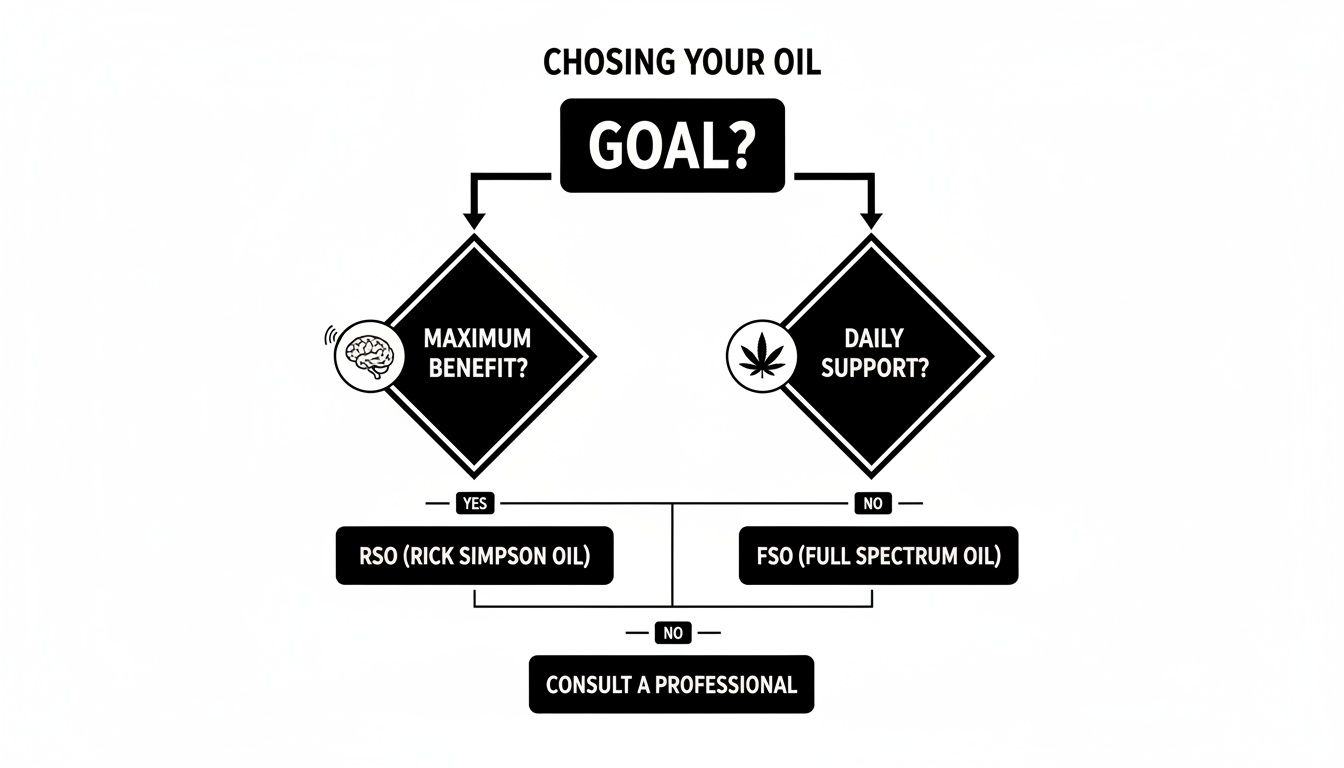
As you can see, your intended outcome—whether it's an intensive intervention or general wellness—is the most important factor here.
When to Choose RSO High-Potency Scenarios
RSO was created with one thing in mind: maximum strength. It’s designed for people who need a powerful, high-THC oil to tackle significant health challenges. Its entire reputation is built on that uncompromising potency, making it the go-to for targeted, intensive protocols.
Here are a few situations where RSO is often the more appropriate choice:
- Serious Health Conditions: When facing a major health battle, many turn to RSO for its maximum-strength properties. The objective is to flood the body’s systems with a highly concentrated dose of cannabinoids.
- Managing Severe Symptoms: For those dealing with intense, persistent discomfort or other severe symptoms that just haven't responded to milder options, RSO's high THC content can offer a completely different level of support.
- Following a Specific Protocol: If you’re committed to following a specific high-potency protocol, you need an oil that meets its specifications. In that case, authentic RSO is the only thing that fits the bill.
Expert Takeaway: Choose RSO for targeted, high-dose protocols where you need maximum strength. Its potency is its greatest asset when confronting serious health issues, but it absolutely demands respect and a slow, methodical approach to dosing.
Because of its intensity, RSO is almost never the right choice for casual use or for anyone brand new to cannabis. Its powerful psychoactive effects can be overwhelming without a slow, careful titration schedule. For personalized guidance and access to verified, lab-tested oils, the team at RSOhelp.com offers free consultations to help you navigate the process safely.
When to Choose FSO Flexible Wellness and Milder Needs
FSO offers a much more versatile and approachable path for a broader range of people. Its key advantage is its sheer flexibility. FSO can be formulated with all sorts of cannabinoid profiles, letting you find a product that perfectly matches your tolerance and wellness goals without the heavy psychoactivity of RSO.
FSO is the ideal choice in these common scenarios:
- Daily Wellness and Balance: If you're looking to support overall health, manage everyday stress, or get better sleep, a balanced FSO provides all the benefits of the entourage effect in a manageable daily dose.
- Beginners and THC-Sensitive Individuals: Just starting out with cannabis oil or know you're sensitive to THC? FSO is the logical starting point. You can begin with a low-THC formula and gently find the dose that works for you.
- Managing Moderate Symptoms: FSO is incredibly effective for addressing moderate discomfort, inflammation, and other common ailments. It provides meaningful support without knocking you out or disrupting your daily routine.
Expert Takeaway: Choose FSO for flexible, daily wellness and lower-potency needs. It allows you to tap into the power of the whole plant in a controlled, adaptable way that fits seamlessly into your life.
Ultimately, the best oil is simply the one that aligns with your specific situation. Think of RSO as a specialized, powerful tool for serious applications, while FSO is a versatile ally for long-term, daily wellness.
Making the Right Choice for Your Health
So, how do you choose between FSO and RSO? The truth is, there's no single "best" answer. The right oil is the one that fits your specific health goals, your body, and your life. It's a deeply personal decision, and the goal here is to help you make it with confidence.
To get there, we need to cut through the noise and ask a few pointed questions. Take a moment to think through these—your honest answers will point you in the right direction.
A Quick Checklist to Guide Your Decision
Before you go any further, consider these key factors. They’ll help you figure out where to start.
- What am I trying to achieve? Are you looking for intensive support for a serious health condition, or is your goal more about finding daily balance and managing less severe symptoms?
- How do I handle THC? If you're experienced with cannabis and comfortable with strong psychoactive effects, your options are different than if you're new to this and need to begin with a gentle, non-intoxicating dose.
- How does this fit into my daily life? Do you need to be sharp and functional during the day? Or is your plan built around evening use where a powerful, sedative effect is acceptable or even welcome?
Thinking through these practical points makes the choice much clearer.
The best wellness plan isn't just about the oil you choose. It's about the entire approach—the product, the protocol, and the professional guidance you have along the way.
Finding Quality Oil and Expert Guidance
Choosing the right oil is step one. Step two is just as important: finding a high-quality, lab-tested product and getting the right support to use it effectively. Navigating the world of cannabis concentrates on your own can be overwhelming, and having a reliable resource makes all the difference for both your safety and your results.
This is where a knowledgeable guide is indispensable. For anyone who needs personalized support and wants to connect with verified sources for authentic, lab-tested RSO, a resource like RSOhelp.com is invaluable. They focus on patient education and health, meaning you’re not just buying something—you’re getting a partner for your wellness journey. They can help you decipher lab reports, map out a dosing plan, and understand what to expect.
Ultimately, choosing the right partner is just as critical as choosing the right oil.
Frequently Asked Questions About FSO and RSO
When you're exploring the differences between these potent cannabis oils, a few key questions always seem to pop up. Let's tackle some of the most common ones to help you understand the nuances in the FSO vs RSO debate.
Can I Use FSO and RSO Interchangeably?
The short answer is no. Think of them as two different tools for different jobs. RSO is specifically known for its extremely high THC concentration, which is the cornerstone of its intended use in intensive therapeutic regimens. Swapping in a standard FSO just won't deliver the potency needed to get similar results.
On the flip side, substituting potent RSO for a milder FSO could lead to an uncomfortably strong psychoactive experience. This is often overkill for someone simply looking for general wellness support. Your choice should always come down to your specific health goals and your personal tolerance for THC.
Is One Oil Inherently Safer Than the Other?
The safety of either FSO or RSO hinges on one thing: production quality. A professionally made, lab-tested RSO from a reputable source is perfectly safe when used as directed. The main "safety" concern with RSO is simply managing its high potency, which is done through very careful, slow, and gradual dosing.
An FSO might seem "safer" due to its lower THC levels, but any cannabis oil can be dangerous if it's contaminated. The only way to be sure about what you're getting is to insist on seeing a full Certificate of Analysis (COA) for any product. This is your proof of purity and potency.
The biggest safety risk isn't the oil's cannabinoid profile—it's the source. Always, always prioritize products that come with transparent, third-party lab testing to ensure they are free from residual solvents, pesticides, or other contaminants.
Which Oil Is Better for Topical Application?
Both oils are excellent for topical use, but they shine in slightly different situations. RSO is unrefined, meaning it still contains plant waxes and chlorophyll. Many people believe these extra compounds boost its effectiveness for targeted skin concerns, which is exactly how Rick Simpson originally used it.
FSO is also a great topical. Because it's more refined, it's often preferred for applying over larger areas of skin, especially since the dark color of RSO can stain clothing and skin. The best choice really depends on what you're trying to address.
Why Does RSO Have a Darker Color and Thicker Texture?
That distinct, tar-like appearance is a direct byproduct of how RSO is traditionally made. Using a solvent like ethanol strips nearly everything from the plant, including chlorophyll (which gives it that dark green-to-black hue) and plant waxes (which create the thick, sticky texture).
FSO, on the other hand, is often produced with more modern methods like CO2 extraction. These techniques can be calibrated to leave heavier compounds like chlorophyll and waxes behind, resulting in the cleaner, lighter, and more liquid oil you might be more familiar with.
For personalized guidance on your wellness journey and to connect with verified sources for authentic, lab-tested RSO, RSOhelp.com is an invaluable resource. Explore your options with confidence at https://ricksimpsonoil.info.