

Constipation seems simple on the surface. You're not moving your bowels normally, so the obvious question is whether cannabis can “get things moving.” But when people ask does weed help constipation, they're usually running into a messy reality. Some users say it helps them feel more comfortable. Others feel more backed up after using it.
Both experiences can be real.
Cannabis doesn't act like a standard laxative. It interacts with the endocannabinoid system, a signaling network involved in pain, inflammation, appetite, and gut movement. That means the answer depends on what cannabinoid is involved, how much is used, how it's taken, and what kind of constipation a person has. THC, CBD, oral extracts such as RSO or FECO, inhaled cannabis, and suppositories can affect the body differently.
That's why a simple yes or no usually misleads people. A person may feel less cramping yet still have slower bowel transit. Another person may notice a subjective improvement that comes from less discomfort, not more frequent bowel movements. Safety matters here, especially for people already dealing with slow motility, medication-related constipation, cancer care, or other digestive conditions.
This article is for educational purposes only. Individual results may vary. Further research is needed. Consult a licensed medical professional.
Introduction Understanding the Cannabis and Constipation Puzzle
People often expect one clean answer: weed either helps constipation or it doesn't. In practice, the relationship is bidirectional. Cannabis may ease some symptoms around constipation for certain people, while making gut motility worse for others.
That confusion starts with how people define “help.” Some mean less abdominal pain. Some mean less straining. Others mean more frequent stools. Those are not the same outcome. A product that reduces cramping may feel helpful even if it doesn't improve stool passage.
Another source of confusion is that cannabis is not one substance. THC and CBD don't behave identically. Full-spectrum extracts such as RSO contain multiple cannabinoids and plant compounds, while isolates are narrower. Route matters too. An oral oil moves through the digestive system and liver before its effects are fully expressed. A suppository interacts with the body through a different pathway and may shift the experience.
Key point: When readers ask whether weed helps constipation, the better question is which cannabinoid, which dose, and which route.
There's also a difference between symptom relief and bowel function. If a person feels calmer, sleeps better, or experiences less pelvic tension, they may report that cannabis “helped,” even if stool frequency didn't change much. From a clinical perspective, that distinction matters.
The Endocannabinoid System and Gut Motility
The digestive tract has its own signaling networks that constantly regulate movement, secretion, and sensation. One of those systems is the endocannabinoid system, often shortened to ECS. You can think of it as a set of biological controls that helps the body keep balance.

Where cannabinoids act in the gut
Cannabinoids interact with receptors, including CB1 and CB2 receptors. These receptors are present in the gastrointestinal tract as well as elsewhere in the body. In plain language, they help influence how strongly intestinal muscles contract, how nerves signal discomfort, and how inflammatory responses are modulated.
One of the main practical issues in constipation is motility, meaning how efficiently the intestines move material forward. Healthy motility requires coordinated muscle contraction. If that process slows down too much, stool can sit in the colon longer, lose water, and become harder to pass.
For readers who want a related overview of this question from another angle, this guide on whether smoking weed can make you constipated explores the issue in a practical format.
Why gut movement can change
The gut relies heavily on nerve signals, including signals involving acetylcholine, to trigger smooth muscle contraction. When cannabinoid activity alters those signals, motility can change. That doesn't automatically mean improvement. It means the pace of gut movement may shift.
A simple way to picture it is this:
| Gut function | What it does | Why it matters in constipation |
|---|---|---|
| Nerve signaling | Coordinates intestinal activity | Too little stimulation can slow transit |
| Smooth muscle contraction | Pushes stool through the bowel | Weak or slowed contractions can worsen backup |
| Sensory signaling | Affects pain, cramping, urgency | Lower discomfort may feel better without fixing motility |
The same product can change how the gut feels and how the gut moves. Those are related, but they aren't identical.
Why this matters before choosing a product
Many individuals become confused. They assume a calming effect on the abdomen means a motility benefit. Sometimes it doesn't. In some people, the gut may feel quieter because cramping is reduced, while actual bowel propulsion becomes slower.
That's why cannabinoid discussions need more precision than casual online advice usually offers.
The Dual Effect How Cannabinoids Can Help or Hinder
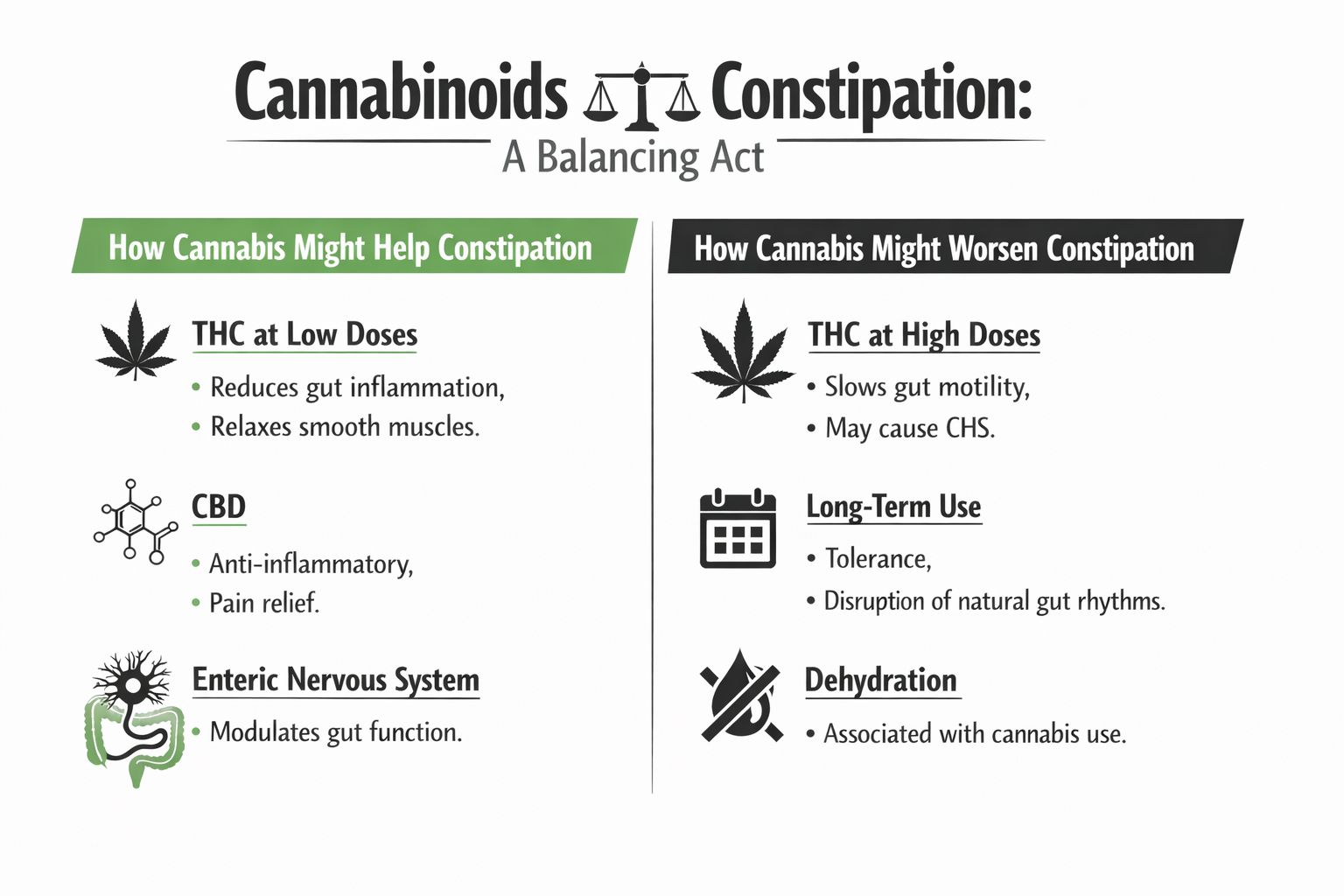
The core paradox is straightforward. Cannabinoid signaling can plausibly push in opposite directions depending on context. A review discussing gut and bladder health notes that CB1 and CB2 activity in the gut can reduce acetylcholine release and slow smooth-muscle contraction, which may impair motility and contribute to constipation in some users. The same discussion also described a mouse model of loperamide-induced constipation in which a water extract of Cannabis sativa improved motility, water-electrolyte balance, gut-barrier integrity, and inflammatory markers, but the benefit disappeared after intestinal flora depletion, suggesting a microbiome-dependent effect rather than a direct laxative action, as described in this discussion of cannabis and gut and bladder health.
When cannabis may feel helpful
A person with constipation may feel better after using cannabis for reasons that don't involve direct laxative activity. Examples include:
- Less cramping: If abdominal muscles feel less tense, the episode may seem easier to tolerate.
- Reduced discomfort: Pain perception can change, which may lower distress.
- Less symptom focus: Some people feel more relaxed and less preoccupied with pelvic or abdominal discomfort.
That distinction matters. Feeling better is meaningful, but it isn't the same as faster bowel transit.
When cannabis may work against motility
THC is often the main concern here. If a person already has slow-transit constipation, adding something that further slows intestinal contraction may be unhelpful. This is especially relevant when people use stronger products, increase dose quickly, or use cannabis heavily over time.
A practical summary looks like this:
| Scenario | Possible outcome |
|---|---|
| Lower symptom burden but no bowel movement change | The person reports relief, but constipation remains |
| Slower intestinal movement | Stool may become harder to pass |
| Different response by formulation | One product may be tolerated better than another |
Relief from discomfort can mask ongoing constipation. That's one reason cannabis shouldn't be assumed to function like a bowel regimen.
Where CBD and the microbiome fit
CBD is often discussed as a gentler cannabinoid, but the evidence for constipation itself remains limited. What's more useful is understanding that cannabis effects may involve more than just one receptor and one outcome. The microbiome finding in the animal model is important because it suggests some benefits may depend on the broader gut environment, not a simple direct stimulant effect on the bowel.
That's also why broad statements like “weed helps constipation” or “weed causes constipation” both miss the point. The relationship is conditional.
Administration Routes Oral RSO vs Suppositories
How a cannabinoid enters the body changes the experience. That matters with constipation because the digestive tract isn't just the target. With oral products, it is also part of the delivery route.
Oral RSO and first-pass metabolism
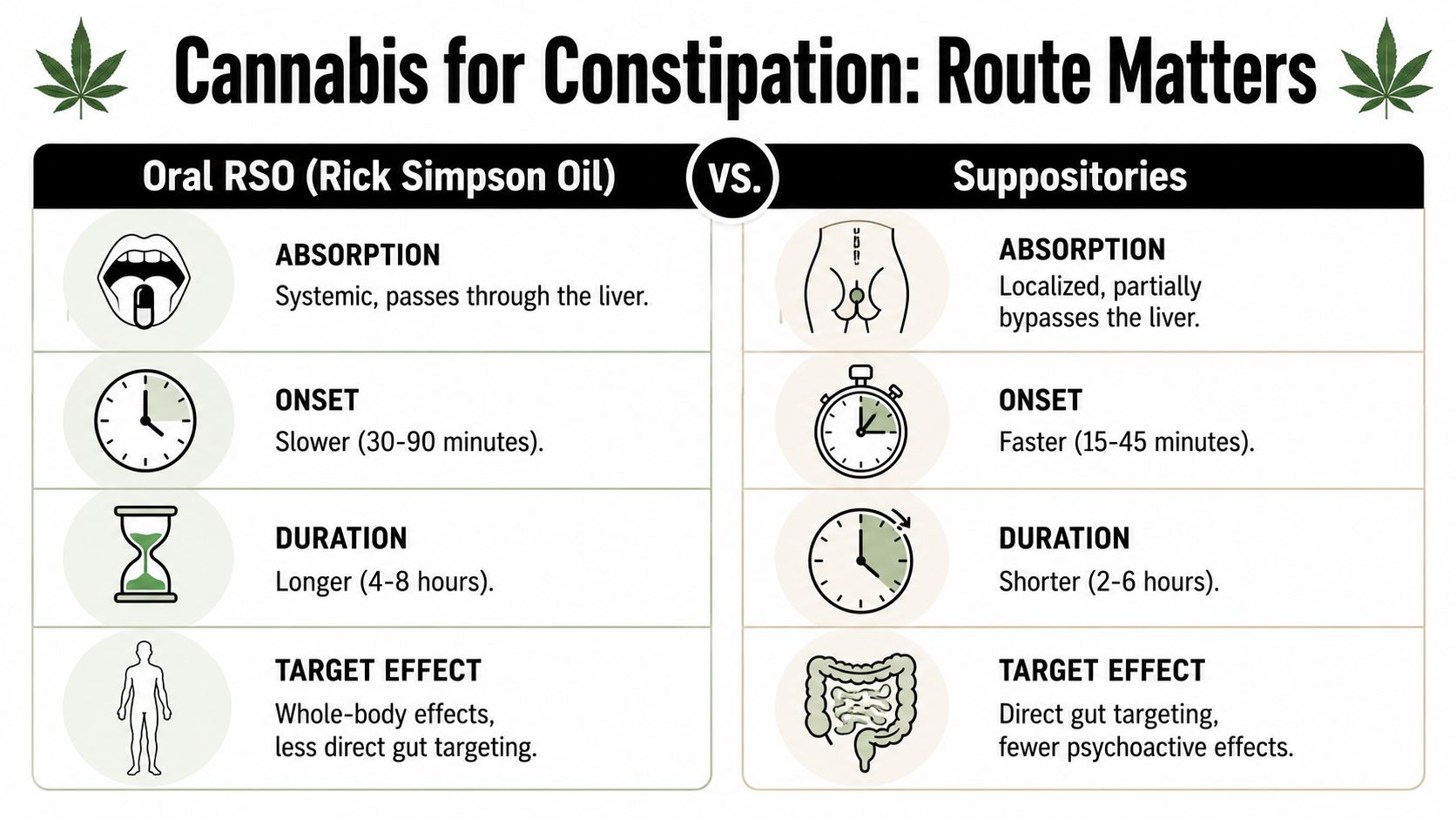
Rick Simpson Oil (RSO) and other full extract cannabis oils are usually taken orally unless formulated for another route. When swallowed, cannabinoids pass through the digestive system and then through the liver. This is called first-pass metabolism.
That liver processing can change how the product feels and how long it lasts. In practical terms, oral THC-containing extracts often feel more systemic. The effects may be broader, less localized, and sometimes harder for beginners to predict.
For readers trying to understand safe titration, this guide to RSO oil dosing is useful background.
Suppositories and local considerations
Suppositories are discussed differently because they may provide a more local pelvic and lower bowel approach and may partially bypass the liver compared with oral ingestion. That doesn't mean they're automatically better for constipation. It means the route may produce a different balance of local versus systemic effects.
People sometimes become interested in suppositories when oral THC feels too strong, too sedating, or too unpredictable. In an integrative discussion, route selection can matter as much as strain or cannabinoid profile.
Side by side comparison
| Route | Main practical feature | Clinical implication |
|---|---|---|
| Oral RSO or FECO | Passes through the GI tract and liver | Broader whole-body effects, less direct local targeting |
| Suppository | More localized lower bowel or pelvic use | May be considered when oral use is poorly tolerated |
If someone is specifically asking whether weed helps constipation, route should be part of the question. An oral extract that increases body-wide THC exposure may not behave the same way as a rectal formulation aimed at local use.
Reported Outcomes and Clinical Research Data
Human data are limited, but there is one useful population-level finding that deserves careful interpretation. A nationally representative U.S. study published in 2019 found that recent marijuana users had 32% lower odds of constipation than past or never users after adjustment for demographics, comorbidities, and diet. In the same analysis, constipation prevalence measured by Bristol Stool Form Scale was 5.2% among recent users, 6.7% among past users, and 8.1% among never users, and there was no relationship with diarrhea, according to this summary of the 2019 constipation study.
That sounds encouraging, but it doesn't prove cannabis caused the difference. It shows an association. In research terms, that means the two things appeared linked in the data, even after adjustment for several factors. It does not establish direct cause and effect.
How to read the finding without overreading it
The reported odds ratio of 0.68 means recent users had lower odds of reporting constipation compared with the comparison groups in that analysis. The confidence interval tells researchers how precise the estimate is. In plain language, the result was statistically meaningful, but it still doesn't settle the practical question for an individual patient.
Population data can point toward a pattern. They can't tell you how one person with slow transit, medication side effects, or pelvic floor dysfunction will respond.
This is where clinical judgment matters. A person dealing with opioid-related constipation, low fluid intake, pelvic floor issues, or a medication burden may have very different drivers of constipation than those captured in survey data.
Safety Considerations and Potential Side Effects
Cannabis should not be treated as a first-line constipation remedy. Independent medical content notes that cannabis is not a first-line constipation treatment, that evidence for direct use in constipation is limited, and that THC can slow gut motility, which may aggravate constipation in some people. The same discussion notes that long-term heavy use has been linked to extreme constipation in expert commentary, as outlined in this medical overview of whether cannabis can help constipation.

Who should be more cautious
Some people need a more conservative approach than others:
- People with slow-transit symptoms: If bowel movement frequency is already poor, more motility slowing may be the wrong direction.
- Those using high-THC products: Stronger THC exposure may increase the risk of worsening constipation.
- Long-term heavy users: Chronic heavy use raises a different set of digestive concerns.
- Patients on other constipating medications: Opioids and some other drugs can already slow the bowel.
A related educational resource on whether CBD can cause constipation can help readers think more carefully about cannabinoid-specific effects.
Practical safety rules
A safety-first approach usually means:
- Start low: Rapid dose escalation makes it harder to tell whether symptoms are improving or worsening.
- Track bowel function, not just comfort: Write down stool frequency, stool form, straining, and abdominal pain.
- Don't ignore red flags: Severe abdominal swelling, vomiting, inability to pass stool or gas, or significant worsening needs medical evaluation.
- Check interactions: Cannabis can complicate care in people already taking multiple medications.
For a brief visual overview, this video may be useful before making decisions about self-management.
Another point often missed is that comfort can hide progression. If pain falls but stool burden rises, the situation may be worsening unnoticed. That's one reason bowel symptoms should be followed objectively when possible.
Frequently Asked Questions
Does weed help constipation or just reduce discomfort
It can do either, and those aren't the same thing. Some people feel less cramping or less distress without a meaningful improvement in stool passage. That's why symptom tracking matters.
Is THC more likely than CBD to slow the gut
THC is more often discussed as the cannabinoid that may slow motility. CBD is often perceived as gentler, but that doesn't make it a proven constipation treatment.
Does strain matter
People often ask whether indica or sativa matters, but those labels don't reliably predict bowel effects. A more practical question is cannabinoid profile, THC intensity, dose, and route.
Is oral RSO different from a suppository for constipation concerns
Yes. Oral RSO goes through digestion and liver metabolism, while a suppository changes the delivery path and may shift the balance between local and systemic effects. That difference can matter in tolerability.
Could cannabis help opioid-related constipation
It's possible that some people may report symptom changes, but opioid-induced constipation has its own mechanism and often needs standard medical management. Cannabis shouldn't replace a clinician-guided bowel plan.
Should I try cannabis before standard constipation care
Usually no. Hydration, fiber strategy when appropriate, medication review, and clinician evaluation of the cause come first. Cannabis is better viewed as an adjunctive discussion, not a default first step.
| Question | Answer Summary |
|---|---|
| Does weed help constipation directly | Sometimes people feel better, but direct laxative effects are not reliable |
| Is THC always helpful | No, THC may slow gut motility in some users |
| Does route matter | Yes, oral and suppository routes can feel very different |
| Is cannabis a first-line treatment | No, it isn't considered first-line care |
| Should symptoms be tracked | Yes, objective bowel changes matter more than comfort alone |
If you're researching cannabinoid formulations, dosing, or administration routes in a careful way, RickSimpsonOil.info offers educational guides on RSO, FECO, suppositories, and safety-focused use. It's designed for patients and caregivers who want a more structured, evidence-aware starting point for discussion with a licensed medical professional.
This article is for educational purposes only. Individual results may vary. Further research is needed. Consult a licensed medical professional.