
You may be looking at a bottle labeled Delta 9 oil, then another page that says hemp-derived THC, then a syringe described as RSO or FECO, and it can feel like the labels are talking past each other. Patients and caregivers run into this confusion constantly. The names sound similar, but they often describe very different products, legal categories, and use cases.
That distinction matters most when someone isn't shopping for novelty. It matters when the goal is symptom management, sleep support, appetite support, or an integrative discussion around more serious health concerns. A legally compliant hemp product and a dense full-spectrum cannabis extract can both contain delta-9 THC, but they are not interchangeable in how they're made, how they behave, or how people typically use them.
This article is for educational purposes only. Individual results may vary. Further research is needed. Consult a licensed medical professional.
An Introduction to Delta 9 Oil
Delta 9 oil usually refers to an oil-based cannabis product that contains delta-9-tetrahydrocannabinol, the main intoxicating cannabinoid associated with cannabis. That sounds straightforward, but in practice the term covers a wide range of products. Some are hemp-derived tinctures designed to fit federal hemp rules. Others are cannabis extracts sold in state medical or adult-use systems. Some contain mostly one cannabinoid. Others retain a much broader plant profile.
A helpful way to think about it is to compare juice with whole-fruit puree. Two products can both come from the same plant family, but one is filtered down to emphasize a narrow component while the other keeps much more of the original material. That difference affects flavor, texture, and how a person chooses to use it. The same basic logic applies when comparing many standard Delta 9 oils with full-spectrum products such as FECO and Rick Simpson Oil.
Patients often get tripped up by three questions:
- What is it chemically: Is this mostly delta-9 THC, or is it a broader extract with other cannabinoids and plant compounds?
- What makes it legal: Is the product being sold under hemp rules or under a state cannabis framework?
- What is it for: Is it positioned as a general-use tincture, or is it part of a more concentrated full-extract protocol?
The label tells you what a product is called. The lab report and extraction style tell you much more about what it actually is.
That's why careful terminology matters. If someone says they are using Delta 9 oil, that alone doesn't tell you whether they're taking a compliant hemp tincture in small measured servings or a thick full-extract oil intended for a very different style of use. For therapeutic decision-making, that gap is too important to ignore.
Understanding the Chemistry and Legality
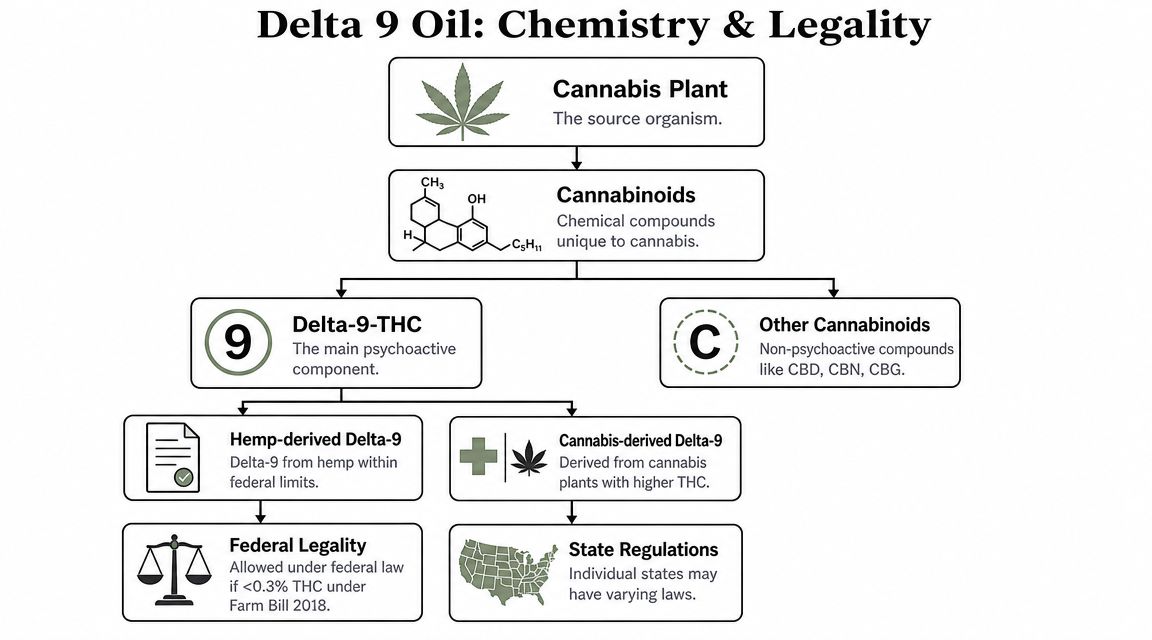
Delta-9 THC is the cannabinoid commonly referred to as THC. It interacts strongly with the body's CB1 receptors, which are found in high concentration in the brain and central nervous system. That receptor activity helps explain why delta-9 can affect mood, perception, appetite, memory, and coordination.
The chemistry itself is only half the story. The other half is legal classification. In the United States, one rule created much of today's hemp-derived Delta 9 category.
The rule that changed the market
The 2018 U.S. Farm Bill defined hemp as cannabis containing no more than 0.3% delta-9 THC by dry weight, which opened a legal pathway for hemp-derived cannabinoids and extracts that stay under that threshold, as described in this discussion of legal Delta 9 potency and Farm Bill compliance.
That dry-weight standard is where many readers get confused. A product can remain compliant by percentage while still containing a noticeable amount of THC in the full package. One example from that same source is a 3,500 mg product that could still contain up to 10.5 mg of delta-9 THC at 0.3% by weight. In plain terms, a small percentage of a larger product can still equal a meaningful serving.
Why hemp-derived Delta 9 can still feel potent
This is easier to understand with a kitchen analogy. If salt makes up a small fraction of a large pot of soup, the percentage may be low, but the total amount of salt can still be substantial. Hemp-derived Delta 9 works the same way under dry-weight rules. Low percentage doesn't automatically mean trivial effect.
That's one reason many consumers are surprised by compliant tinctures and gummies. The product may fit hemp law on paper while still delivering a psychoactive dose.
For readers comparing THC variants, this related guide on Delta 9 vs Delta 10 can help sort out naming differences without losing sight of the bigger issue, which is how the product is made and regulated.
Chemistry is stable. Product categories are not
The delta-9 molecule doesn't change because a label says hemp. What changes is the source material, concentration strategy, and legal framework. That's why two products can both say Delta 9 oil yet belong to very different product families.
A simple comparison helps:
| Question | Hemp-derived Delta 9 oil | State-regulated cannabis THC oil |
|---|---|---|
| Legal basis | Federal hemp threshold by dry weight | State-specific cannabis laws |
| Typical framing | Compliant hemp product | Medical or adult-use cannabis product |
| Consumer confusion point | “How can hemp contain THC?” | “Is this the same as a tincture from a dispensary?” |
The key point is that legality is not the same thing as formulation philosophy. A product may be lawful in one framework and still be very different from a whole-plant extract used in more intensive cannabis protocols.
Comparing Delta 9 Oil with RSO and FECO
If the previous section answered what Delta 9 oil is, the more practical question is whether it belongs in the same category as RSO or FECO. Usually, it doesn't.
A difference in production philosophy
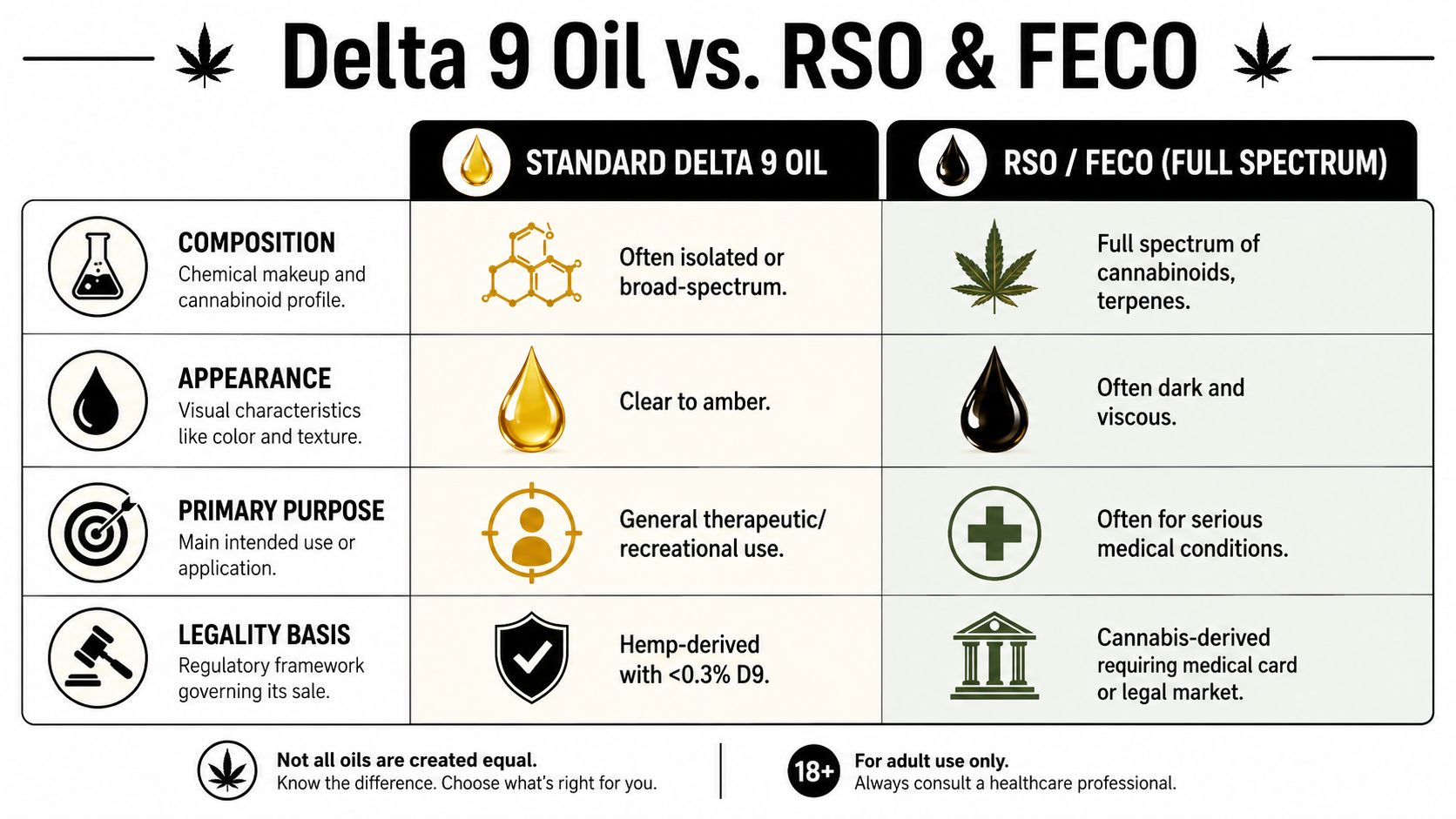
Many standard Delta 9 oils are built around a target cannabinoid. The manufacturer may start with hemp extraction, refine the material, and formulate around delta-9 THC as the central active ingredient. Sometimes other cannabinoids are present. Sometimes they are added back in. Sometimes the product is broad-spectrum rather than entirely whole-plant.
RSO and FECO come from a different mindset. They are usually discussed as full-extract cannabis oils, meaning the goal is to preserve a much wider chemical picture of the plant. That can include multiple cannabinoids, terpenes, pigments, waxes, and other plant compounds depending on the extraction and cleanup method.
A useful shorthand is this:
- Standard Delta 9 oil often asks, “How do we deliver a defined amount of THC?”
- RSO or FECO often asks, “How much of the plant's native profile can we preserve in concentrated form?”
Why full-spectrum matters to some patients
In this context, the idea of the entourage effect typically arises. It's best understood as a formulation theory, not a guarantee. The idea is that cannabinoids and terpenes may behave differently together than in isolation.
Consider an orchestra. A solo violin can still play the melody. But a full ensemble creates a richer and more layered sound. People who prefer FECO or RSO are often looking for that broader botanical complexity rather than a cleaner single-note THC experience.
Clinical lens: If your goal is simple, predictable THC exposure, a standard Delta 9 oil may make sense. If your goal is a whole-plant extract for a more complex protocol, that's the conversation where FECO or RSO usually becomes more relevant.
For readers who want a deeper explanation of whole-plant concentrates, this guide to full extract cannabis oil is the more appropriate starting point.
Texture, appearance, and intended use
The visual difference is often obvious. Many Delta 9 tinctures are relatively fluid and clear to amber. RSO and FECO are commonly darker, thicker, and more resinous. That appearance reflects a heavier extract with more retained plant material.
Here is the simplest side-by-side comparison:
| Feature | Standard Delta 9 oil | RSO or FECO |
|---|---|---|
| Main focus | THC-centered formulation | Whole-plant extract |
| Texture | Usually thinner | Usually thick and viscous |
| Chemical profile | Narrower or selectively blended | Broader and fuller spectrum |
| Typical context | General THC use | More intensive therapeutic discussion |
Why this distinction matters in therapeutic settings
For someone exploring cannabinoid use as part of an integrative health plan, confusing these categories can lead to poor expectations. A person may buy a compliant hemp Delta 9 tincture expecting it to behave like a dense full-spectrum cannabis extract. Another person may avoid a full-extract oil because they assume it's just “more THC,” when in reality the broader composition is the defining feature.
This distinction also affects discussions about receptor signaling. Delta-9 THC interacts prominently with CB1 and, to a lesser degree, CB2 pathways. Other cannabinoids and terpenes may influence the overall experience, tolerability, and practical use pattern. In oncology-related conversations, people also encounter terms such as apoptosis, angiogenesis, metastasis, and the blood-brain barrier. Those are serious research topics, but they don't erase the more basic product question. You still need to know whether you're dealing with a THC-forward tincture or a full-spectrum extract.
That's why educational resources focused on RSO and FECO matter. They help people compare products by composition and intended use, not just by headline THC language.
Dosing Bioavailability and Administration
The same amount of delta-9 THC can feel very different depending on how you take it. That isn't just anecdotal. It follows basic pharmacology.
Why route changes the experience
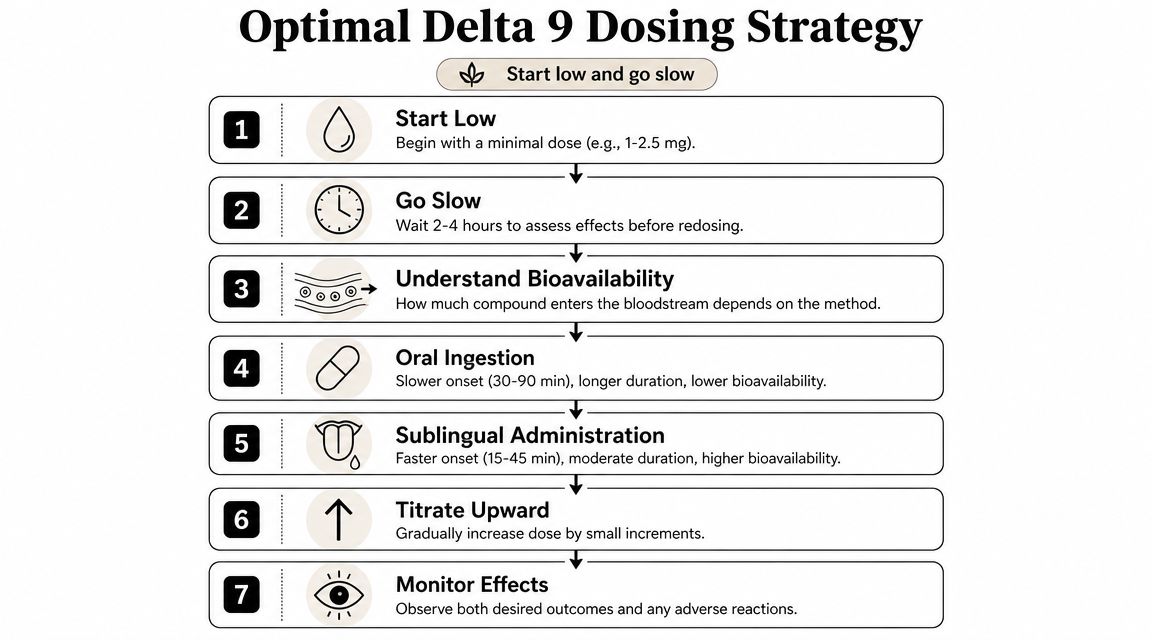
Bioavailability means how much of a compound reaches circulation after you take it. An easy analogy is mail delivery. You may send the same package from two different routes, but one route is direct while the other goes through a sorting center that delays and alters the shipment.
With Delta 9 oil, the “sorting center” is often the liver.
According to the THC pharmacology summary on tetrahydrocannabinol metabolism and bioavailability, oral administration has approximately 6–20% bioavailability, while inhalation is cited at 10–35%. The same source notes that delta-9 THC is metabolized mainly by liver enzyme systems in the CYP2C family, and oral use produces 11-OH-delta-9-THC, a psychoactive metabolite associated with the stronger, more edible-like effect profile.
That helps explain a common patient report. A dose taken by mouth may start slower, then feel deeper or longer than expected. The label dose didn't change. The processing route did.
Oral versus sublingual use
Many people use Delta 9 oil one of two ways. They either swallow it, or they hold it under the tongue before swallowing some portion of it.
The practical tradeoffs usually look like this:
- Oral use tends to have slower onset and more variability because much of the dose goes through first-pass liver metabolism.
- Sublingual use may feel faster for some people because some absorption can occur before the oil reaches the digestive tract.
- Inhaled oil formats can produce faster effects, but they also raise a different set of concerns, especially around respiratory irritation and product quality.
A patient choosing a route should match it to the goal. If someone wants longer duration and is prepared for a delayed build, oral use may fit. If someone wants a more controllable beginning, sublingual use may be easier to gauge.
A brief visual walkthrough can help reinforce those decisions.
A cautious titration framework
Because onset and metabolism vary so much, the safest pattern is still slow titration. That advice sounds simple, but it's rooted in chemistry rather than caution alone.
A practical approach is to:
- Begin low with a very small amount, especially if the oil is new to you.
- Wait long enough to judge the full effect before taking more.
- Keep notes on timing, effects, and side effects.
- Change one variable at a time, such as dose or route, but not both at once.
Taking more before the first dose has peaked is one of the most common reasons people have an unpleasant THC experience.
Why this matters for therapeutic use
Patients using cannabinoids for symptom control often want consistency more than intensity. That's where methodical dosing becomes valuable. A lower, repeatable amount may be more useful than a larger amount that feels unpredictable from day to day.
This is also where full-spectrum products can differ from narrow THC oils. A concentrated whole-plant extract may not translate neatly into the same serving logic as a standard Delta 9 tincture. The plant matrix, route, and pacing all matter.
If you're discussing a cannabinoid plan in the context of active treatment, chronic illness, or a complicated medication list, self-experimentation shouldn't be casual. Consult a licensed medical professional who understands both symptom management and medication safety.
Safety Profile Side Effects and Drug Interactions
Delta-9 THC can be helpful for some people, but it's not neutral. Side effects can include dizziness, anxiety, dry mouth, sedation, impaired attention, and short-term cognitive slowing. Some people feel relaxed. Others feel overstimulated. The same product can land differently depending on dose, route, sleep, food intake, and personal sensitivity.
That variability is especially important for patients trying cannabinoids during periods of illness or treatment. A person who is already fatigued, dehydrated, or taking sedating medication may feel stronger unwanted effects. Someone else may tolerate the same product without major difficulty. This is why broad statements about “good” or “bad” reactions are rarely useful.
The liver is part of the safety discussion
THC is processed through liver enzyme systems that also handle many prescription medications. In plain language, that means cannabinoids may compete with, slow, or otherwise complicate how the body handles other drugs. The exact significance depends on the medication, the person, and the dose pattern.
Common areas where clinicians often want extra caution include:
- Sedating regimens, where THC may add to drowsiness or slowed reaction time
- Complex medication schedules, where timing and metabolism already matter
- Conditions involving mood or cognition, where psychoactive effects may be harder to tolerate
- Serious illness, where nutrition, hydration, falls, and mental clarity are already concerns
Risk reduction in real life
Safety isn't just about reading a side effect list. It's about planning around vulnerable moments.
A sensible approach includes avoiding driving, avoiding rapid dose escalation, and not mixing a new THC product into an already chaotic symptom picture without supervision. If a person is considering Delta 9 oil as part of an integrative plan, the conversation should include the prescribing team, not bypass it.
Further research is needed, and cannabinoid use should fit into medical care rather than sit outside of it.
That same principle applies in oncology discussions. A cannabinoid product shouldn't be framed as a substitute for established treatment. It belongs, if at all, in a careful adjunctive discussion based on goals, tolerability, and monitoring.
How to Buy Quality Delta 9 Oil Safely in 2026
A bottle can look clinical, polished, and reassuring. Then the details tell a different story.
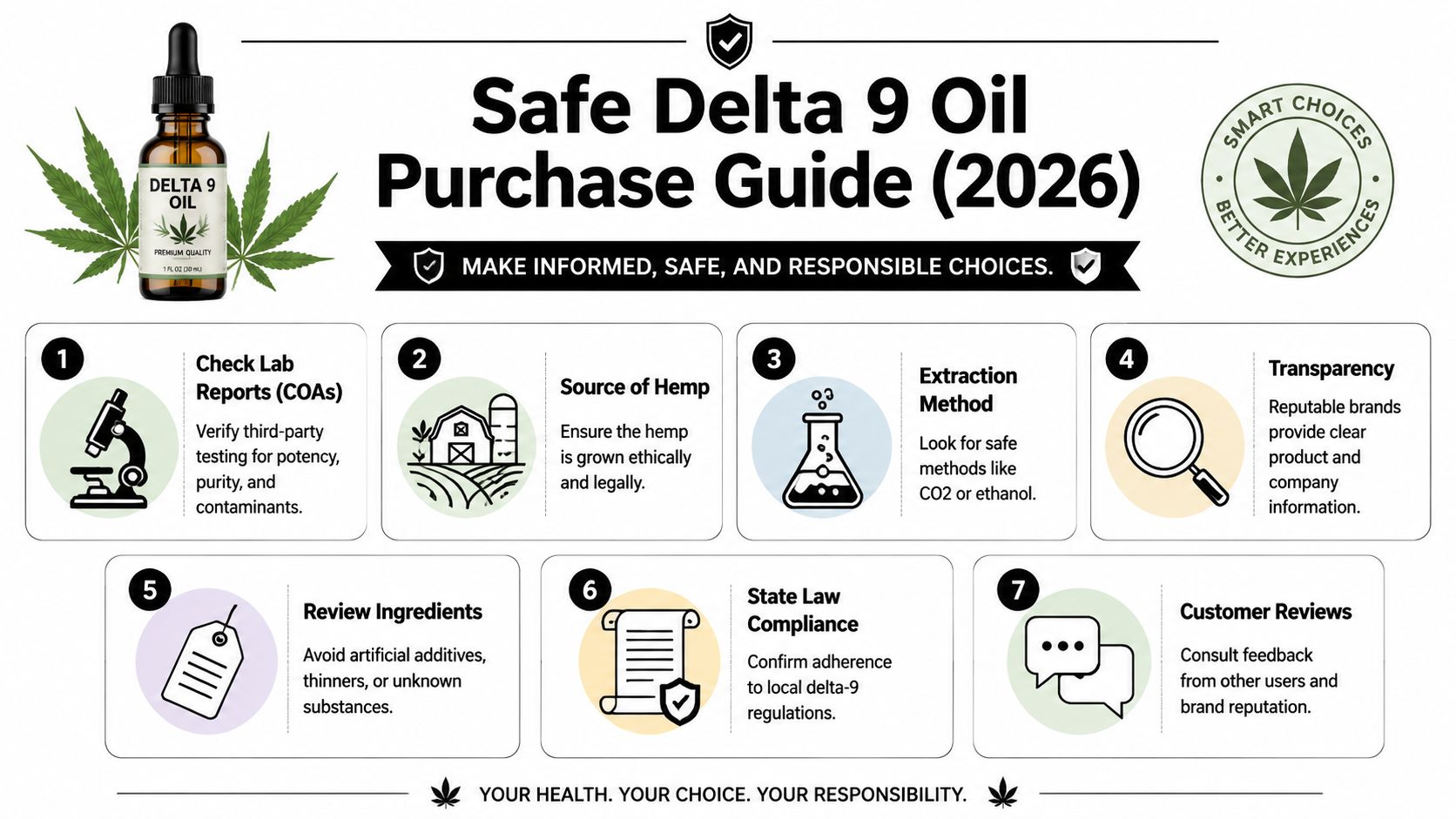
In a peer-reviewed analysis of 53 hemp-derived Delta 9 products, 66.0% differed from their stated dosage by more than 10%, and 71.1% of the provided lab reports did not check for impurities, as reported in this peer-reviewed study of hemp Delta 9 product accuracy and safety testing. For a patient trying to titrate carefully, that is not a small labeling problem. It is the difference between a measured plan and guesswork.
What to check before you buy
Start with the paperwork. Branding can suggest quality, but only testing can show what is in the bottle.
The first document to request is a Certificate of Analysis, or COA. A COA works like a product's lab passport. It should identify the exact item, show its cannabinoid content, and confirm whether the manufacturer tested for contaminants such as residual solvents, heavy metals, pesticides, or microbes.
Use this checklist:
- Match the product name: The COA should clearly match the exact oil you are considering, not a broad company sample or a different flavor.
- Check cannabinoid potency: The report should list the cannabinoids present and the amount of each.
- Look for contaminant testing: A potency-only report leaves a major blind spot. You want to see whether the oil was screened for impurities.
- Review ingredient transparency: Carrier oils, flavoring agents, and other additives should be listed clearly.
- Confirm legal fit in your state: Federal hemp rules do not override state restrictions on THC products or edible formats.
How to read a COA without chemistry training
You do not need laboratory training to screen out weak documentation.
Focus on three questions. Is the report current? Does it match the exact product? Does it include both potency and safety testing?
A simple table can help.
| COA feature | What you want to see | Red flag |
|---|---|---|
| Identity | Exact product match | Generic or mismatched product name |
| Potency | Clear cannabinoid listing | Vague summary language |
| Safety | Impurity screening included | No contaminant panel |
| Access | Easy to obtain before purchase | Hidden or available only after purchase |
If a COA only highlights THC content, treat it the way you would treat a medication bottle that lists dose but omits the ingredient list and expiration date. It is incomplete, and incomplete information makes informed use harder.
Why the product category matters
This is the point many buyers miss. “Delta 9 oil” is not a single therapeutic category.
A federally compliant, hemp-derived Delta 9 tincture is often designed around legal thresholds and retail sale. RSO or FECO is a different class of extract altogether. Those oils are usually discussed in the context of whole-plant concentration, broader cannabinoid content, and different therapeutic goals. Legality is part of the distinction, but chemistry and intended use matter just as much.
That is why buying safely is not only about finding a legal bottle. It is about confirming that the product type matches the reason you are considering it in the first place.
For legal context on ingestible THC products, this guide on whether edibles are legal under current rules helps explain why jurisdiction and product format both affect what can be sold and how it is labeled.
A practical buying standard
Before you order, pause and answer three questions:
- What is this product chemically
- What legal framework is it being sold under
- Where is the independent testing that confirms potency and impurity screening
Clear answers reduce avoidable surprises. Fuzzy answers increase the odds that you will buy a product that is mislabeled, poorly tested, or the wrong category for your goals.
For a casual buyer, that may mean an inconsistent experience. For a patient or caregiver comparing a narrow hemp Delta 9 oil with a fuller cannabis extract such as RSO or FECO, it can affect dosing logic, symptom tracking, and conversations with the clinical team.
Frequently Asked Questions About Delta 9 Oil
What is the difference between delta-8 and delta-9 oil
They are different THC isomers. In practical terms, people usually discuss delta-9 as the more familiar primary THC in cannabis, while delta-8 is typically framed as a related but distinct cannabinoid with a different effect profile. The more important question, though, is still formulation. A narrow THC product and a full-spectrum extract can differ more meaningfully than two labels that merely compare isomers.
How long do the effects of orally ingested Delta 9 oil typically last
Oral Delta 9 oil often lasts longer than inhaled use because digestion and liver metabolism change the effect curve. People usually notice a slower onset and a longer tail. The exact duration varies by dose, meal timing, metabolism, and individual sensitivity.
Can Delta 9 oil be used topically for localized relief
Some products are marketed for topical use, but topical application is a different route from oral or sublingual administration. Product design matters. A tincture meant for swallowing is not automatically the same thing as a topical preparation. Anyone considering topical use should confirm the product is intended for that route.
Why is multi-strain FECO or RSO often preferred for complex health protocols
The preference usually comes from a whole-plant philosophy. Multi-strain full-spectrum extracts may provide a broader cannabinoid and terpene profile than a narrower THC-forward oil. In serious protocols, some patients and caregivers value that chemical diversity because they are looking beyond isolated THC exposure alone. That doesn't guarantee any outcome, but it does explain why FECO and RSO remain central in more advanced cannabinoid discussions.
Is hemp-derived Delta 9 oil the same as RSO
Usually, no. A hemp-derived Delta 9 oil is often sold under dry-weight hemp rules and may be formulated around THC content. RSO is generally discussed as a thicker, fuller cannabis extract with a different production philosophy and a broader whole-plant profile.
Should Delta 9 oil replace conventional treatment
No. It's more responsible to frame cannabinoid use as an adjunctive or integrative discussion. Patients should consult a licensed medical professional and avoid stopping prescribed treatment based on internet content alone.
If you're comparing Delta 9 oil with full-spectrum options such as FECO or RSO, RickSimpsonOil.info offers educational guides on dosing, administration routes, product selection, and safe sourcing questions for patients and caregivers who want a more structured starting point.