A sore knee after walking, an itchy patch of skin that keeps flaring, a stiff hand that makes daily tasks harder. Many people in that situation want something targeted. They don't want the whole-body effects associated with inhaled or oral cannabis. They want to apply a product where the problem is and keep the rest of the day predictable.
That's where cannabis topical cream enters the conversation. In practical terms, it means a cream, lotion, balm, or similar preparation that contains cannabinoids and is rubbed directly onto the skin. The appeal is straightforward. It's local, familiar, and usually easier to fit into a routine than a systemic product.
Patients and caregivers often ask a reasonable question: if cannabinoids can affect the body, why not just use a cream for everything? The answer is more complicated than marketing language suggests. A topical may be a sensible choice for some goals and a poor match for others. A person choosing between a skin-focused product and a systemic extract such as RSO needs a clear picture of what each route can plausibly do.
That's the purpose of this guide. It treats cannabis topical cream as one tool, not a miracle product, and focuses on the physical limits of skin application. If you're comparing formats, a background review like this overview of cannabis body lotion can help frame the basics before you decide what questions to bring to a clinician.
A Patient's Guide to Cannabis Topical Cream
A patient with localized discomfort often starts with a simple hope: “If I put it right where it hurts, maybe I can avoid the rest of the body being involved.” That instinct makes sense. It's the same reason people use moisturizers for dry skin or a menthol rub on a sore shoulder. Topicals feel intuitive because the application matches the location of the symptom.
A cannabis topical cream follows that same logic. It's designed to be spread over a limited area of skin, not swallowed or inhaled. That distinction matters because route of administration shapes what the product can realistically affect.
Why people often consider a topical first
Some readers are trying to manage a skin problem such as itching or irritation. Others are exploring a cream for a painful joint or muscle. Those are very different goals, even though the product category sounds the same.
Topicals are easiest to understand when you think of them as local tools. The question isn't only “Does cannabis help?” It's “Can this form reach the target I care about?”
That question protects people from two common mistakes. The first is expecting a cream to behave like an oral extract. The second is dismissing topicals entirely because they aren't whole-body products.
A practical way to frame expectations
A cream applied to intact skin usually aims at the skin and nearby structures. An oral or other systemic product aims much more broadly. Neither approach is automatically better. The right choice depends on the treatment goal, tolerance for systemic effects, and the quality of the product itself.
For informed patients and caregivers, the useful mindset is restraint. Ask what symptom is localized, what symptom is widespread, and whether the route matches the objective. That kind of thinking is more valuable than any broad “works for everything” claim.
The Science of Topical Cannabinoid Application
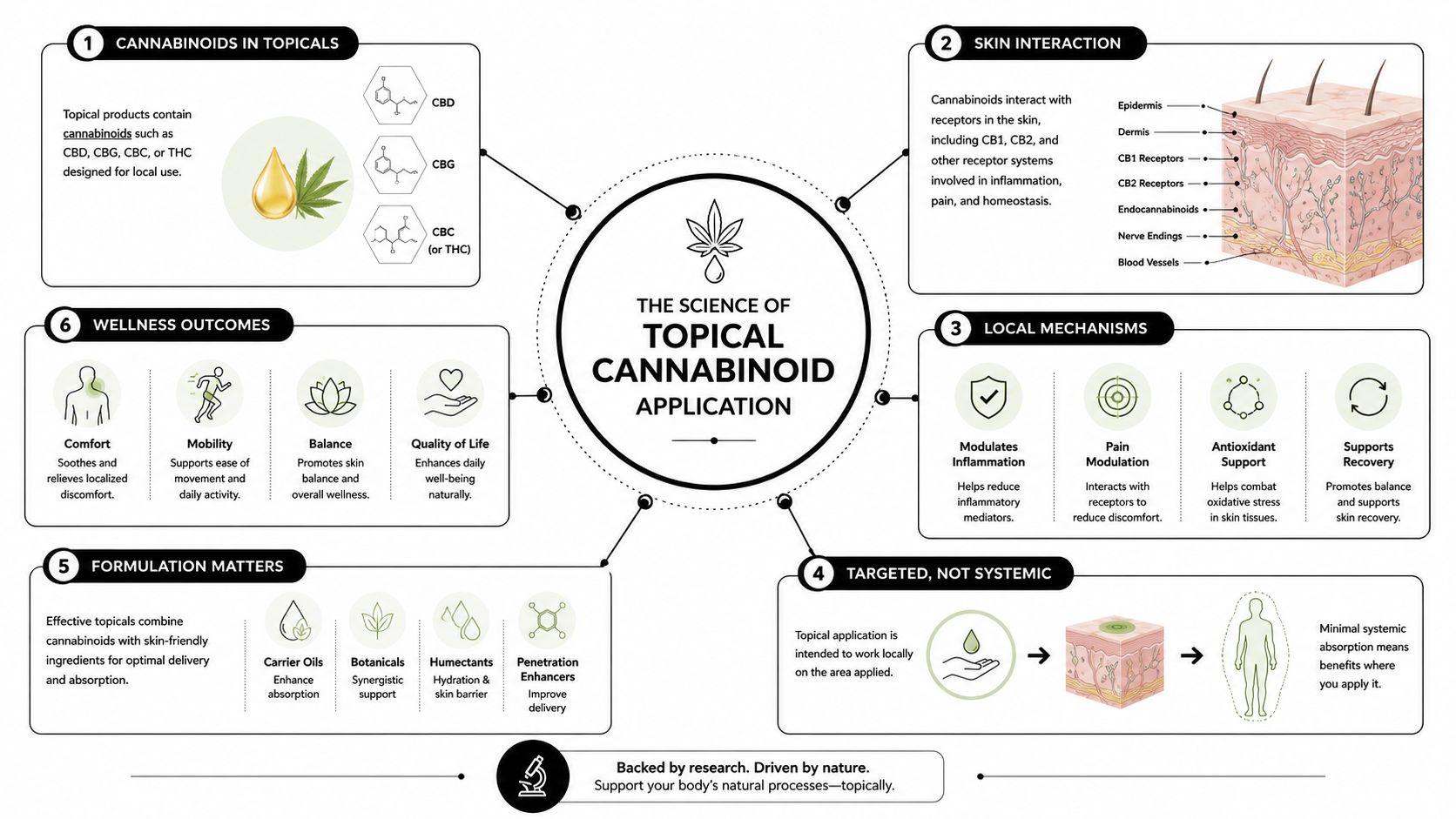
The skin isn't just a covering. It's a biologically active organ with nerve endings, immune cells, and signaling systems, including parts of the endocannabinoid system. That's the scientific basis for interest in topical cannabinoids.
How receptors in the skin matter
A helpful analogy is a lock-and-key model. CB1 and CB2 receptors are part of the signaling “locks,” and cannabinoids are among the possible “keys.” In the skin, these receptors are involved in local processes such as sensation, immune signaling, and barrier function.
When a topical is applied to intact skin, the main idea is local interaction, not meaningful transfer into the bloodstream. A patient who wants a deeper explanation can review this discussion of whether THC can be absorbed through skin, which helps separate topical exposure from systemic delivery.
Why psychoactive effects are generally unlikely
A useful evidence-based summary comes from Verilife's explanation of cannabis topicals, which describes these creams as intended for localized skin exposure. Cannabinoids applied to intact skin primarily interact with receptors in the skin and are described as acting on the top layers rather than entering the bloodstream in meaningful amounts. That's why psychoactive effects are generally unlikely.
This also explains why formulation matters so much. If a product is supposed to act locally, the cream base is not just filler. It helps the active compounds spread, hydrate the area, and stay in contact with the skin long enough for local activity.
Why the base can matter as much as the cannabinoid
A rough, dry patch of skin doesn't behave like well-hydrated skin. A thick balm doesn't behave like a light lotion. Those differences affect contact time and the experience of use.
Practical rule: With topical products, the carrier isn't secondary. The cream, balm, or lotion base helps determine how long the cannabinoids stay where you apply them.
That's why two products with similar label claims can feel very different in practice. One may sit on the surface longer. Another may absorb quickly but provide less lasting skin contact. Neither detail tells you whether the product will help a deep joint. It does tell you why “same cannabinoid, same outcome” is too simplistic.
Topical Creams vs Systemic Cannabis Extracts like RSO
Readers often get stuck on a particular idea. They hear “localized relief” and assume a cream might also reach a painful joint, a deep muscle, or an internal process if they apply enough. Current evidence doesn't support that kind of certainty.
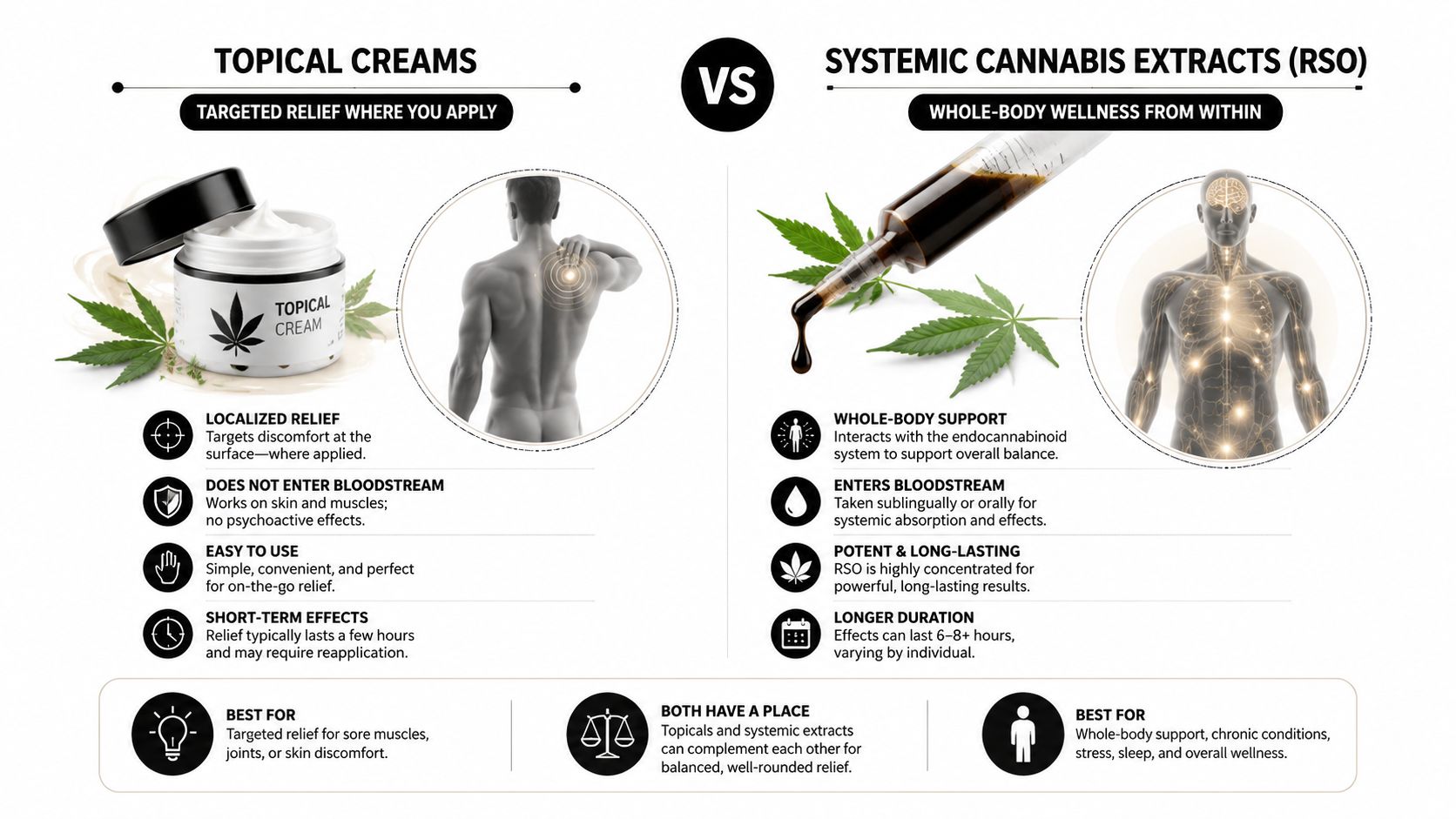
The core difference is local versus systemic intent
A topical cream is designed for application to a specific area of skin. A systemic extract such as Rick Simpson Oil is used when the goal is whole-body exposure. That difference is not a marketing distinction. It is a pharmacologic one.
If your goal is a skin symptom in a defined area, a topical has a rational role. If your goal involves broader body exposure, a systemic route is the more coherent category to discuss with a clinician.
Where evidence becomes thin
A high-quality review from RxFiles on topical cannabis notes a key unanswered question: whether cannabis topicals penetrate sufficiently for joint or muscle pain. The same review states that clinical evidence is weak, with no well-designed randomized controlled trials demonstrating effectiveness or safety for many topical cannabis products, and no clinical studies on percutaneous absorption of cannabis ointments, creams, or lotions.
That gap matters because patients usually don't ask, “Can this affect my epidermis?” They ask, “Will this help my knee, back, or shoulder?” Those are not the same question.
A side-by-side way to think about it
| Goal | Topical cream | Systemic extract like RSO |
|---|---|---|
| Local skin exposure | Strong conceptual fit | Not the main reason to choose it |
| Whole-body exposure | Not the intended route | Better conceptual fit |
| Psychoactive concern | Generally unlikely with intact skin use | Depends on product, dose, and route |
| Deep penetration certainty | Evidence gap remains | Systemic delivery aims beyond the skin |
A person comparing formats for pain may also want a broader review of RSO oil for pain, especially if the target problem doesn't seem limited to the skin surface.
Choosing the right tool for the right job
This isn't a contest between methods. It's closer to choosing between eyedrops and an oral medication. Both may contain useful active ingredients, but they're built for different therapeutic goals.
For complex cases, especially where someone is considering a systemic cannabinoid approach alongside conventional care, a structured educational resource can be helpful. RickSimpsonOil.info provides articles on dosing, route comparisons, and product selection for readers who want to understand how systemic extracts differ from localized topicals.
If the symptom is local, start by asking whether a local route makes sense. If the objective is systemic, don't expect a skin cream to behave like an oral extract.
Understanding Different Cream Formulations
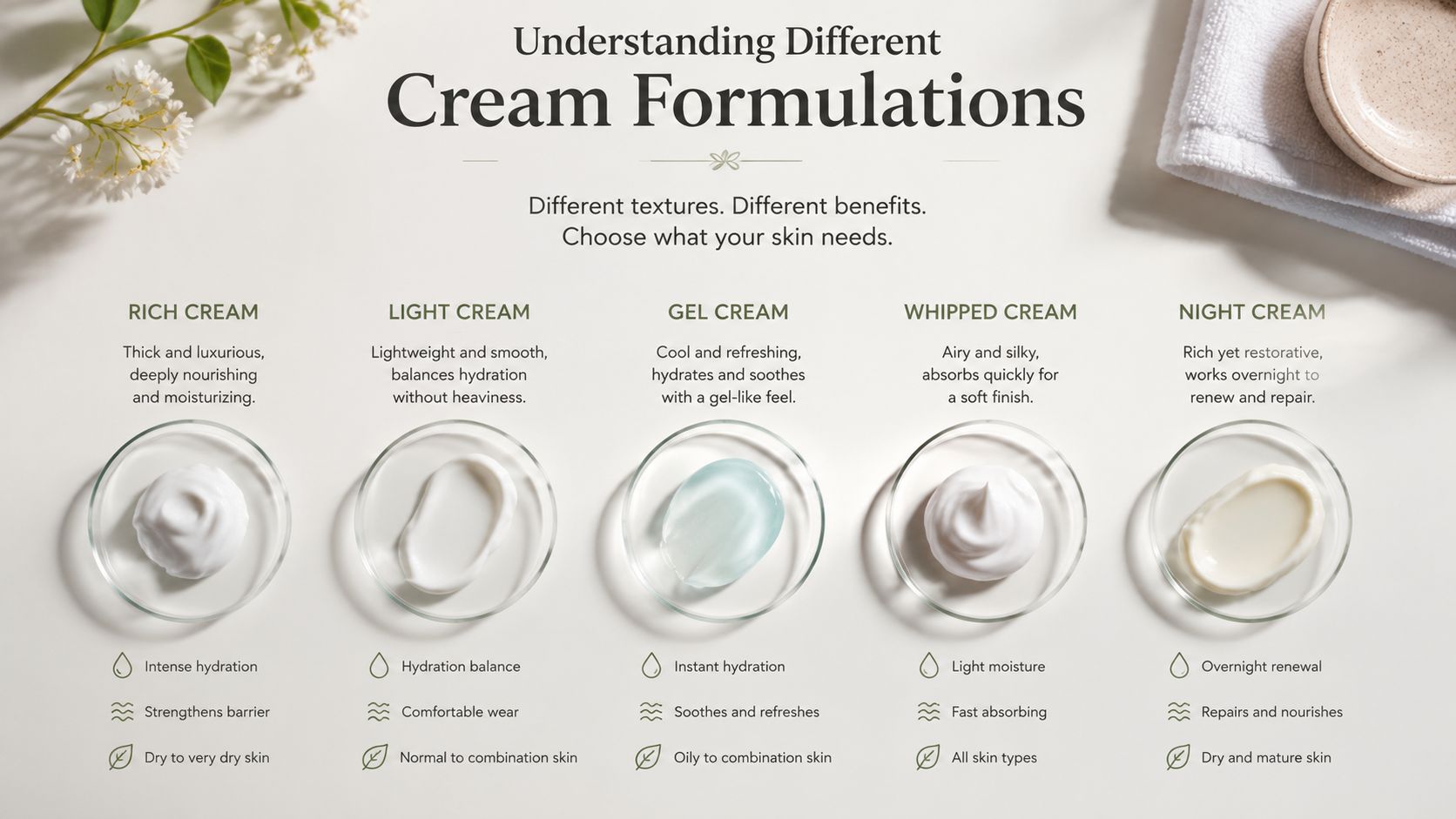
One reason topical products are confusing is that people focus on the cannabinoid and ignore the vehicle. In dermatology and skin science, the vehicle often shapes the actual experience. Cream, lotion, salve, balm, and emollient are not interchangeable words.
Oil-rich bases and water-rich bases
An oil-based balm or salve usually stays on the skin longer. That can be useful when you want prolonged surface contact or a more occlusive feel. The tradeoff is texture. Some people find these products greasy or inconvenient under clothing.
A water-based lotion or lighter cream tends to spread easily and feel less heavy. It may be more acceptable for daytime use or larger areas. The tradeoff is that quick absorption can shorten the sense of surface presence.
Why emollients deserve attention
An emollient is designed to soften and moisturize the skin. That may sound cosmetic, but it matters clinically when the target symptom includes dryness, irritation, or itch. Better hydration can improve barrier function and change how a product feels over time.
A 2022 evidence review in PMCID PMC9210160 found that topical cannabinoid research remains limited, but it reported notable early findings for itch-related conditions. In a 3-week open-label study of 21 patients with uremic pruritus, a topical endocannabinoid-containing cream applied twice daily eliminated itching entirely in more than 38% of participants, while another 52% reported significant improvement. The same review also cited an average 86% reduction in subjective pruritus in a topical endocannabinoid emollient study.
What those findings do and don't mean
Those figures are meaningful because they show a signal for benefit in small human studies, especially for itch and inflammatory skin symptoms. They do not establish topical cannabinoid creams as standard therapy across all conditions.
That distinction is important. A reader with eczema-like symptoms or chronic itch may reasonably see topical formulations as worth discussing with a clinician. A reader hoping the same cream will reliably treat deep structural pain should recognize that the evidence question is different.
A simple formulation framework
- Balms and salves usually suit smaller areas where longer surface contact matters.
- Creams often balance spreadability with a more substantial feel.
- Lotions may work better for larger areas or people who dislike residue.
- Emollient-focused products may make the most sense when dryness and itch are central complaints.
The lesson is simple. Don't choose by cannabinoid content alone. Choose by the skin problem, the area involved, and the base that makes repeated use realistic.
How to Use and Dose Topical Cannabis Products Safely
The safest first use is methodical. People get into trouble when they apply too much, use it on irritated skin without checking ingredients, or keep switching products before they know what caused a reaction.
A cautious first-use routine
Start with clean, dry skin. Apply a small amount to a limited area. If you have sensitive skin, patch test first on a small spot and watch for irritation before using it more broadly.
Then keep the routine simple:
- Clean the area so the product contacts the skin directly.
- Patch test first if the formula contains fragrances, essential oils, or unfamiliar botanicals.
- Use a small amount at the beginning. A thin layer is usually easier to evaluate than a heavy one.
- Wait and observe before reapplying.
- Record what you used and what you noticed.
Why tracking matters
If a patient says, “It helped,” that's useful but incomplete. It helps more to know where it was applied, how often, whether the skin was intact, and whether the result was skin comfort, less itch, or a general cooling sensation from non-cannabinoid ingredients.
Keep a brief log with the product name, application site, timing, and any skin response. That makes future decisions more reliable.
When to stop and ask for help
Stop using the product if you develop visible irritation, worsening redness, or a reaction that seems linked to the formula. Many problems come from the base ingredients rather than the cannabinoids themselves.
Consult a licensed medical professional if you're pregnant, breastfeeding, managing a significant skin disease, or using the product near compromised skin. If you're also considering a systemic cannabis product, ask for guidance on route, timing, and interactions rather than layering products without a plan.
Evaluating Lab-Tested Products and Certificates of Analysis
The label on the jar isn't enough. In cannabinoid products, the most useful document is the Certificate of Analysis, usually called a COA. It shows what an independent laboratory found in the product.

Why this isn't optional
A 2022 JAMA Network Open case series assessed 105 hemp-derived topical cannabinoid products and found major labeling inconsistencies. 18% were overlabeled, meaning they contained more than 10% less CBD than advertised, and 58% were underlabeled, meaning they contained more than 10% more CBD than advertised.
Those numbers don't prove every product is unreliable. They do prove that accuracy cannot be assumed.
What to look for on a COA
A useful COA should let you verify several things at a glance:
- Cannabinoid content that reasonably matches the package label.
- Recent testing rather than an old report that may not reflect the current batch.
- Contaminant screening for issues such as pesticides or heavy metals.
- Clear batch identification so the report belongs to the product in your hand.
A practical buying standard
If a company won't provide an up-to-date third-party COA, that's a problem. If the report is hard to match to the lot number, that's also a problem. Transparency doesn't guarantee clinical benefit, but lack of transparency should lower your confidence immediately.
For patients and caregivers, this is one of the simplest ways to reduce avoidable risk. Verify first. Apply second.
Frequently Asked Questions About Cannabis Topicals
Can a cannabis topical cream get you high
For standard use on intact skin, psychoactive effects are generally unlikely. That's because these products are designed for localized skin exposure rather than meaningful systemic delivery.
Can it help joint or muscle pain deep under the skin
That's one of the main unanswered questions. Public marketing often says “localized relief,” but the evidence for deep penetration remains limited, so expectations should stay cautious.
Is a balm better than a lotion
Not universally. A balm may stay on longer, while a lotion may spread more easily and feel lighter. The better option depends on the area treated, skin type, and whether dryness or itch is part of the problem.
Should I make my own topical at home
DIY products make it harder to know the actual cannabinoid content and the safety of the final mixture. For most patients, a lab-tested commercial product is the more responsible choice.
Do I still need medical guidance if it's only topical
Often, yes. That's especially true if you have chronic skin disease, allergies, sensitive skin, or you're comparing a topical with a systemic option such as RSO.
What's the most important takeaway
Use the route that matches the goal. A topical is a local tool. A systemic extract is a different category.
Patients and caregivers who want a clearer comparison between topical cannabis products, oral extracts, dosing approaches, and lab-tested sourcing can review the educational guides at RickSimpsonOil.info. The site focuses on evidence-aware cannabinoid education, including RSO, route-of-administration differences, and practical safety considerations for people making careful treatment decisions.
This article is for educational purposes only. Individual results may vary. Further research is needed. Consult a licensed medical professional.