
A cannabis indica tincture is an alcohol-based extract of cannabis indica strains, traditionally associated with sedative and analgesic properties and designed for sublingual use under the tongue. If you're trying to decide whether an indica tincture is practical for symptom support, the most useful starting point is this: a 30 mL bottle with 1,800 mg total cannabinoids contains 60 mg per mL and about 3 mg per drop, while sublingual tinctures are typically described at 30 to 40% bioavailability and RSO at 50 to 70% when people compare concentrated formats for therapeutic use.
If you're reading this, you may be in a familiar position. You want something more precise than smoking, more flexible than an edible, and easier to titrate than a very dense oil. You may also be wondering whether an indica tincture is enough for your goals, or whether a more concentrated full extract such as FECO or RSO makes more sense.
That's where careful education matters. A lot of cannabis content treats all tinctures as if they work the same way, and a lot of RSO content skips over why some patients begin with a tincture first. This article is for educational purposes only. Individual results may vary. Further research is needed, and you should consult a licensed medical professional before adding any cannabinoid product to a treatment plan.
An Introduction to Cannabis Indica Tinctures
You get home in the evening, symptoms are building, and you want something measured. Smoking feels too short-lived. A strong edible can be hard to predict. A cannabis indica tincture often sits in the middle. It gives you a liquid dose you can measure carefully, usually with a dropper, and many patients use it under the tongue so part of the dose may absorb before it passes through digestion.
That middle-ground role is why indica tinctures stay relevant in structured care plans. They are often used by patients who want a calmer, more body-focused cannabinoid profile without jumping straight to a dense full extract. In practice, that can matter for pain, sleep disruption, evening muscle tension, treatment-related discomfort, or simple dose sensitivity. The format makes adjustment easier. If a dose feels too heavy, the next one can be lowered with much more precision than a homemade edible.
Indica tincture works like a dimmer switch compared with a high-potency oil that behaves more like an on-off setting. Both can have a place in a protocol. The better choice depends on how much cannabinoid exposure you need, how quickly you need to build a routine, and how closely you want to track each dose.
Patients often get confused by the word tincture because it describes a preparation method, not a promise about strength or outcome. A tincture may be relatively mild or fairly concentrated. It may be made with alcohol or another carrier. It may also preserve different amounts of minor cannabinoids and aromatic compounds depending on extraction technique. If you want a clearer foundation before comparing products, this explanation of how cannabinoid extracts are made helps show why two bottles with similar labels can behave differently.
That difference becomes even more important when people compare an indica tincture with FECO or RSO. All three may come from cannabis, but they are not interchangeable in a simple one-to-one way. A tincture is usually easier to measure in small increments and easier to fit into a cautious titration plan. FECO and RSO are usually more concentrated, often thicker, and commonly chosen when a patient needs larger cannabinoid intake in a smaller volume. The question is less about which format is "better" and more about which one matches the job.
An indica tincture is best understood as a controlled delivery format with a specific absorption pattern, not just "liquid cannabis."
For a patient who is new, sensitive, or trying to keep careful records, that can be a real advantage. For a patient following a more intensive protocol, the same tincture may serve as a stepping stone rather than the final format.
A practical way to frame it is:
- Choose an indica tincture first if you want small, repeatable dose changes and clearer day-to-day tracking.
- Consider FECO or RSO if your protocol calls for higher concentration and less volume per dose.
- Compare them by function. Ask how each product fits your symptom pattern, tolerance, and ability to titrate safely.
That clinical framing keeps the decision grounded in use, not marketing.
Understanding Tincture Chemistry and Extraction
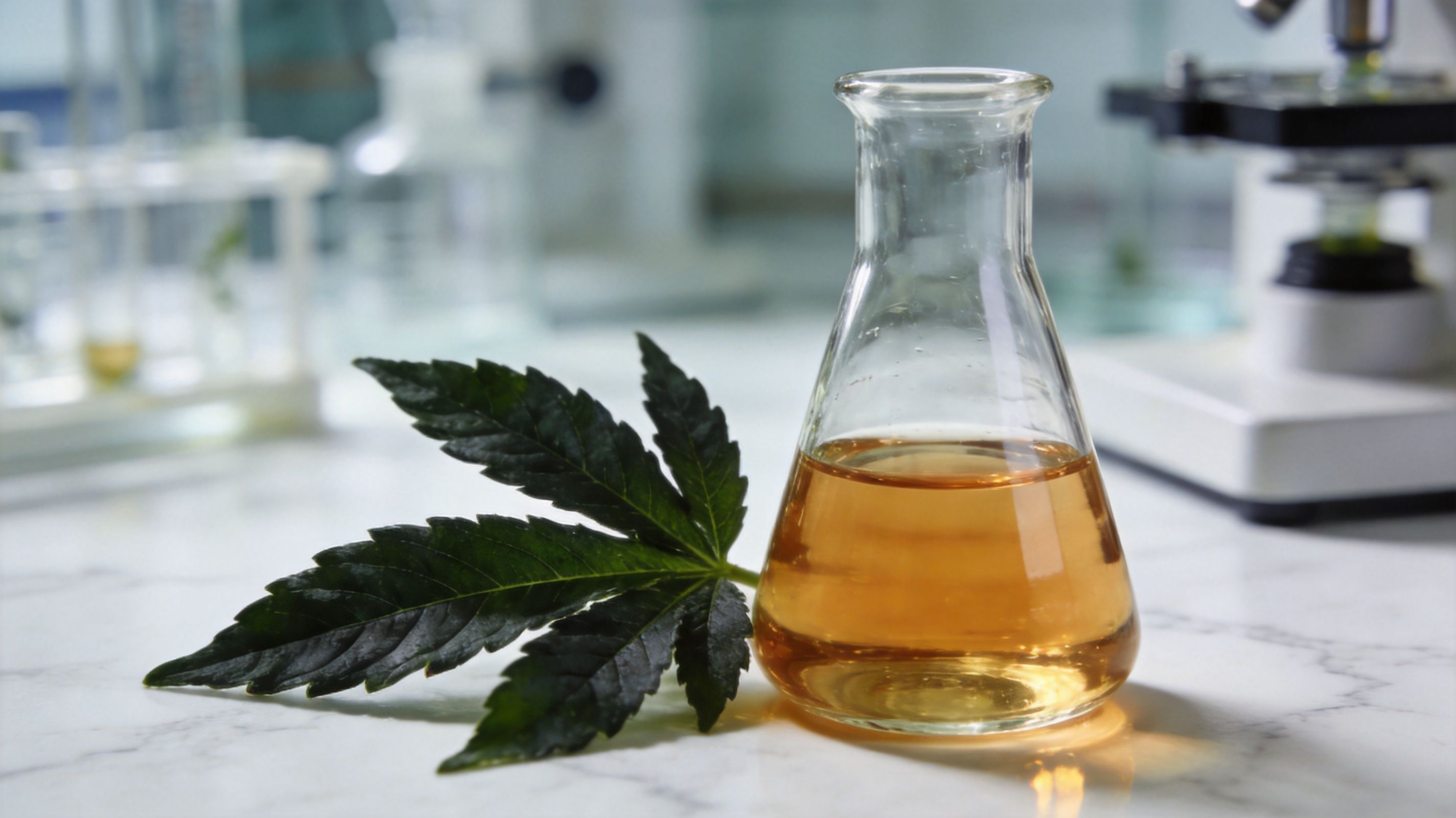
A tincture isn't defined only by the plant. It's also defined by how the extract was made. That matters because cannabinoids and terpenes don't all dissolve the same way, and the solvent changes what ends up in the bottle.
What's inside an indica tincture
Most patients first notice the cannabinoid label, usually THC, CBD, or a ratio of the two. That's important, but it isn't the whole picture. The plant also contains terpenes, aromatic compounds that help shape the overall profile. In an indica-leaning preparation, patients and clinicians often pay close attention to compounds such as myrcene, along with other supporting constituents that may influence how calming or body-heavy the product feels.
A simple analogy helps. Think of cannabinoids as the main instruments in a small ensemble, and terpenes as the room acoustics. The melody may be the same, but the experience changes depending on what surrounds it. That's the basic idea behind the entourage effect, which people use to describe why a fuller extract may feel different from an isolated compound.
Full-spectrum, broad-spectrum, and isolate
These labels confuse many readers because they sound more standardized than they are. A practical distinction is:
- Full-spectrum: contains multiple cannabinoids and terpenes from the source plant.
- Broad-spectrum: contains multiple compounds but is usually processed to exclude some components.
- Isolate: centers on a single cannabinoid rather than a whole-plant profile.
For patients seeking a preparation that behaves more like a traditional herbal extract, full-spectrum products tend to be the closest conceptual match. If you want to review one part of that process in more detail, this guide on how CBD is extracted gives useful background on why extraction choices shape the final product.
Practical rule: don't assume two tinctures with similar front-label wording will behave the same way.
Why solvent choice changes the product
Labels can become misleading at this point. The extraction methodology determines cannabinoid profile consistency, and Leafly's tincture extraction discussion notes a ten-fold variance in THC-to-CBG ratios depending on solvent strength, with E80 yielding approximately three-fold THC:CBG ratios compared to E20 formulations. In plain terms, two products both called indica tinctures may have meaningfully different chemistry.
That matters for patients because chemistry drives experience. Alcohol-based tinctures also differ from glycerin or oil-based formulas in how they move across tissues. Alcohol preparations are often discussed as faster-acting under the tongue, while oil carriers may change absorption behavior in a different way.
A careful buyer should look for a product with a clear cannabinoid profile and a usable lab report, not just an attractive strain name.
Reported Therapeutic Effects and Strain Considerations
When patients say an indica tincture helps them, they usually aren't talking about one single effect. They're often describing a pattern: less physical tension, less discomfort, less nighttime mental overactivity, and an easier transition into rest. That combination is why indica products are commonly discussed for pain support, sleep support, and evening use.
Why indica products are described as calming
The common shorthand is that indica feels more settling, while sativa feels more activating. Real life is less tidy than that. The better way to frame it is that the cannabinoid ratio and terpene profile shape the experience, and some indica-dominant products are selected because patients report heavier body effects and more sedation.
This is also where terms like myrcene come up. Many people associate myrcene-rich profiles with a more physically relaxing effect, but the clinical literature is still catching up with what patients and practitioners report in everyday use.
The missing data patients need
The biggest source of confusion is that strain labels often promise more precision than the evidence can currently support. According to this discussion of THC tinctures and strain-specific gaps, there is a data gap in medical literature quantifying how indica-dominant profiles, including higher myrcene, produce measurable differences in onset time and duration compared with sativa tinctures. It also notes that patients often lack strain-specific titration protocols.
That gap matters. A patient may buy an indica tincture for sleep and expect a predictable time course, but most patient-facing guidance still talks about tinctures in generic terms rather than explaining the botanical profile in a clinically useful way.
A label that says "indica" is a starting clue, not a full dosing instruction.
How to choose with more confidence
Instead of relying only on the word indica, it helps to compare these features:
| What to check | Why it matters |
|---|---|
| THC and CBD ratio | Affects intensity, tolerance, and the balance between psychoactivity and symptom support |
| Terpene listing | Gives added context for how the product may feel |
| Full-spectrum status | Suggests whether the extract preserves more of the original plant chemistry |
| Lab documentation | Helps verify that the bottle matches the claim |
Patients sometimes ask whether a given indica tincture will definitely make them sleepy. It might, but not always. Dose, tolerance, timing, food intake, and other medications all shape the result. That's why it's safer to think in terms of reported tendencies, not guaranteed effects.
If your goal is daytime symptom support, a heavy evening-style indica tincture may not be ideal. If your goal is rest, a low initial dose may still be wiser than assuming more is better.
Dosing Protocols Administration and Bioavailability
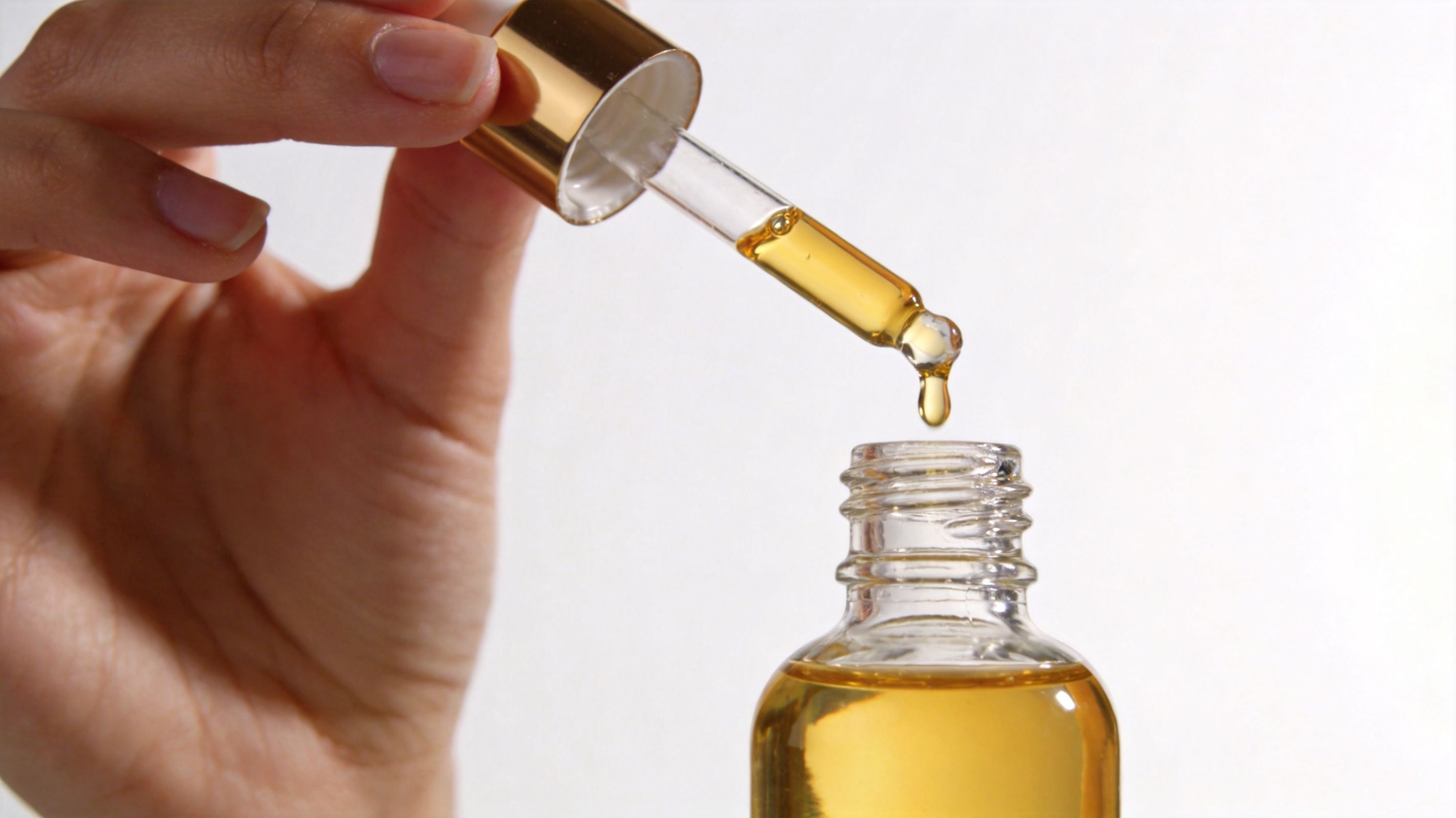
The best dosing plan for a cannabis indica tincture is usually the simplest one. Start low, measure carefully, write it down, and change only one variable at a time. Patients get into trouble when they stack doses too quickly or use a product without understanding the actual milligrams in the dropper.
Why sublingual use is different
When you place a tincture under the tongue, some of the cannabinoids may absorb through the tissues there before the rest is swallowed. That matters because sublingual administration can bypass first-pass liver metabolism for the absorbed portion, which is one reason tinctures are often chosen over standard oral edibles.
Generic tincture guidance commonly describes onset around 15 to 30 minutes and duration around 2 to 6 hours, but that range doesn't solve the strain-specific questions discussed earlier. It does, however, support a basic safety rule. Don't redose quickly just because you don't feel a full effect right away.
A practical mg-per-drop example
The simplest calculation comes from a common bottle format. A 30 mL tincture with 1,800 mg total cannabinoids yields 60 mg per mL, and with about 20 drops per mL that equals 3 mg per drop, as outlined in this tincture dosage guide.
That means you can estimate a dose with reasonable precision:
- Microdose range: 0.10 to 0.25 mL, or about 3 to 7.5 mg
- Beginner starting point: 0.25 mL, or 15 mg
- Standard therapeutic range for experienced users: 0.50 to 1 mL, or 15 to 30 mg
- Higher dose example for severe needs: 2 mL, or 60 mg
If you want help checking your own bottle math, this THC tincture dose calculator is a useful practical tool.
If the bottle math isn't clear, stop before dosing. Unclear potency is a safety problem, not a minor inconvenience.
A careful titration method
A simple patient-friendly approach looks like this:
- Choose one time of day. Evening is often easiest for first trials because sedation is less disruptive there.
- Take a low measured amount. For a new patient, the lower end of the microdose range is often the cleanest way to test sensitivity.
- Hold under the tongue briefly, then swallow. Keep the method consistent each time.
- Record what happened. Write down time, dose, symptom change, and any unwanted effects.
- Adjust gradually. Increase only after you understand the prior dose.
Later in the process, some readers find a visual explanation helpful:
The goal isn't to chase a dramatic effect. The goal is to find the minimum effective dose that supports the problem you're trying to address.
Comparing Indica Tinctures to RSO and FECO
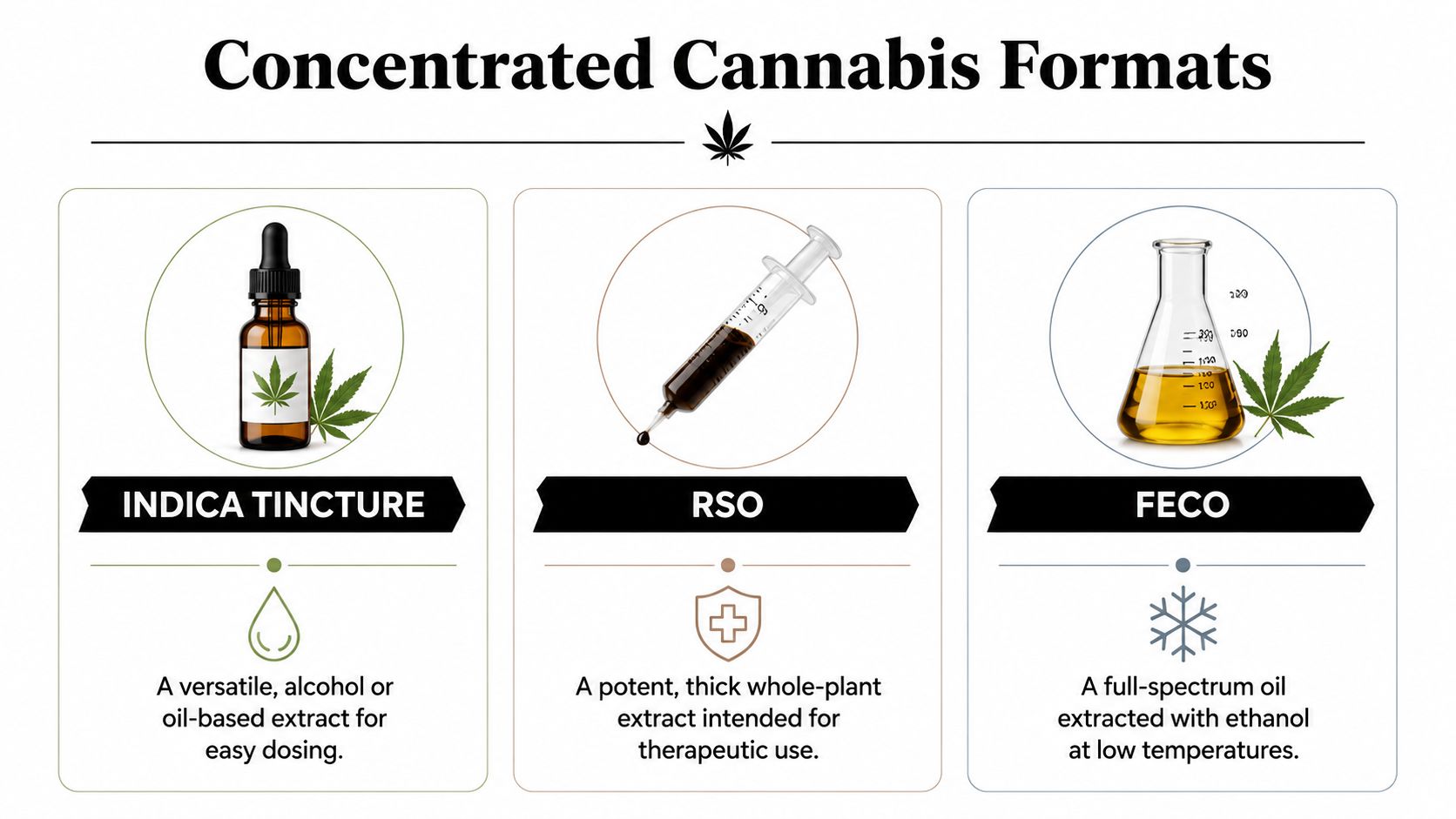
Patients often compare these formats as if they're interchangeable. They aren't. An indica tincture is usually built around precise liquid dosing and convenience. RSO and FECO are concentrated whole-plant oils that are generally discussed when a patient wants a denser, more potent format within a structured protocol.
The clearest difference is concentration and absorption
A tincture spreads cannabinoids through a liquid carrier so you can dose in drops or partial droppers. RSO and FECO are thicker, stronger, and usually better suited to very small measured amounts. For some patients, especially those trying to keep dosing highly structured at lower levels, a tincture is the easier place to begin. For others, a concentrated oil becomes more practical because the target dose would require too much liquid tincture.
Bioavailability is part of that decision. According to this comparison discussion involving tinctures and therapeutic use, industry data suggests RSO can achieve 50 to 70% bioavailability, while sublingual tinctures typically achieve 30 to 40%. That doesn't make tinctures inferior in every situation. It means the format can affect how much of the dose may become available to the body.
Side-by-side decision points
| Format | Main strength | Main limitation | Best fit |
|---|---|---|---|
| Indica tincture | Flexible measured dosing | Lower concentration per volume | Early titration, lighter routines, sublingual use |
| RSO | Dense full-extract format | Harder for beginners to titrate casually | Structured high-potency protocols |
| FECO | Full-spectrum concentrated oil | May require more care in handling and dose planning | Patients prioritizing concentrated whole-plant extracts |
If you want a broader patient education comparison, this guide on RSO vs tincture is a useful companion.
The right question isn't "Which one is stronger?" The better question is "Which format matches the dose range, absorption route, and level of precision I actually need?"
When a tincture may be enough and when it may not
An indica tincture often makes sense when a patient needs careful symptom tracking, low-dose flexibility, or a route that feels less intimidating than a concentrated oil. It may also be easier for caregivers who are just beginning to build a routine.
RSO or FECO may become more relevant when the patient needs a more concentrated format and wants to reduce the volume required per dose. In integrative discussions, that difference matters because practical adherence matters. If a dose format is cumbersome, people often stop using it consistently.
This is one reason patients sometimes start with a tincture and later reassess whether a concentrated full extract better suits their goals.
Safety Legality and Choosing a Quality Product
A patient buys an indica tincture for evening symptom relief, takes a full dropper because the bottle looks mild, and then spends the next two hours feeling heavier, dizzier, and less steady than expected. That outcome is common enough to plan for. A tincture is still an active cannabis preparation, and safe use starts with the same habits you would use for any medicine. Read the label closely, verify what is in the bottle, and begin with a dose that leaves room to adjust.
Safety also includes choosing the right format for the job. Indica tinctures are often easier to measure in small increments than FECO or RSO, which can make them a better fit for careful titration. Concentrated oils may deliver a similar cannabinoid profile in a much smaller volume, but that convenience can make dose errors easier for beginners. For a patient building a structured protocol, product strength and product form both matter.
What to watch for during use
The first warning signs are usually practical rather than dramatic. A dose may feel too sedating. Your thinking may slow down. Some patients notice dry mouth, lightheadedness, or a delayed onset that leads them to redose too soon.
If that happens, lower the next dose and give the product more time to declare itself. Keep the route of use consistent. Sublingual use, swallowed use, and concentrated oils do not behave exactly the same way, so changing methods while also changing dose can make your response harder to interpret.
A few safeguards help keep the trial orderly:
- Medication review: ask a licensed clinician or pharmacist about interactions, especially with sedatives, pain medicines, or drugs with narrow dosing ranges.
- Driving and machinery: avoid both until you know how this tincture affects coordination, reaction time, and attention.
- Children and pets: store the bottle in a locked or clearly inaccessible place.
- Routine: use the same product, measured the same way, at the same time of day when you are assessing tolerance.
How to judge quality before buying
Start with the Certificate of Analysis, or COA. It works like the product's report card. The label tells you what the manufacturer intends to sell. The COA helps you confirm what was measured in that batch.
A useful COA should show cannabinoid potency and include contamination screening. The bottle and the lab report should agree closely on THC, CBD, and other listed cannabinoids. If the product is marketed as full-spectrum, broad-spectrum, or isolate, that should be clear in both the labeling and the test documentation. Storage instructions matter too, because heat, light, and poor sealing can gradually change potency and flavor.
Use this quick screen before you buy:
- Potency is clearly listed: cannabinoids are stated per bottle and per serving, not hidden behind vague terms.
- Lab testing is batch-specific: the report matches the product lot, not a generic sample from long ago.
- Purity testing is included: look for screening for contaminants such as residual solvents, pesticides, heavy metals, or microbial issues.
- Ingredients are transparent: carrier oils, flavorings, and alcohol content should be easy to identify.
A polished package can still hide a poorly documented extract.
Historical legitimacy and modern caution
As noted earlier, cannabis tinctures have a long history in pharmacy. That history gives context, but it does not guarantee that a modern product is legal where you live, accurately labeled, or appropriate for your treatment plan. Current rules differ by state, product category, and intended use.
Patients sometimes assume a tincture is automatically gentler than FECO or RSO because it looks more familiar and is dispensed with a dropper. The bottle shape can be misleading. What matters is the cannabinoid concentration per milliliter, how you take it, and how carefully the dose is measured. In practice, a well-made indica tincture can be safer for structured titration, while a concentrated oil may suit patients who already know their target range and need less volume per dose.
Treat the preparation with respect. Document your response, verify legality before purchase, and bring your clinician into the decision if you have complex symptoms, a history of sensitivity to THC, or an existing medication plan.
Frequently Asked Questions
How long does a cannabis indica tincture last on the shelf?
Shelf life depends on formulation, storage, and manufacturer guidance. Keep it tightly closed, away from heat and light, and follow the label if it provides storage instructions.
Is an alcohol tincture different from an oil-based tincture?
Yes. They can feel different in use and may absorb differently. Alcohol-based tinctures are the traditional format, while oil-based products may appeal to people who dislike the taste or mouthfeel of alcohol.
Can I make my own indica tincture at home?
Some people do, but home preparation creates problems with consistency, potency, and safety. If you need reliable dosing, a lab-tested product is usually the safer option.
Can indica tinctures interact with medications?
They can. The safest step is to review potential interactions with a licensed medical professional or pharmacist, especially if you take sedatives, pain medication, or complex long-term prescriptions.
Is an indica tincture better than RSO?
Not universally. A tincture may be better for measured, flexible dosing, while RSO may be better when a patient needs a more concentrated full extract. The better choice depends on dose goals, tolerance, and how structured the protocol needs to be.
Will an indica tincture definitely help me sleep?
Not necessarily. Many patients choose indica products for evening use, but effects vary with dose, product chemistry, tolerance, and individual response.
If you're comparing tinctures with more concentrated full-extract options and want practical, evidence-aware guidance, RickSimpsonOil.info offers educational resources on RSO dosing, product selection, bioavailability, and safe-use planning. Families seeking a structured starting point can also review the site's guides and consultation options for a more informed discussion with their care team.