You're probably here because the phrase best edible for anxiety sounds simple, but the shelf doesn't. One gummy says “relax.” Another says “high potency.” A third looks gentle but lists several cannabinoids you don't recognize. If you're already prone to anxiety, that confusion matters. The wrong product isn't just disappointing. It can leave you feeling overstimulated for hours.
A safer way to think about this is to stop asking which brand is best and start asking what edible properties are best for an anxiety-sensitive person. In practice, the most important variables are the THC dose, the CBD:THC ratio, the extract type, and whether the product is clearly labeled so you can repeat or adjust your experience carefully.
This article is for educational purposes only. Individual results may vary. Further research is needed. Consult a licensed medical professional.
Defining the "Best" Edible for Anxiety
The best edible for anxiety usually isn't the strongest one. It's the one that gives you the most predictable effect with the least chance of pushing you into discomfort.
For many cautious beginners, that means looking first at low-dose, CBD-forward, or balanced products rather than high-THC gummies marketed for intensity. That may sound less exciting, but it matches how anxiety-sensitive users tend to respond. A product that feels mild on paper can be the better clinical choice because anxiety often worsens when the psychoactive effect overshoots the person's comfort zone.
What actually makes an edible a good fit
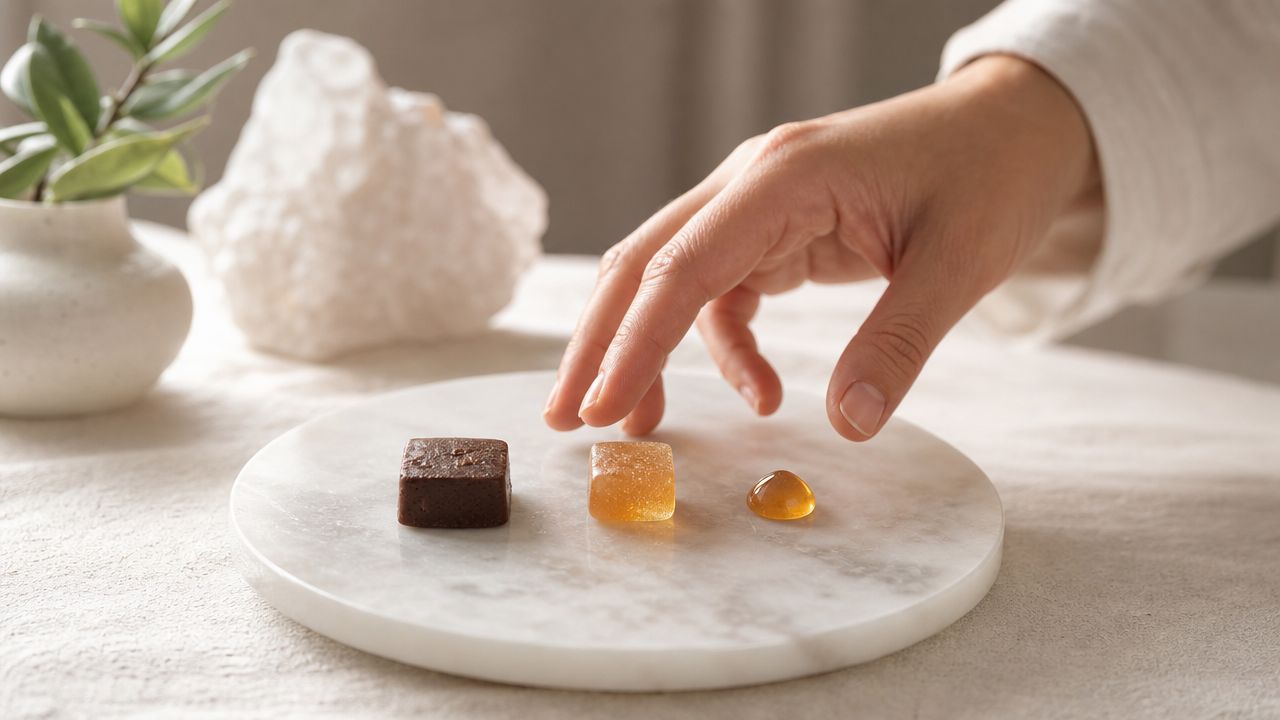
Three features matter more than the flavor or branding:
- Measured cannabinoid content so you know how much THC and CBD you're taking
- A conservative profile such as CBD-dominant or balanced THC:CBD
- A format you can titrate slowly, like a scored gummy, capsule, or carefully portioned oral extract
If a label is vague, or if the serving size seems built around a strong recreational effect, that's usually not the best starting point for anxiety.
Why people get this wrong
Many people assume “more cannabis equals more calm.” Anxiety doesn't work that way. The same compound that feels relaxing at a low amount can feel uncomfortable at a higher amount. That's why the most useful question isn't “What edible is popular?” It's “What profile lets me stay in control?”
Clinical mindset: The best product is the one that helps you find the lowest effective dose, not the one that delivers the biggest effect.
One more point is worth keeping in view. The FDA still hasn't approved medical cannabis for any health conditions, so anxiety use remains an off-label, patient-directed decision rather than an FDA-endorsed treatment, as described in GoodRx's overview of medical cannabis use. That doesn't mean people don't use it. It means you should approach it with the same caution you'd bring to any self-directed symptom strategy.
Analyzing Cannabinoid and Terpene Profiles
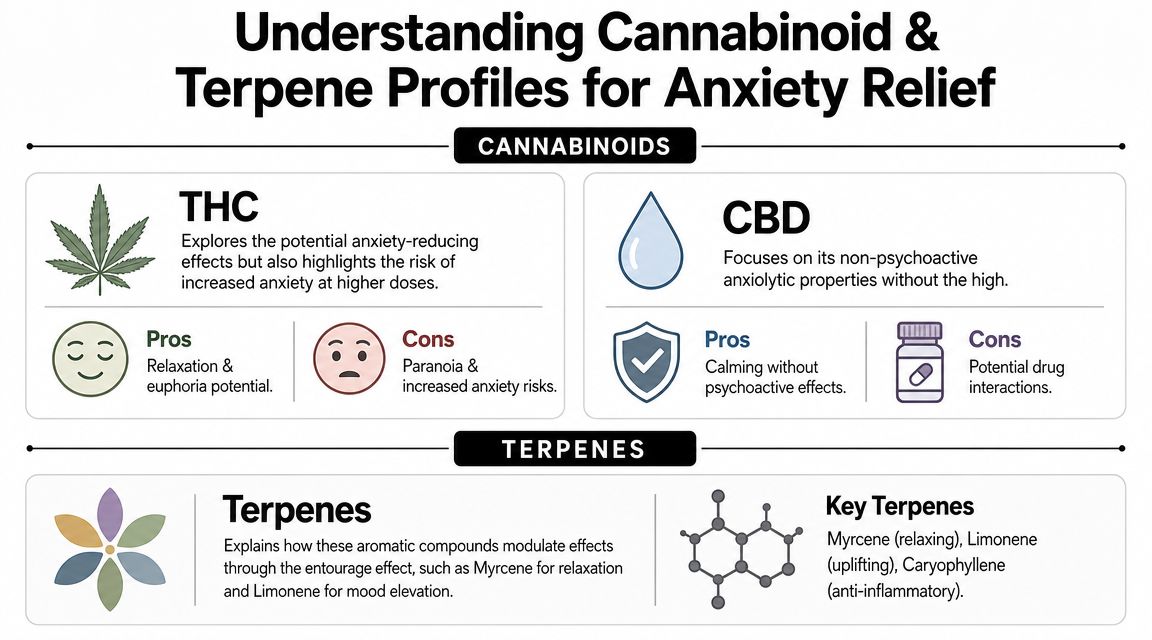
If you want to understand the best edible for anxiety, start with the two widely recognized cannabinoids: THC and CBD. They don't affect anxiety in the same way.
THC is the main intoxicating cannabinoid. In some people, a low amount may feel relaxing. In others, or at a higher amount, it can bring a racing heart, mental overfocus, and paranoia. CBD is different. It's non-intoxicating and is commonly associated with calming effects. That difference is why anxiety-focused guidance usually begins with CBD-dominant products or a balanced 1:1 THC:CBD option.
Why THC can help and hurt
The key concept is the biphasic effect. THC doesn't have a simple straight-line response. A lower amount may feel calming, while a higher amount may increase anxiety in a sensitive user.
A practical summary from Sunrise Dispensary's anxiety guide is especially useful here: for anxiety-sensitive users, the most technically defensible edible profile is typically a low-dose, CBD-dominant or balanced 1:1 THC:CBD product, and multiple expert sources converge on a starting range of about 3 to 5 mg THC total per dose. The same guidance explains why. CBD is non-intoxicating, while THC at higher doses can trigger paranoia, tachycardia, and increased anxiety in sensitive users.
That's the reason high-THC edibles often disappoint anxious beginners. They may be potent, but potency isn't the same thing as suitability.
The role of terpenes and the whole formula
Cannabinoid ratios matter first, but some people also pay attention to terpenes, the aromatic compounds that may shape the experience of a product. In anxiety-oriented discussions, linalool, myrcene, and caryophyllene often come up because they're commonly associated with a softer, more calming profile.
Terpenes shouldn't override the basics. A gummy with a terpene blend can still feel too strong if the THC dose is high. Think of terpenes as modifiers, not rescue agents.
For readers comparing other minor cannabinoids alongside THC and CBD, this overview of CBG for anxiety can help frame how people evaluate broader cannabinoid formulas.
| Compound type | What to look for in an anxiety-focused edible |
|---|---|
| THC | Lower total dose, especially if you're sensitive or new |
| CBD | Higher proportion if you want less intoxication |
| Ratio | CBD-dominant or balanced 1:1 often makes more sense than THC-heavy |
| Terpenes | Supportive detail, but not a substitute for careful dosing |
A calm experience usually comes from the right ratio and dose, not from chasing the strongest label.
Mastering Dosing Onset and Duration
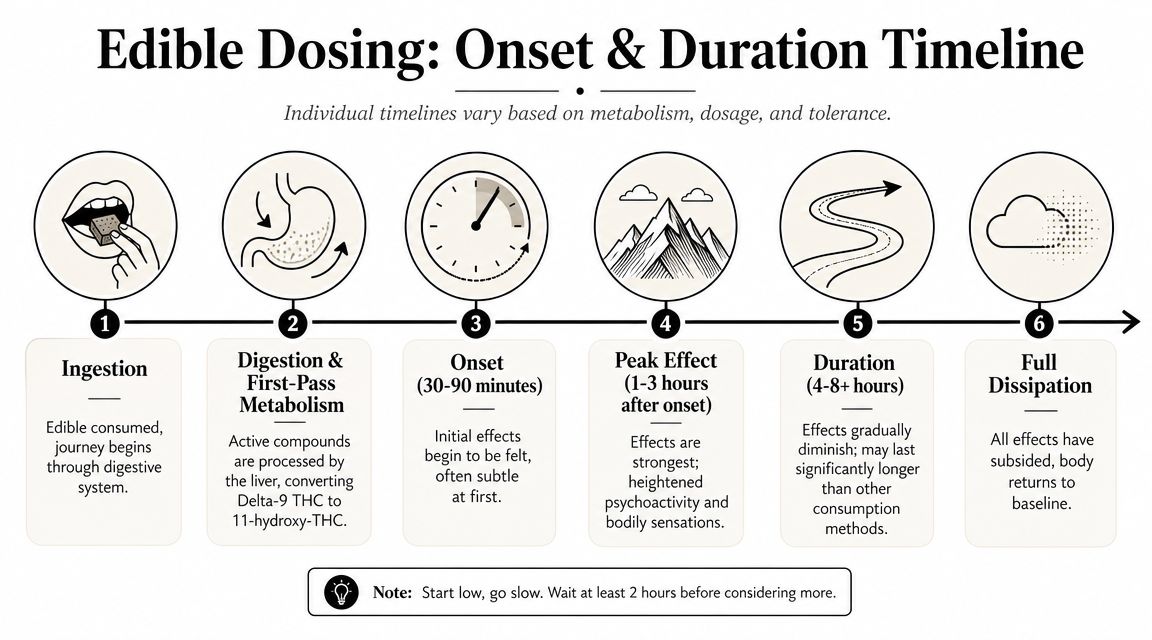
Most bad edible experiences happen because the person took too much, then took more before the first dose had fully declared itself. Edibles require patience because your body processes them through digestion and the liver before the effects become clear.
That liver step matters. Oral cannabinoids go through first-pass metabolism, which changes the timing and often makes the experience feel longer and harder to reverse once it's underway. For someone using cannabis for anxiety, that can be helpful when the dose is right and very frustrating when it isn't.
What the timeline means in real life
According to Stoops NYC's discussion of edibles for anxiety, edibles have a slower onset than inhaled cannabis because of first-pass hepatic metabolism, but the effects often persist for 6 to 8 hours and can last 12 hours or more depending on dose and metabolism.
That long window is why some people like edibles for sustained symptom control. It's also why overdoing the dose can create a long afternoon or a difficult evening.
Here's the practical implication:
- Take one measured dose
- Wait long enough to assess it fully
- Don't stack doses because you feel “nothing yet”
If you tend to get anxious from body sensations, delayed onset can be deceptive. The product may be working, but subtly. Then the effect builds later than expected.
For a deeper explanation of timing, this guide on how long gummies take to kick in is useful reading before you experiment.
A short visual walkthrough can also help clarify the timeline:
What “start low, go slow” should mean
That phrase gets repeated so often that it can lose meaning. In practice, it means choosing a dose that leaves room for error.
For THC-containing edibles, many cautious users do best by treating the first trial as a sensitivity test, not a treatment session. The goal is to learn how your body responds. If the product also contains substantial CBD, that may soften the experience, but it doesn't cancel the need for patience.
Practical rule: If you're deciding whether to redose, you probably haven't waited long enough.
Full-Spectrum Extracts Versus Isolates Explained
Two products can show the same THC and CBD numbers on the label and still feel different. One reason is the type of extract used to make the edible.
A full-spectrum extract contains a wider range of plant compounds, including multiple cannabinoids and terpenes. An isolate is much narrower. It usually centers on one cannabinoid that has been separated from the rest. Neither category is automatically better in every situation, but they create different expectations.
Why this distinction matters
A simple way to think about it is that isolates are more stripped down, while full-spectrum extracts try to preserve more of the plant's original chemical complexity. Many patients and formulators prefer full-spectrum options because of the entourage effect idea, meaning cannabinoids and terpenes may work together in a more modulated way than isolated compounds alone.
That theory doesn't mean every full-spectrum product feels gentler. The dose still decides much of the experience. But when people say one edible feels “rounder” or “less sharp” than another, they're often describing the difference between a broader extract and a more purified one.
What to check on the label
If you're comparing products for anxiety, the label questions are straightforward:
- Does it say full-spectrum, broad-spectrum, or isolate?
- Does it list only THC, or does it show CBD and other cannabinoids too?
- Is there any terpene information, or is the formula opaque?
For readers trying to understand the broader extract categories before choosing an oral product, this comparison of full-spectrum vs broad-spectrum lays out the difference clearly.
Some people want the narrowest possible formula for predictability. Others prefer a broader extract because it may feel more balanced. Both approaches depend on careful dosing.
There's also a practical issue. Mass-market gummies are often built from distillate because it's easy to formulate consistently. That can be useful for precision, but it doesn't give you the same chemical profile as a dense, full-extract oil. If your priority is a richer plant profile rather than just a single cannabinoid target, that distinction becomes important.
Comparing RSO with Traditional Edibles
When people compare Rick Simpson Oil (RSO) with a standard edible, they're really comparing two oral cannabis formats that can behave differently in both composition and use. One isn't automatically “the best edible for anxiety” for every person. The better fit depends on how much control you need, how broad an extract you want, and how comfortable you are measuring your dose.
Traditional commercial edibles are often easy to understand at first glance. A gummy or capsule usually tells you the cannabinoid content per serving. That simplicity helps beginners. RSO is different. It's a concentrated full-extract cannabis oil, and because it's more concentrated, it demands more care in portioning.
Where each format stands out
Commercial edibles often win on convenience. You can cut a gummy, use one capsule, and repeat the same serving with little effort. That can reduce confusion for a new user who wants consistency.
RSO often stands out for extract breadth. People who value a fuller plant profile may prefer it over a more stripped-down edible made from distillate. But that benefit comes with a tradeoff. Because RSO is concentrated, dosing precision depends heavily on the user's ability to measure and titrate conservatively.
UCHealth reports that edibles were 268 times more likely than inhaled marijuana to cause users in Colorado to seek medical help, which is one reason dosing precision matters so much in oral products, as noted in UCHealth's edible safety review. The same source says the state-recommended edible dose is 10 mg, but even that can be too high for some people, and first-time users are advised to start at 2.5 to 5 mg.
Oral Cannabis Formats A Comparison
| Feature | Typical Commercial Edibles | Rick Simpson Oil (RSO) |
|---|---|---|
| Extract style | Often narrower and more standardized | Usually fuller-spectrum and more concentrated |
| Dosing experience | Pre-portioned and simpler for beginners | Flexible but requires careful measuring |
| Anxiety suitability | Good if low-dose and CBD-forward | Can fit experienced, methodical users who want a full extract |
| Label clarity | Often easier to read per serving | Requires more interpretation and discipline |
| Main caution | Redosing too soon | Taking too much because the concentrate is potent |
A careful way to frame RSO for anxiety
RSO isn't a beginner candy. It's a concentrated oral cannabis option. For some users, that concentration and full-spectrum character are exactly why it's appealing. For others, especially those who are very THC-sensitive, a simpler low-dose gummy or capsule may be easier to manage at first.
That's why a cautious patient approach matters more than loyalty to any format. If your nervous system reacts strongly to THC, the winning choice is often the product that lets you stay precise, repeatable, and calm.
Developing Your Personal Titration Protocol
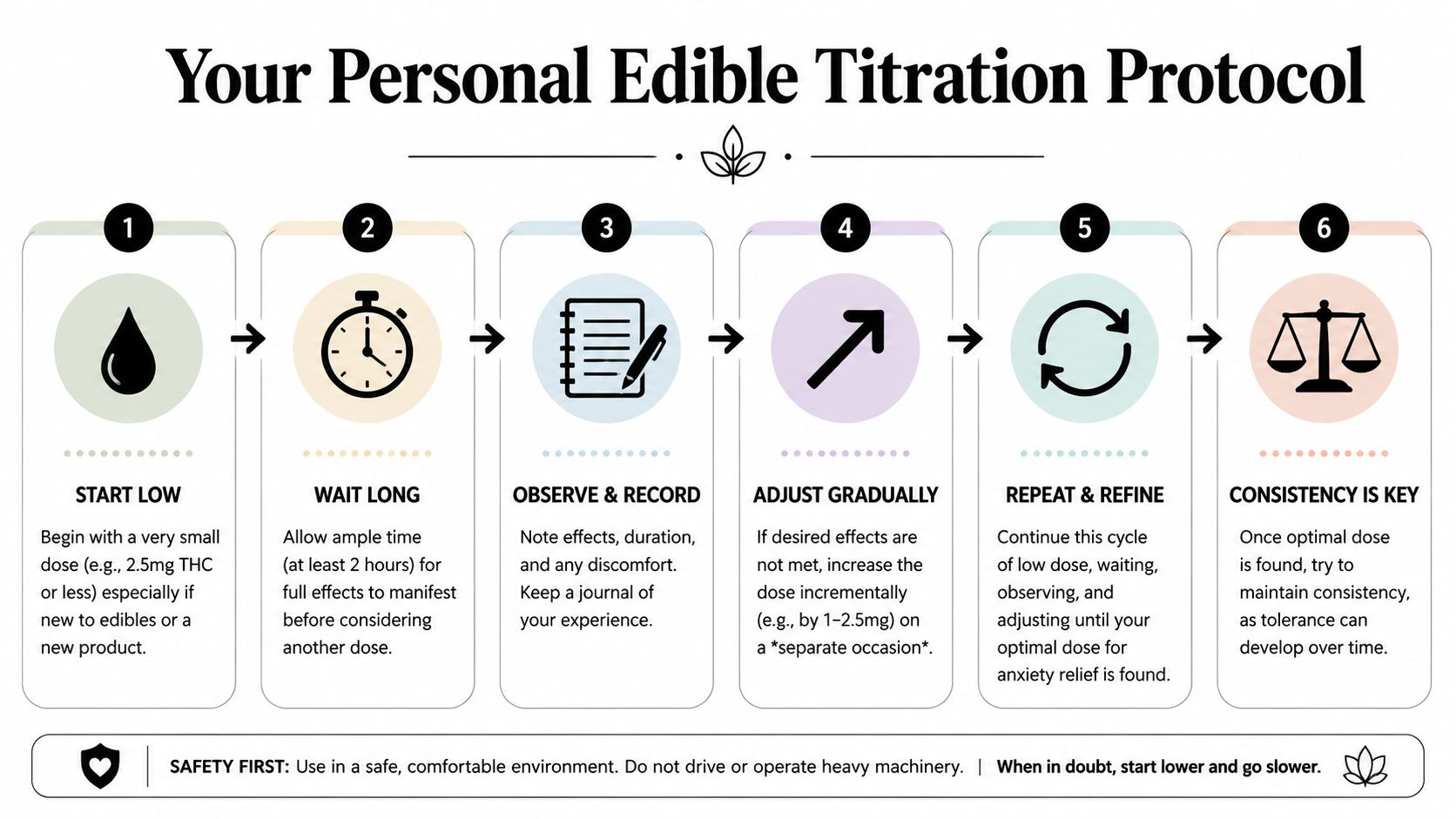
A safe anxiety protocol isn't about bravery. It's about method. You're trying to find the lowest effective dose that improves comfort without pulling you into intoxication or mental overstimulation.
That means changing only one variable at a time. Don't test a new product, in a new setting, on an empty stomach, after a stressful day, and then try to interpret the result. Keep the conditions as steady as you can.
A simple beginner framework
Use this as a template, not a prescription:
Choose a conservative product
Start with a CBD-dominant edible or a balanced formula with a very low THC exposure.Test on a quiet day
Don't begin before a demanding work shift, social event, or long drive. Anxiety is easier to assess in a stable setting.Take one small measured dose
Treat the first session as observation. Your job is to learn the product.Record what happens
Note timing, body sensations, mental state, appetite, sleep, and whether the experience felt steady or uncomfortable.
What to write in your journal
A brief note is enough if it captures the essentials. Include:
- Product details such as ratio, format, and extract type
- Dose taken in the smallest measurable terms available
- Timing of ingestion, first effects, strongest effects, and when you felt baseline again
- Effect quality including calm, sedation, racing thoughts, dry mouth, or discomfort
- Context such as whether you had food beforehand and what your stress level was
This kind of recordkeeping sounds simple, but it's one of the fastest ways to distinguish “wrong dose” from “wrong product.”
When to adjust
If the first attempt feels too strong, don't try to “push through” the same amount again hoping it will feel better next time. Lower the dose or move toward a higher-CBD ratio. If it feels too subtle, increase only on a separate occasion and keep the increase small.
The right dose for anxiety is often lower than the dose a person would choose for recreation.
For more complex situations, such as combining oral cannabis with other medications or choosing between gummies and concentrated extracts, many patients benefit from structured educational guidance before experimenting further.
Frequently Asked Questions About Edibles and Anxiety
Can edibles make anxiety worse
Yes, they can. That's most likely when the THC dose is too high for your sensitivity level, when the person redoses too soon, or when the product is heavily THC-dominant. This is one reason low-dose and CBD-forward options are often preferred.
What should I do if I take too much
Stay in a safe, quiet place. Don't take more. Try slow breathing, hydration, and reducing stimulation. Remind yourself that the effect is temporary, even if it feels intense. If symptoms feel severe or concerning, seek medical care.
Is CBD-only usually safer than THC for anxiety
For many cautious beginners, yes. CBD is non-intoxicating and commonly associated with calming effects. That said, “safer” doesn't mean universally right for every person, and product quality still matters.
Are balanced 1:1 products a reasonable middle ground
Often, yes. A balanced THC:CBD formula may offer a more moderate experience than a THC-heavy edible. Many anxiety-sensitive users find this profile easier to tolerate than products built around strong THC exposure.
Should I talk to my doctor before trying an edible
Yes, especially if you take prescription medications, have a history of panic symptoms, or are managing other health conditions. A licensed medical professional can help you think through risks, timing, and interactions.
How do I know whether a product is suitable for careful titration
Look for a clear label, measurable servings, and a cannabinoid profile that supports a cautious start. If you can't tell how much THC and CBD you're taking, it's harder to use the product safely.
If you want a more structured education on oral cannabis formats, dosing logic, and how concentrated extracts compare with standard edibles, RickSimpsonOil.info offers practical guides designed for patients, caregivers, and cautious first-time users. The site focuses on clarity, measured use, and responsible decision-making rather than hype.