Patients often ask a simple question that turns out not to have a simple answer. If RSO/FECO is the concentrated option they already know, where does an alcohol cannabis tincture fit, and why would someone choose a liquid extract instead of a thick oil?
That confusion is reasonable. Cannabis preparations can look similar on a label while behaving very differently in the body. A tincture, an edible, an oil infusion, and a syringe of FECO may all contain cannabinoids, but they differ in concentration, absorption route, speed of onset, and dosing flexibility.
This article is for educational purposes only. It isn't a substitute for medical advice, and individual results may vary. If you're using cannabis therapeutically, especially alongside oncology care or other prescription treatment, consult a licensed medical professional.
Navigating the World of Cannabis Extracts
Many people approach cannabis extracts with the wrong starting assumption. They look for the “strongest” product first, when the more useful question is often, what delivery method matches the goal.
For some patients, the priority is a highly concentrated full extract that can be measured in very small amounts. That points them toward FECO or RSO. For others, the need is different. They want a preparation that can be adjusted drop by drop, taken under the tongue, and felt relatively quickly. That's where the alcohol cannabis tincture becomes relevant.
An alcohol tincture isn't new or experimental. It's one of the oldest cannabis preparations in formal medicine, and it still matters because it occupies a distinct pharmacokinetic niche. It isn't merely a weaker version of FECO, and FECO isn't merely a more powerful tincture. They are different tools.
Clinical lens: A preparation can be appropriate because of its delivery profile, not just its concentration.
That distinction matters in real-world care discussions. A person using a structured FECO protocol may still benefit from a rapidly absorbed tincture for short-term symptom management. Another person may tolerate a tincture better because it allows slower titration and clearer feedback from each dose.
A careful comparison also helps prevent a common mistake. People sometimes assume all “drops” act the same. They don't. A cannabinoid in alcohol held under the tongue behaves differently from a cannabinoid in a swallowed oil capsule. First-pass metabolism, sublingual absorption, and concentration all shape the experience.
Understanding the Alcohol Cannabis Tincture
What exactly is an alcohol cannabis tincture, and why would someone choose it instead of a thicker extract such as FECO or RSO?
An alcohol cannabis tincture is a liquid preparation made by soaking cannabis in food-grade ethanol, then straining the plant material away. Some people still use the old nickname green dragon, which fits the usual appearance. The liquid is often green to brown because ethanol pulls more than cannabinoids. It can also draw out chlorophyll, aromatic compounds, and other plant constituents that affect taste, color, and mouthfeel.
What it is and what it is not
A tincture uses ethanol as both the extraction solvent and the liquid vehicle. That is different from an infused oil, where cannabinoids are carried in fats such as MCT or olive oil. It is also different from FECO or RSO, which are usually concentrated further until they become thick and resin-like.
That distinction matters because the physical form influences how the preparation behaves in practice. A tincture is usually measured in drops or milliliters. FECO and RSO are usually measured in very small rice grain sized amounts or by syringe markings. The goal is not the same.
Alcohol tinctures also have a long medical history. Earlier pharmacy practice treated cannabis tinctures as a recognized dosage form, which helps explain why the preparation still appears in modern therapeutic discussions. That history does not prove it is better than FECO or RSO. It shows that tincture is a separate category with its own logic.
Why ethanol changes the result
Ethanol is good at dissolving cannabinoids, which is why it has been used for botanical extraction for so long. The alcohol percentage matters. Higher-proof ethanol generally extracts cannabinoids more efficiently, while lower-proof alcohol brings in more water and changes what ends up in the bottle.
Readers often get tripped up by the word "alcohol." In this context, the term means food-grade ethanol. It does not mean rubbing alcohol, denatured alcohol, or industrial solvent. For a patient, that difference is as important as the cannabis itself, because the solvent becomes part of the final preparation unless it is evaporated off further.
A useful comparison is tea versus syrup. Tea spreads active compounds through a drinkable liquid. Syrup condenses them into a smaller volume. An alcohol tincture sits closer to the tea side of that analogy. FECO or RSO sits closer to the syrup side.
Why the experience differs from FECO or RSO
The thinner liquid form gives tinctures a different pharmacokinetic profile. If held under the tongue for a short period, part of the dose may absorb through oral tissues before the rest is swallowed. That can produce a faster felt onset for some users than a swallowed oil-based extract alone. It also allows small, repeatable adjustments.
The tradeoff is concentration. Even a strong tincture spreads cannabinoids through a liquid volume, so it is usually less compact than FECO or RSO. For a therapeutic user trying to deliver a large amount in a very small physical dose, the thicker extract often fits better. For someone who wants finer titration, a tincture may be easier to work with.
The alcohol itself can also be a drawback. Some patients dislike the burning sensation under the tongue, the sharp herbal taste, or the idea of using ethanol at all. Others have medical, personal, or religious reasons to avoid alcohol-based products.
For readers comparing these formats more closely, this RSO vs tincture comparison guide helps clarify how concentration, onset, and dosing flexibility differ.
| Preparation | Usual form | Common use pattern |
|---|---|---|
| Alcohol cannabis tincture | Liquid in a dropper bottle | Small adjustable doses, often used sublingually or swallowed |
| FECO or RSO | Thick, viscous extract | Highly concentrated dosing in very small amounts |
That is the main clinical distinction to keep in view. A tincture is not merely "lighter RSO." It is a different delivery tool, with advantages in speed and adjustability, and limitations in concentration and solvent tolerance.
Alcohol Tincture vs RSO A Detailed Comparison
Which preparation makes more sense for your goal: a fast, adjustable liquid, or a dense extract built to deliver more cannabinoids in less volume?
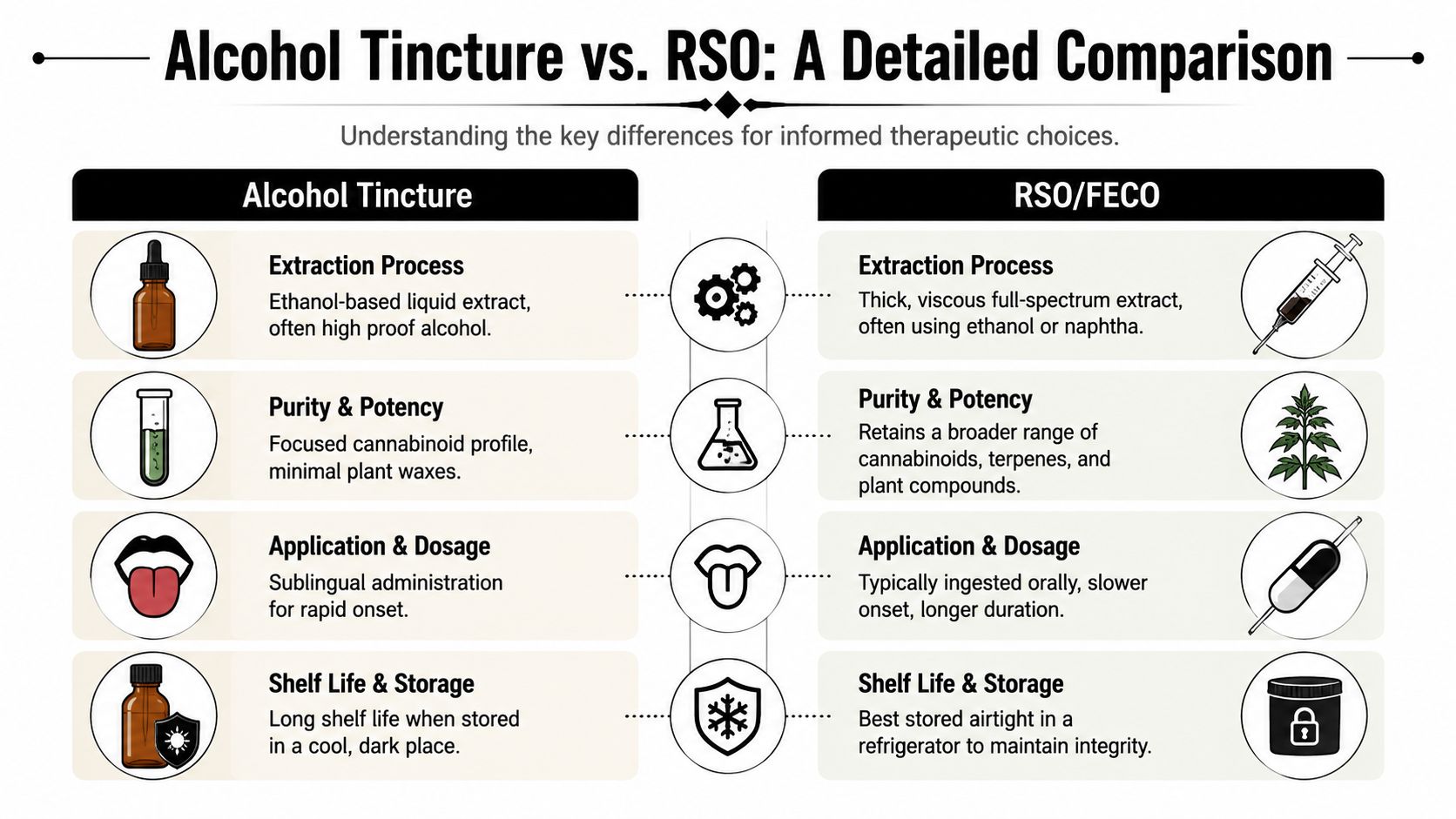
A useful comparison starts with pharmacokinetics, not brand loyalty or shorthand claims about one being "stronger." Alcohol tinctures and FECO or RSO can come from the same plant, yet they behave like different dosage forms. One is a liquid designed for measured drops and possible sublingual absorption. The other is a thick full extract usually taken orally in very small amounts.
Potency and concentration
Concentration is the clearest dividing line.
FECO or RSO is physically compact. That matters for therapeutic users following protocols that call for substantial cannabinoid intake without swallowing much volume. A small rice grain sized amount can contain far more cannabinoids than the same visible amount of tincture, because the tincture distributes those compounds through liquid.
An alcohol tincture can still be clinically useful, but its strength is usually discussed in milligrams per milliliter rather than in a paste-like mass. That difference sounds technical until you picture the dosing tools. A syringe of dense extract is built for concentrated delivery. A dropper bottle is built for incremental adjustment.
For a closer side by side explanation of these formats, this RSO vs tincture comparison guide is a helpful reference.
Onset and absorption
Onset is where tinctures often earn their place in a protocol.
If the liquid is held under the tongue for a short period, part of the dose may pass through the oral tissues before the rest is swallowed. That can produce a faster felt effect than relying on digestion alone. FECO or RSO is more often used as an oral extract, so a larger share of the experience depends on gastrointestinal absorption and liver metabolism.
A simple analogy helps here. Tincture is closer to using a ramp into circulation. FECO or RSO is closer to taking the main road through the gut and liver. Neither route is universally better. They serve different timing goals.
That timing difference can matter for symptom patterns. A patient managing sudden nausea, breakthrough discomfort, or evening sleep onset may value a preparation that feels easier to time. A patient focused on delivering a concentrated baseline oral dose may accept a slower path in exchange for density.
We also need to be careful not to overstate the science. Direct head to head pharmacokinetic studies comparing alcohol tincture and FECO across real patient use patterns are limited. A cautious clinician should treat the onset advantage as plausible and often observed, not as a guarantee of superior total absorption.
Administration and therapeutic fit
This is why tincture should not be described as diluted RSO. That framing confuses concentration with function.
Tinctures are often easier to titrate in small steps. A caregiver can measure drops or fractions of a milliliter, observe tolerance, and adjust gradually. For sensitive users, older adults, or anyone who has had unwanted effects from overshooting a dose, that control can be practical.
FECO or RSO fits a different therapeutic strategy. Its thickness and density make it useful when the goal is concentrated oral dosing, capsule filling, or protocols that depend on a small physical amount. The tradeoff is that tiny changes in volume can represent meaningful changes in dose, so careful measurement matters even more.
A practical way to separate them is to ask what problem you are solving:
- Alcohol tincture fits patients who want flexible liquid dosing, possible sublingual use, and easier timing adjustments.
- FECO or RSO fits patients who want a dense full extract and need more cannabinoids in less volume.
- Some protocols use both. One product provides the baseline. The other is reserved for short term symptom changes.
Handling and day to day use
The user experience differs before absorption even begins.
A dropper bottle invites slow titration, repeated small measurements, and sublingual administration. A syringe or thick applicator pushes the routine toward concentrated oral dosing. For many patients, adherence improves when the format matches the task. If the preparation is awkward to measure, unpleasant to hold under the tongue, or too easy to overdispense, consistency usually suffers.
Storage also shapes real-world use. Alcohol tinctures are often kept as stable liquids in dark bottles. FECO and RSO require handling a sticky, viscous extract that can be harder to portion neatly. That does not make one superior. It shows why delivery form is part of the treatment decision, not just a packaging detail.
The central point is simple. Alcohol tincture is not a replacement for RSO or FECO. It is a separate tool with a different speed, different concentration profile, and different practical strengths.
Extraction Methods and Safety Considerations
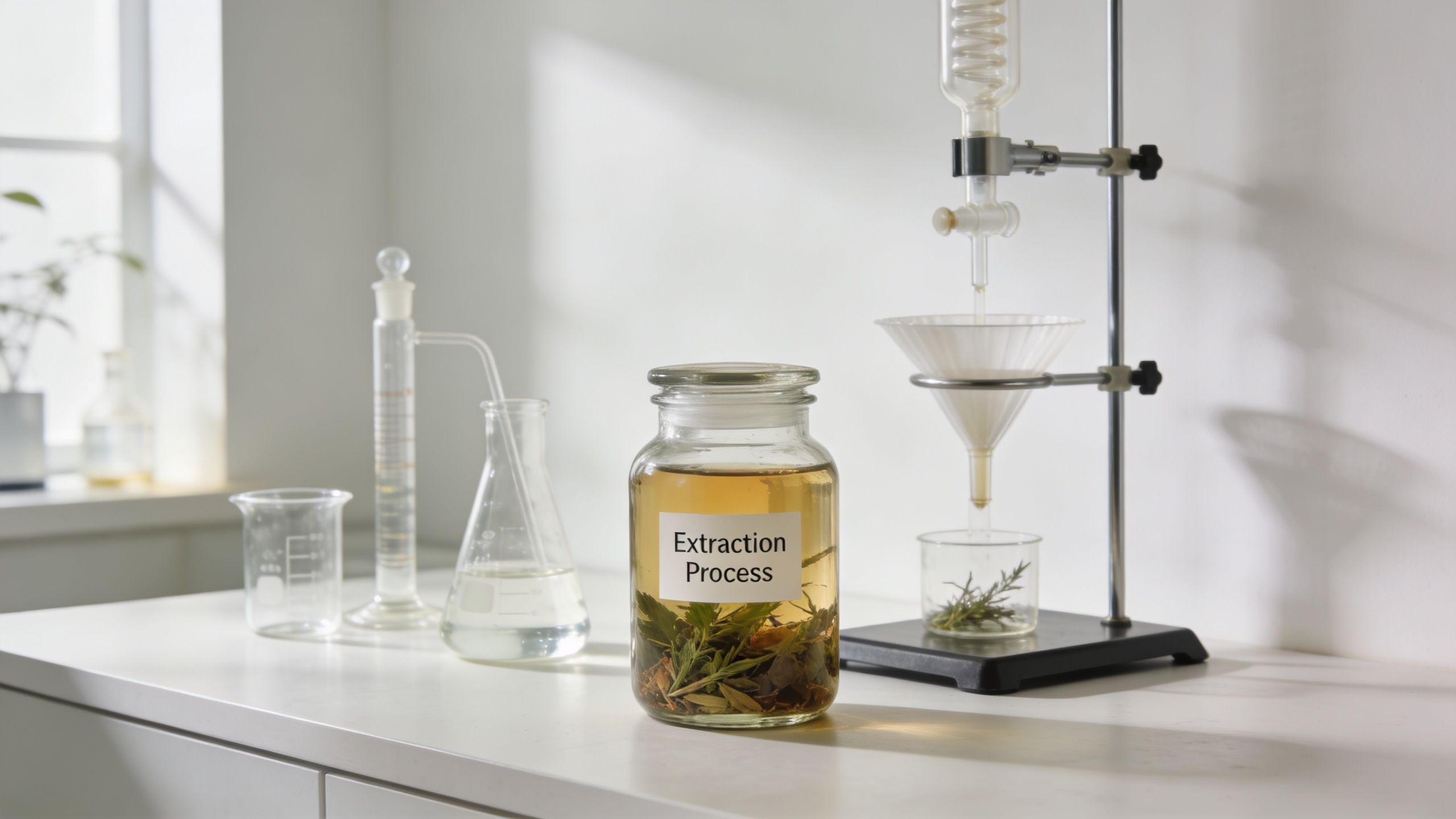
What makes an alcohol cannabis tincture feel fast for some patients and still require more caution during preparation than a thick oil extract? The answer starts with the solvent itself. Ethanol can pull cannabinoids into a liquid that is easy to measure and use sublingually, but that same solvent also changes the safety questions you need to ask.
Why proof and process matter
For any consumable tincture, only food-grade ethanol is appropriate. That is the starting point, not a preference.
Proof also affects what ends up in the bottle. Higher-proof ethanol generally extracts cannabinoids efficiently, and shorter contact with plant material can limit the harsher compounds that make a tincture unusually bitter or dark. Patients sometimes read dark color as a sign of strength. In practice, color often says more about extraction selectivity than therapeutic value.
A useful comparison is coffee brewing. If water runs through the grounds briefly and under controlled conditions, the cup can taste cleaner. If the soak is excessive, more unwanted material comes along for the ride. Alcohol extraction follows a similar logic. The goal is not just to pull more from the plant. The goal is to pull the components you want while reducing material that makes dosing, taste, and consistency harder to manage.
Readers who want context on how this differs from dense full-extract preparations can review this overview of extracting cannabis oil. That comparison helps clarify why tinctures and FECO or RSO raise different formulation and handling issues even when they begin with the same plant.
Residual solvent risk and product testing
A finished tincture should be judged by what remains in it, not just by how it was made. For therapeutic use, that means asking two separate questions. Does the bottle contain the labeled cannabinoids, and is it free of contaminants at an acceptable level?
Third-party certificates of analysis help answer both. They should show cannabinoid content clearly enough for dose planning, and they should address contaminants relevant to cannabis products, including residual solvents when a solvent-based extraction was used.
A cautious buyer should look for:
- Cannabinoid profile: The tested concentration should align closely with the label so small volume changes do not create large dosing surprises.
- Contaminant screening: The report should address pesticides, heavy metals, microbial concerns, or other manufacturing impurities as appropriate to the product.
- Residual solvent transparency: If ethanol or another solvent was part of production, the lab report should show whether the final product was cleaned up properly.
If a seller cannot provide current lab results, the uncertainty falls on the patient.
Home extraction adds a separate layer of risk. Ethanol is highly flammable. Vapors matter. Ventilation matters. Temperature control matters. A process that looks simple online can become dangerous quickly, especially if someone tries to evaporate solvent in an enclosed space or near an ignition source. That safety profile differs from the usual patient conversation around FECO or RSO, where people often focus on concentration first and underestimate solvent handling.
A short visual explanation can help clarify the process concerns and why handling standards matter:
Alcohol content and patient concerns
Some patients hesitate because the word "alcohol" sounds pharmacologically significant. In ordinary tincture dosing, the volume is small enough that intoxication from the ethanol itself is usually not the practical concern. The more relevant question is tolerance for the formulation. A person with oral sensitivity, alcohol avoidance, religious restrictions, liver-related concerns, or a strong preference against ethanol may still decide that another delivery method fits better.
That distinction matters. The alcohol tincture is not trying to imitate FECO or RSO in every respect. It is a different preparation with a different balance of speed, concentration, and handling risk. For some therapeutic plans, that tradeoff is useful. For others, a more concentrated extract with no alcohol in the final dose will make more sense.
Dosing Administration and Therapeutic Strategy
A tincture is easy to misuse if someone treats the dropper casually. Precision starts with the route.
How sublingual use works
When a tincture is taken sublingually, the liquid is placed under the tongue and held there before swallowing. The goal is to allow some of the cannabinoids to absorb through the mucosal tissue rather than sending the full dose directly through digestion first.
That route is one reason tinctures are often described as feeling more immediate than swallowed oils. It also helps explain why patients may report different effects from the same nominal cannabinoid amount depending on whether they hold the tincture under the tongue or mix it into food.
A careful routine usually includes these steps:
- Measure the dose clearly. Use the markings on the dropper if available.
- Place the liquid under the tongue. Avoid swallowing immediately.
- Hold, then swallow. This supports sublingual absorption before the remainder enters the digestive tract.
- Wait and observe. Don't stack doses quickly.
Start low and go slowly
For a cautious patient, the important skill isn't chasing a target dose on day one. It's learning how the body responds. Titration means increasing in small, deliberate steps while watching for both desired effects and unwanted sedation, dizziness, or dysphoria.
Some educational sources discuss using 2.5 mg THC increments for careful titration, particularly for beginners, but the central principle matters more than the number. Go slowly enough that each adjustment teaches you something useful.
A good dosing plan should be boring. Predictable, documented, and easy to repeat.
A dosing journal can help. Record the product, time, amount, route, and effect. Patients using multiple cannabinoid products often think they will remember the details. Most don't.
For readers who want a practical dosing reference, this tincture dosage chart can help organize a cautious starting framework.
Where tinctures fit in a broader therapeutic plan
The most sensible use of an alcohol cannabis tincture is often adjunctive, not competitive. A patient may rely on FECO or RSO as the concentrated backbone of a larger protocol, then use a tincture when a faster-acting, easier-to-adjust option is needed.
Examples include situations where a person wants:
- Shorter-onset support: A sublingual option may be easier to time than a swallowed oil.
- Fine dose control: A liquid can be easier to adjust than a dense paste.
- Daytime flexibility: Some users prefer small, repeatable increments during the day and reserve heavier oral extracts for another time.
This approach also aligns with basic pharmacology. Route of administration changes the experience. First-pass metabolism in the liver, oral mucosal absorption, and product concentration all shape how quickly effects begin and how long they may persist.
Families seeking guidance on complex dosing protocols can schedule a consultation, especially when cannabis is being considered alongside active medical treatment. That kind of support can be useful when several products, routes, and symptom goals are in play.
Legal Purchasing and Trusted Alternatives
The legal status of cannabis extracts varies by location, so the first step is always understanding the rules where you live. That includes rules on possession, medical use, adult use, and what types of products licensed providers are allowed to sell.
Once legality is established, product quality becomes the next filter. A careful buyer should prioritize licensed, reputable sources that provide transparent lab documentation, clear ingredient lists, and consistent packaging. If the origin is vague, the cannabinoid content is uncertain, or testing isn't available, the risk rises quickly.
For some users, an alcohol tincture will be the right fit because its liquid format supports sublingual use and flexible titration. For others, a lab-tested FECO or RSO remains the more practical option because they need a highly concentrated extract for a structured protocol. Neither choice should be made on marketing language alone.
The safer question is simple. Can the product be verified, measured, and used consistently?
That standard matters even more in therapeutic settings, including integrative oncology discussions. Further research is needed, and cannabis shouldn't be presented as a replacement for conventional care. A responsible approach keeps cannabinoid use evidence-aware, adjunctive when appropriate, and grounded in product transparency.
Frequently Asked Questions
| Question | Answer |
|---|---|
| Is an alcohol cannabis tincture the same as RSO? | No. A tincture is a liquid ethanol extract usually used by dropper. RSO or FECO is a thicker, more concentrated full extract. |
| Does a tincture work faster than FECO? | It can feel faster when used sublingually because part of the dose absorbs through the mouth rather than relying entirely on digestion. |
| Is the alcohol in a tincture enough to cause intoxication by itself? | In typical sublingual use, the alcohol amount is very small. The cited Leafly data describes less than 0.1 g ethanol in a 0.5 mL dose. |
| Why does high-proof ethanol matter? | Higher-proof food-grade ethanol extracts cannabinoids more effectively than lower-proof alcohol and can reduce unwanted plant material in the final liquid. |
| Should patients choose tincture instead of FECO for serious protocols? | Not automatically. The better choice depends on the goal, desired concentration, route, and how the product fits into the broader care plan. |
| What should I check before buying any extract? | Look for licensed sourcing, clear labeling, and third-party lab results that support purity and potency. |
If you want a more structured understanding of RSO, FECO, tinctures, dosing, and safe sourcing, RickSimpsonOil.info offers educational guides designed for patients and caregivers who want clear, evidence-aware information without the hype.