If you're reading about CBG for anxiety, you're probably in a familiar place. CBD may have been your first cannabinoid experiment, but the results were mixed, too subtle, or inconsistent. You may also be trying to sort through online claims that blend wellness language, dispensary marketing, and scattered science into something hard to trust.
CBG has started to draw attention because it appears to offer a different profile. It is generally described as non-intoxicating, and recent human research has made it more than a purely anecdotal topic. That doesn't make it a proven treatment for anxiety. It does mean there is now a more serious basis for discussion, especially for patients and caregivers who want an adjunctive option rather than another promise.
For readers who want a broader primer on non-intoxicating cannabinoids before going further, this overview of cannabinoids without THC is a useful starting point.
This article is for educational purposes only. Individual results may vary. Further research is needed. Consult a licensed medical professional.
Introduction Navigating Beyond CBD for Anxiety Support
Many people approach cannabinoid care in stages. They begin with CBD because it is familiar, then start hearing about CBG in discussions about calm focus, stress support, or a clearer daytime option. That curiosity makes sense, but the main question is still the right one: what do we know?
The most important shift is that CBG for anxiety is no longer supported only by personal reports. In 2024, researchers published the first controlled human trial of isolated CBG and found an anxiolytic signal without THC-like intoxication. For an informed patient, that matters more than broad product claims or social media testimonials.
Practical rule: Think of CBG as an emerging compound with early human evidence, not as a replacement for standard anxiety care.
That distinction helps avoid two common mistakes. The first is dismissing CBG because it isn't as widely known as CBD. The second is overestimating it because it comes from the cannabis plant and sounds novel. Both reactions miss the middle ground, which is where most responsible cannabinoid discussions belong.
For some patients, the practical interest is straightforward. They want support for situational anxiety, a better tolerated daytime cannabinoid, or a way to understand where CBG fits relative to CBD, THC, and full-spectrum extracts such as RSO. Those are reasonable questions, and they deserve a careful answer grounded in mechanism, trial data, and safety.
Understanding CBG The Mother of All Cannabinoids
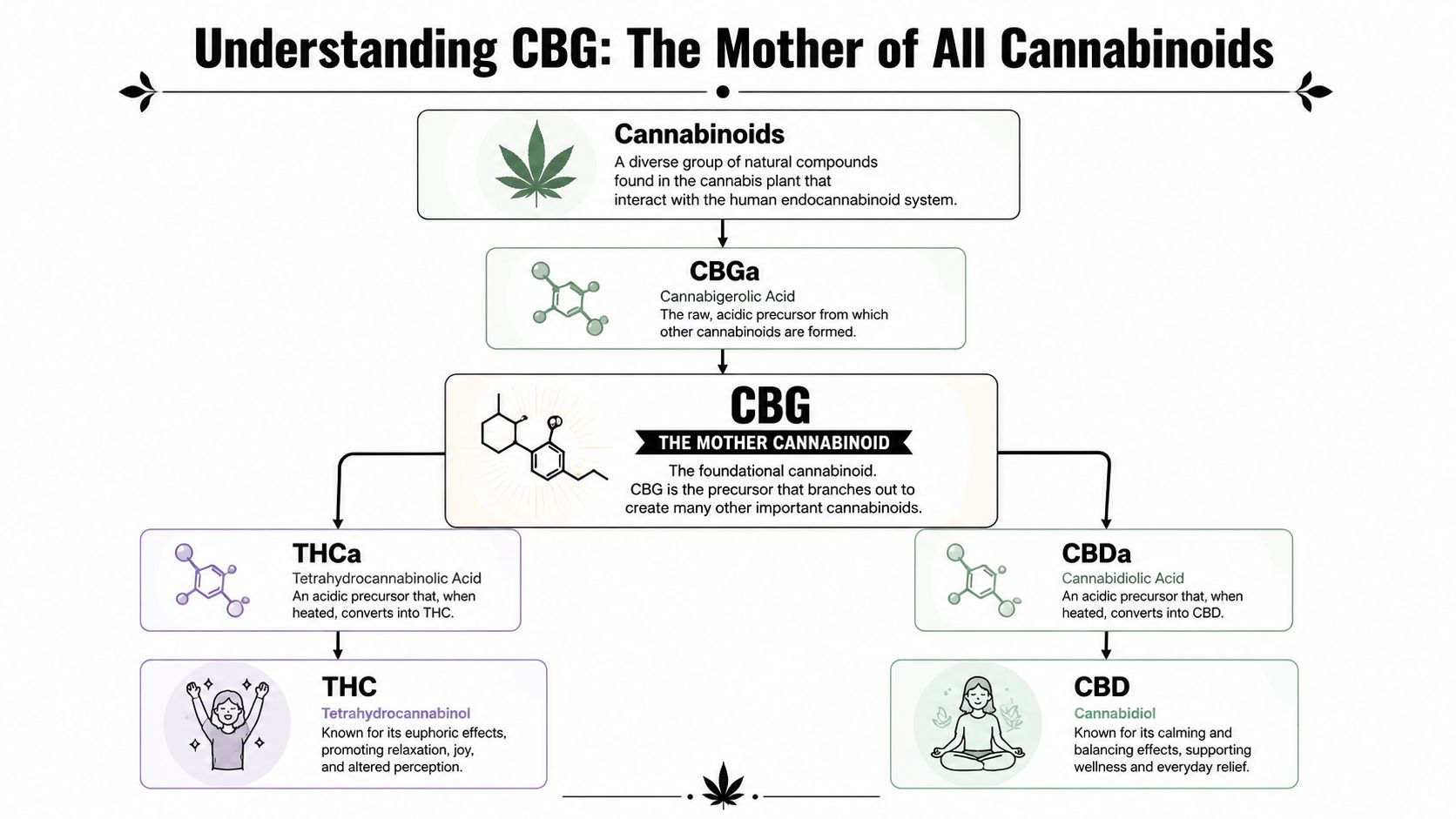
CBG stands for cannabigerol. You'll often hear it called the mother cannabinoid, and that nickname is useful if you don't take it too seriously. In the cannabis plant, its precursor form helps give rise to other well-known cannabinoids, including the acidic precursors that later become THC and CBD.
A simple analogy is a stem cell. It isn't every final cell type, but it sits early in the developmental pathway and helps generate what comes later. That is why CBG is chemically important even when it appears in lower amounts in many mature plants.
Why patients get confused about CBG
The word minor cannabinoid can sound dismissive. It usually refers to quantity in the plant, not to biological importance. A compound can be present in smaller amounts and still matter clinically or pharmacologically.
Another source of confusion is the assumption that all cannabinoids work mainly through the same pathway. They don't. THC is strongly associated with psychoactive effects because of its activity at pathways linked to intoxication. CBG appears more interesting for anxiety because its profile seems to involve other receptor systems.
Here is the key conceptual map:
- CBG comes early in cannabinoid formation. That is why it gets the "mother" label.
- It is usually discussed as non-intoxicating. That separates it from what is commonly meant when individuals worry about getting high.
- It isn't just “CBD in another form.” Its pharmacology appears distinct enough to justify studying it separately.
The short video below gives a visual explanation of where CBG fits in the cannabinoid family.
For patients, the practical takeaway is simple. CBG matters not because it is trendy, but because it occupies a unique position in both plant chemistry and emerging human research.
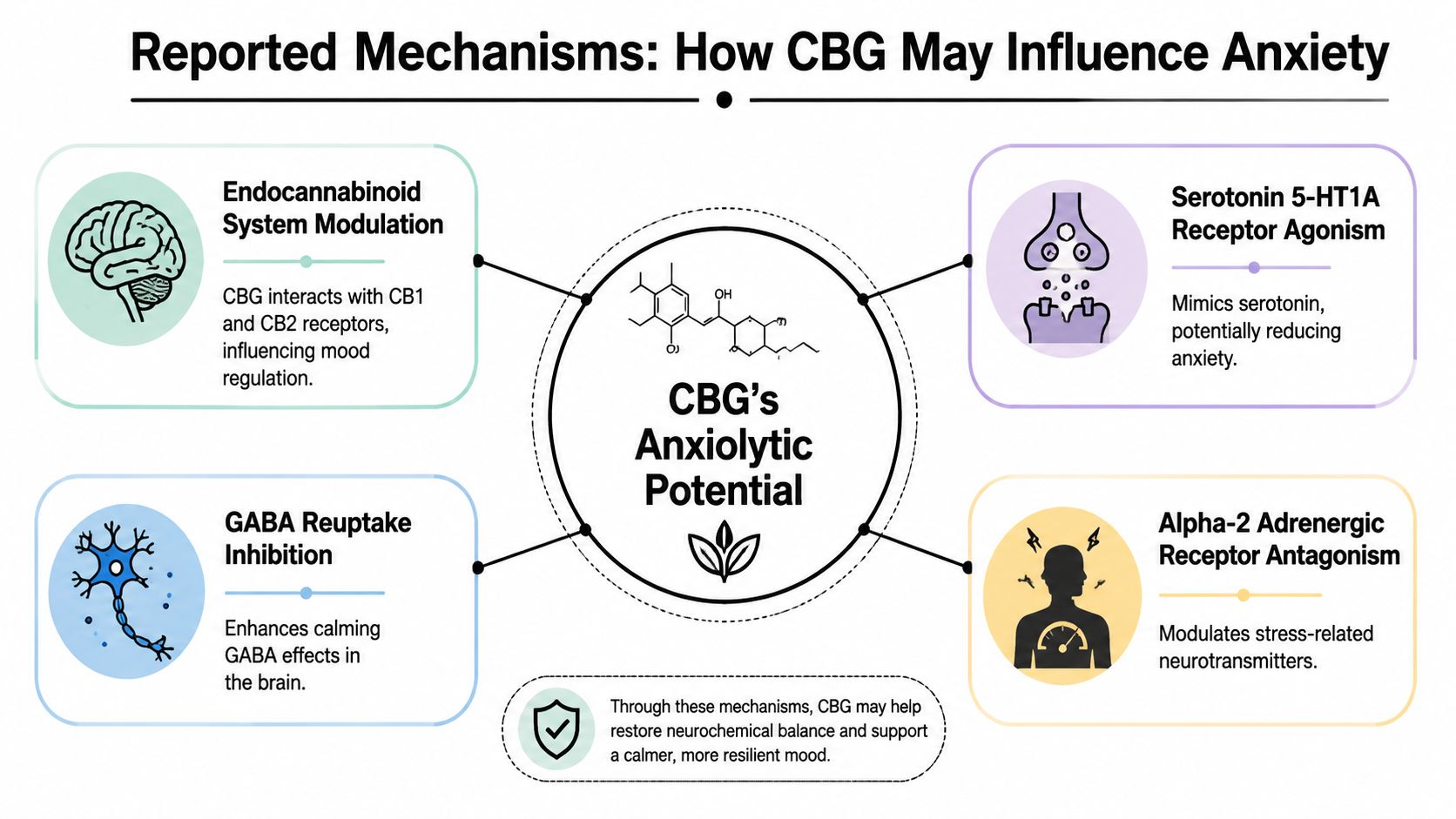
Reported Mechanisms How CBG May Influence Anxiety
A common patient question is simple: if CBG is not working through intoxication, what is it doing?
The current answer is mechanistic, not definitive. Researchers are interested in CBG because its pharmacology points toward stress and mood regulation rather than the classic THC-associated pathway that can help one person relax and make another feel more uneasy.
The receptor systems that matter
Preclinical pharmacology papers describe CBG as interacting with receptor systems tied to anxiety regulation, especially serotonin 5-HT1A and α2-adrenergic signaling, as reviewed in this overview of CBG pharmacology and therapeutic potential.
Those labels can sound abstract, so it helps to translate them. The 5-HT1A system is involved in mood, emotional buffering, and the brain's response to perceived threat. The α2-adrenergic system is more closely related to the body's alarm circuitry, including the sense of being keyed up, vigilant, or unable to downshift after stress.
If those systems are part of anxiety's "volume controls," CBG may be relevant because it appears to touch more than one dial at once.
Why this matters clinically
That receptor pattern is one reason CBG is being discussed as a possible adjunctive option rather than a simple substitute for THC, CBD, or a high-THC full-spectrum product such as RSO. The working idea is not that CBG forces sedation. It may help reduce the intensity of stress signaling while preserving clearer thinking.
For informed patients, that distinction matters. Many people looking beyond CBD are not asking for a compound that makes them feel detached or impaired. They want less internal friction, fewer stress spikes, and a lower chance of the paradoxical anxiety that THC can trigger in some settings.
Why this is different from THC
THC is more directly associated with intoxication because of its activity at cannabinoid pathways linked to the psychoactive "high." CBG is being investigated from another angle. Its possible anxiolytic effects appear more connected to serotonin and adrenergic signaling than to producing intoxication.
That does not prove clinical benefit.
Mechanistic data help explain why a human result might be plausible. They do not tell us how large the effect will be, which patients will respond, or how CBG compares in practice with CBD, THC, or RSO-based protocols. Those questions need human trials.
What mechanism can and cannot tell you
The safest interpretation is modest. CBG has a pharmacologic profile that gives researchers a reasonable basis to study it for anxiety, especially situational anxiety or stress-reactivity. It does not yet justify treating CBG as a stand-alone answer for panic disorder, severe generalized anxiety, or complex psychiatric illness.
That measured view fits the article's broader theme. The 2024 human trial made CBG more than a theory, but the mechanism still matters because it helps explain why CBG may end up occupying a different role from CBD, THC, or full-spectrum extracts. For some patients, that role may be as an add-on that targets tension and overactivation without the impairment concerns that often shape cannabis decision-making.
A Review of the Human and Preclinical Evidence
A patient who has tried CBD without enough relief often asks a reasonable next question. Is there any human evidence for CBG, or is this still mostly theory?
For anxiety, the answer changed in 2024. CBG is no longer supported only by receptor studies, animal work, and user reports. There is now an early human trial, which matters because cannabinoids often look promising in theory long before they show a measurable effect in people.

What the 2024 human trial found
In a double-blind, placebo-controlled, crossover field trial, healthy adults with prior cannabis experience received a single oral dose of isolated CBG or placebo. According to the Washington State University summary of the 2024 clinical trial, the CBG condition was associated with lower self-rated anxiety at multiple time points after dosing. The same summary states that participants showed no evidence of intoxication, motor impairment, or cognitive impairment (and the trial reported no evidence of intoxication, motor impairment, or cognitive impairment).
That pattern is the main reason the study drew attention. For patients comparing cannabis-derived options, the practical signal was not "less anxiety." It was "less anxiety without signs of a THC-like high" in that short-term, controlled setting.
The study still has important limits. It examined an acute response after one dose, not daily use over weeks or months. It also involved a small sample of healthy adults rather than patients diagnosed with generalized anxiety disorder, panic disorder, or trauma-related conditions.
How the earlier evidence fits in
Before the human trial, the evidence base was much thinner. Researchers had preclinical findings that made an anxiolytic effect biologically plausible, and surveys suggested that some CBG users were already seeking it out for tension and anxiety symptoms. As noted earlier in the article, those survey results pointed in the same general direction as the 2024 trial, but surveys cannot separate pharmacologic effect from expectation, product differences, or selection bias.
That distinction matters.
A survey can show interest, patterns of use, and perceived benefit. A controlled trial can test whether a signal still appears when placebo effects are handled more carefully. Preclinical studies add another layer by showing whether the compound interacts with pathways that could reasonably affect stress reactivity. If you want a patient-level comparison of how CBG differs from another non-intoxicating cannabinoid, this guide to CBG vs CBD is a useful companion.
What this evidence does and does not support
The current literature supports a measured conclusion:
| Evidence type | What it adds | What it does not establish |
|---|---|---|
| Preclinical research | A biologic rationale for studying CBG in anxiety-related states | Reliable clinical benefit in patients |
| User-reported survey data | Real-world demand and perceived effects | Proof of efficacy or safety |
| Early human controlled trial | An acute anxiolytic signal under controlled conditions | Long-term effectiveness, ideal dosing, or response in psychiatric populations |
The most defensible reading is simple. CBG now has preliminary human evidence suggesting short-term anxiety reduction, with no signal of intoxication in that first trial. That is more meaningful than mechanistic speculation alone, but it is still early-stage evidence.
For informed patients, a good analogy is a phase of drug development where the first door has opened, not where the case is closed. The 2024 trial makes CBG a serious candidate for adjunctive anxiety support. It does not yet make it a proven stand-alone treatment.
Comparing CBG with CBD THC and RSO
A common real-world scenario looks like this. Someone has already tried CBD, knows THC can be calming or destabilizing depending on dose and timing, and keeps hearing about RSO in broader cannabis protocols. Then CBG appears as a newer option with early human data from 2024. The practical question is not whether these products all come from cannabis. It is which one best matches the goal.
For anxiety-focused readers, that distinction matters. CBG is drawing attention because the first controlled human trial suggested short-term anxiety reduction without an intoxication signal. That places it in a different conversation from THC-dominant products, and often in a different conversation from RSO as well. If you want a narrower side-by-side look at two non-intoxicating cannabinoids, this comparison of CBG and CBD adds useful detail.
Cannabinoid Comparison CBG vs. CBD, THC, and RSO
| Attribute | CBG (Cannabigerol) | CBD (Cannabidiol) | THC (Tetrahydrocannabinol) | RSO (Rick Simpson Oil) |
|---|---|---|---|---|
| Typical psychoactive profile | Generally discussed as non-intoxicating | Generally discussed as non-intoxicating | Intoxicating | Often intoxicating because many preparations are THC-dominant |
| Main discussion in this context | Early clinical interest for anxiety support and clear-headed use | Familiar starting point for many people seeking calm without a high | May relax some users but can also increase anxiety, especially at higher doses or in sensitive users | Whole-extract option often discussed for broader therapeutic goals rather than targeted daytime anxiety support |
| Mechanistic emphasis | Often discussed in relation to 5-HT1A and adrenergic signaling | Broad signaling effects with less of a single-pathway narrative | Strongly tied to CB1 activity and the cannabis high | Effects depend on the extract's cannabinoid and terpene profile |
| Use style | Often isolated or CBG-enriched for more targeted use | Used alone or in broad-spectrum products | Used alone or combined with other cannabinoids | Usually used as a full-extract preparation |
| Best fit for anxiety-focused readers | Adjunctive exploration where mental clarity matters | Familiar first-line cannabinoid option | Often approached cautiously by anxiety-sensitive users | Usually not a direct substitute for a targeted CBG trial |
The easiest way to separate these options is to ask what problem each one is trying to solve.
CBD is often the entry point because it is widely available, non-intoxicating, and familiar to clinicians and patients. CBG now stands out for a different reason. It has less clinical history than CBD, but it gained relevance after the 2024 human trial because it may offer a more alert, daytime-friendly profile for some people exploring adjunctive anxiety support.
THC sits in a different category. For some patients, low doses feel relaxing. For others, especially those with panic symptoms, baseline hyperarousal, or dose sensitivity, THC can amplify the very symptoms they want to reduce. That variability is one reason THC is rarely the cleanest first comparison for someone specifically looking for steadier anxiety control.
RSO also belongs in a different bucket. RSO is generally part of a whole-extract conversation, often involving THC-dominant products and broader therapeutic goals. CBG is being considered as a more targeted cannabinoid option for people who want to test anxiety-related effects without aiming for intoxication.
As noted earlier, user-reported data showed strong interest in CBG for anxiety. That does not prove superiority over CBD, THC, or conventional treatment. It does help explain why CBG moved from a niche cannabinoid into formal human research.
A useful analogy is medication selection by intent. One option may help with sleep but impair daytime function. Another may reduce reactivity while preserving clarity. In that framework, CBG is emerging as a possible adjunct for anxiety-focused use, CBD remains the more established non-intoxicating reference point, THC requires more caution in anxiety-prone users, and RSO is usually discussed in a broader full-spectrum strategy rather than as a direct substitute for CBG.
Practical Guidance for Safe Use and Dosing
If someone wants to try CBG, the safest approach is conservative and boring. That is usually a good thing in cannabinoid medicine. New users often get into trouble by treating these compounds as lifestyle supplements instead of biologically active substances.
Start low and pay attention
The first principle is to use one change at a time. If you start CBG while also changing caffeine intake, sleep aids, or another cannabinoid, you won't know what is driving the result.
A practical approach includes:
- Choose one product form: oral products are easier to track than mixed-use routines.
- Keep a simple symptom log: note timing, context, perceived calm, alertness, and any unwanted effects.
- Avoid stacking rapidly: if you're also using THC, CBD, or sedating medications, changes can become hard to interpret.
For anxiety, the goal isn't to feel altered. The goal is to see whether baseline tension, reactivity, or mental noise becomes easier to manage.
Check interactions and product quality
Cannabinoids can interact with other medications, especially when the same liver enzyme systems are involved. That is particularly relevant for people taking psychiatric medications, seizure medications, anticoagulants, or complex oncology regimens. Consult a licensed medical professional before starting anything new.
Product quality also matters. Look for products with third-party laboratory testing that confirm identity, potency, and purity. If a label is vague, the company avoids certificates of analysis, or the formula obscures how much CBG is present, move on.
For readers dealing with overlapping issues such as anxiety at night, this discussion of CBG for sleep may help clarify whether timing and symptom pattern change the decision.
When more support makes sense
Some patients are not just choosing a single cannabinoid. They are trying to understand how a daytime option like CBG might fit around a more complex regimen that could include CBD, THC, or full-extract oils. In those situations, structured guidance can help. Families seeking help with broader cannabinoid education, including RSO-related questions, can review resources or schedule a consultation through RickSimpsonOil.info.
That should still be framed as adjunctive planning, not as a substitute for medical care.
Frequently Asked Questions About CBG
Does CBG make you feel high
CBG is generally discussed as non-intoxicating. The current human trial evidence is especially notable because participants did not show evidence of intoxication. That said, individual response can vary by product, dose, and whether CBG is combined with THC or other cannabinoids.
Is CBG better than CBD for anxiety
There isn't enough evidence to say that CBG is broadly better than CBD. CBG now has early controlled human evidence for acute anxiety reduction, while CBD has a larger public profile and a different research history. For some people, the more useful question is not which is better in general, but which one is better tolerated and more predictable for their specific symptoms.
Is CBG appropriate for severe anxiety
It shouldn't be framed that way. The available evidence suggests CBG may be more relevant to mild-to-moderate situational anxiety or adjunctive use. Severe anxiety, panic symptoms, suicidal thinking, or major functional impairment require standard clinical evaluation and monitoring.
Can CBG be used together with RSO
Sometimes, but the rationale should be clear. CBG and RSO often serve different purposes. CBG is usually discussed as a targeted cannabinoid. RSO is a full-extract product, often THC-dominant, and may have a very different tolerability profile. Combining products without a plan can make side effects, timing, and symptom interpretation harder.
How quickly does CBG work for anxiety
The first human trial detected anxiety reductions at multiple early post-dose time points after oral use. In practice, onset can still vary based on formulation, metabolism, food intake, and whether other cannabinoids are involved.
Who should be especially cautious with CBG
Anyone who is pregnant or breastfeeding, has a significant psychiatric history, takes multiple prescription medications, or is under active treatment for a serious medical condition should be especially careful. Consult a licensed medical professional before use.
If you're trying to place CBG within a broader cannabinoid strategy, especially alongside questions about full-spectrum oils, dosing logic, or product selection, RickSimpsonOil.info offers educational guides designed for patients and caregivers who want practical, evidence-aware information without hype.