
If you've ever felt uncertain about how to measure Rick Simpson Oil (RSO), you're not alone. The old advice of using a "grain of rice" as a starting point is well-intentioned but can be imprecise. A far more reliable method is using an RSO oil dosage calculator, a simple tool that turns cannabinoid percentages into an exact, measurable dose in milliliters.
This isn't just about convenience; it's about consistency. Using a calculator ensures your RSO plan is built on data, not guesswork, giving you a solid foundation for your wellness goals.
Why Guessing Your RSO Dose Is a Bad Idea
When it comes to something as potent as RSO, precision is everything. The difference between an effective dose and an overwhelming one can be incredibly small. This is where a methodical, calculated approach becomes absolutely essential. Relying on visual estimates introduces too many variables, leading to inconsistent results and unnecessary anxiety.
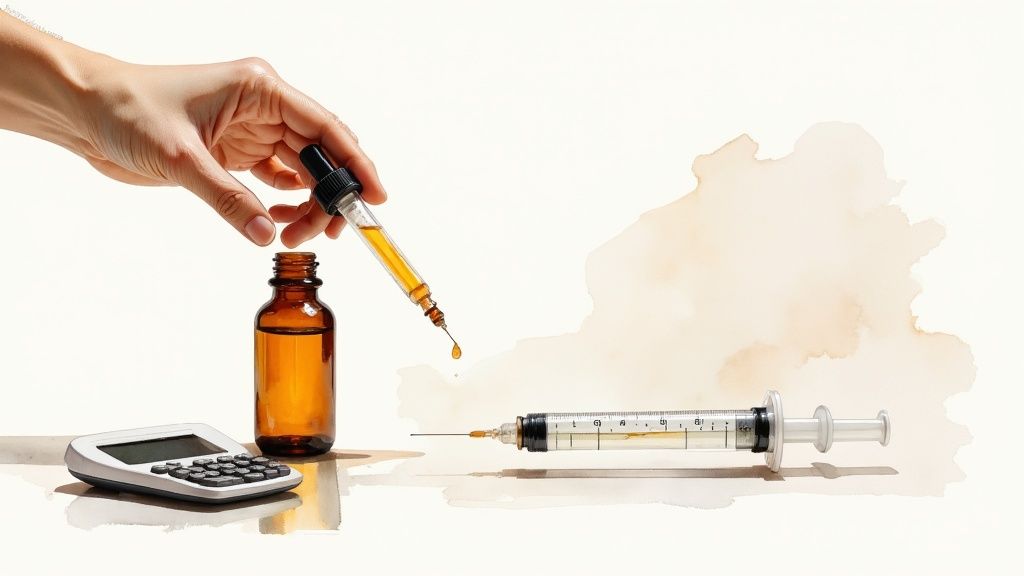
An RSO oil dosage calculator takes the ambiguity out of the equation. It's designed to translate the lab report data from your product into a clear, actionable dosing plan that you can trust from day one.
Building a Dosing Plan That Works for You
The whole point of using a calculator is to personalize your RSO regimen. There’s no such thing as a universal dose because every person's body chemistry, tolerance level, and health objectives are different. A good calculator is built to handle these individual factors.
To give you an accurate and reliable schedule, the calculator needs a few key pieces of information. These inputs are the bedrock of your entire plan.
Here’s a look at what an RSO calculator needs from you and why each piece of information is so important for getting your dose just right.
Key Inputs for Your RSO Dosage Calculator
| Input Variable | Why It's Important for Accuracy | Example |
|---|---|---|
| Total Cannabinoid Content (%) | This is the potency of your specific RSO product. It's found on the Certificate of Analysis (COA) and is the most critical factor for an accurate calculation. | 75% THC |
| Desired Milligram (mg) Dose | This is your target dose for each serving. You can start small and adjust this number as you track your progress and understand your tolerance. | 10 mg |
| Personal Health Factors | Some advanced calculators may incorporate details like body weight to provide even more refined dosing recommendations. | 150 lbs |
Putting this data into a calculator gives you the clarity to move forward confidently. You know that every dose is measured and intentional, which is the key to a predictable and supportive experience.
At RSOhelp.com, we believe that empowerment begins with education. Understanding why precision matters is just as important as knowing how to measure a dose. A calculator is your first step toward taking control of your health with confidence and clarity.
Ultimately, the goal is to establish a consistent, repeatable process. When you can trust your measurements, you can more accurately track how your body is responding and make small, informed adjustments as needed. This removes the guesswork and allows you to focus on what truly matters: your well-being.
Understanding the Original RSO Protocol
To really get a handle on how a modern RSO dosage calculator works, it helps to go back to the beginning. Before we had digital tools, the original RSO protocol was the gold standard, and its approach was surprisingly simple. It wasn't about milligrams or precise measurements—it all started with a visual cue: a single grain of rice.
This early method gave us the core principle that still guides responsible RSO use today: start low and go slow. The advice was to begin with a dose roughly the size of half a grain of rice, taken three times a day. This tiny starting amount let the body get used to the oil's powerful effects without feeling overwhelmed.
The Gradual Escalation Method
At its heart, the original protocol is a titration plan, which just means you increase the dose bit by bit over time. After the first few days on that half-grain-of-rice dose, the user would double the amount every four days. The entire point was to build tolerance at a steady, manageable pace.
This slow-and-steady increase would continue for weeks. It demanded patience and, more importantly, required people to pay close attention to how their bodies were responding. That idea of "listening to your body" is still a critical part of any RSO regimen, even when you're using a precise calculator.
The most widely cited historical regimen for Rick Simpson Oil—often called the “Simpson protocol”—prescribes a gradual escalation to a target of roughly 1.0 gram of RSO per day, taken in divided doses, and continued for a 90-day course to reach a cumulative total of about 60 grams over the treatment period. This regimen originated from Rick Simpson’s own reports and became the basis for dosing charts used today. Learn more about the evolution of RSO dosing protocols from reputable cannabis education outlets like Leafly.
Connecting the Past to the Present
While the "grain of rice" measurement was revolutionary for its time, it has some obvious flaws. Not all grains of rice are the same size, and more critically, the potency of RSO can vary wildly from batch to batch. This is exactly where an RSO oil dosage calculator steps in to bridge the gap.
A modern calculator translates those old-school principles into a precise, data-driven plan. It eliminates the guesswork by factoring in the exact cannabinoid concentration of your specific product—something the original protocol could never do.
Instead of relying on a visual estimate, you get to work with concrete, reliable numbers:
- Milligrams (mg) of the active compounds.
- Milliliters (mL) of oil to draw up in a syringe.
This shift from a visual guess to a calculated measurement is a huge leap forward for consistency and building a confident wellness plan. It respects the "start low and go slow" philosophy but adds a layer of scientific accuracy, empowering you to create a plan that's truly your own.
The core ideas behind the traditional protocol are still incredibly valuable. It teaches patience, self-awareness, and the fundamental concept of titration. By understanding where these ideas came from, you can use today’s tools with more confidence and clarity. For a deeper dive into the history, our guide on the original Rick Simpson cannabis oil is a great resource. This background knowledge helps you use modern calculators more effectively, ensuring your journey is both effective and tailored to your goals.
Getting Started With an RSO Dosage Calculator
This is where the rubber meets the road. Moving away from the old “grain of rice” guesswork to a modern RSO oil dosage calculator is how you bring real precision to your wellness plan. It’s the practical step where you turn the numbers on a lab report into a dose you can actually measure and take. When you use a calculator correctly, you're building your entire regimen on a foundation of data, giving you confidence right from the start.
Let's walk through a real-world scenario to see how simple this is. We'll take the key pieces of information—the specific potency of your product and your personal goals—and plug them into a calculator to generate a clear, easy-to-follow plan.
A Practical, Step-by-Step Example
Alright, let's say you just got a new RSO product. The very first thing you need to do is find its lab report, which is often called a Certificate of Analysis (COA). This document is your single source of truth for the oil’s potency, and you can’t get an accurate calculation without it.
For this example, imagine your lab report shows the RSO contains 72% total cannabinoids. That number is the cornerstone of everything we're about to do.
Next, you have to decide on a starting dose. The golden rule is always "start low and go slow," so a conservative starting point is usually somewhere between 5mg and 10mg. For our purposes, let's aim for a 10mg dose to begin.
With just those two pieces of information, you're all set to use an RSO dosage calculator.
How to Enter Your Data Correctly
A good calculator won't overwhelm you. It should have clear, simple fields for your data. The process is usually straightforward and only takes a moment.
Here’s exactly what you would input using our example:
- Total Cannabinoid Content (%): This is where you enter 72. It tells the calculator the exact strength of your oil.
- Desired Dose (mg): Here, you put in 10, which is your target for a single serving.
- Syringe Size (mL): Most RSO comes in a standard 1mL syringe, so you would select or enter 1.
Once you've entered that information, the calculator does the math for you in an instant. It figures out exactly how much oil in milliliters (mL) you need to get your desired 10mg of cannabinoids. This is what bridges the gap between a theoretical milligram amount and a physical volume you can measure.
A reliable RSO dosage calculator doesn't just spit out a number; it provides clarity. At RSOhelp.com, we designed our tools to be intuitive because managing your health shouldn't be a complicated chore. Our goal is to empower you with precise information you can act on immediately.
The calculator's output is the most critical piece of the puzzle. It will give you a specific volume—for instance, 0.014 mL—that you need to measure out for that 10mg dose. This tiny, precise measurement is something you could never eyeball accurately, which is exactly why these tools are so essential.
Making Sense of the Calculator's Output
The result you get from the calculator is your guide for using the oral syringe. Those tiny markings on the side of the syringe, representing fractions of a milliliter, suddenly become your most important tool. You'll carefully draw the oil to the exact mark the calculator gave you—in this case, 0.014 mL.
This level of accuracy is what truly separates a modern, data-driven RSO regimen from older, less reliable methods. You know with total certainty that every dose is consistent, which is crucial for tracking how your body responds and making smart adjustments over time.
A quality RSO oil dosage calculator often provides other useful information, too, such as:
- Total Doses Per Syringe: It can tell you exactly how many 10mg doses you’ll get out of your 1mL syringe.
- Dosing Schedule Examples: Some tools can even help you map out a titration plan, showing you how to gradually and safely increase your dose over several weeks.
This turns a simple calculation into a complete dosing strategy. It gives you not just the "what" (the dose in mL) but also the "how," helping you structure your entire plan for success. By starting with your product's lab report and a dependable calculator, you're setting a strong and effective course for your wellness journey.
From Milligrams to a Measurable Dose
An RSO dosage calculator can give you a precise target, like 25 mg, but that number doesn't mean much until you can actually measure it out. This is where the rubber meets the road—translating that digital output into a physical amount of oil in your syringe. Getting this right demystifies the whole process, replacing guesswork with genuine confidence.
The journey from a milligram target to a measurable volume in milliliters (mL) is where the real precision comes into play. While the math is simple, it’s what separates a well-managed regimen from the old, vague "grain of rice" estimates. We emphasize this clarity because a consistent, measurable dose is the foundation of any predictable wellness protocol.
This simple flowchart shows how you move from your product's lab report to an exact, measurable dose.
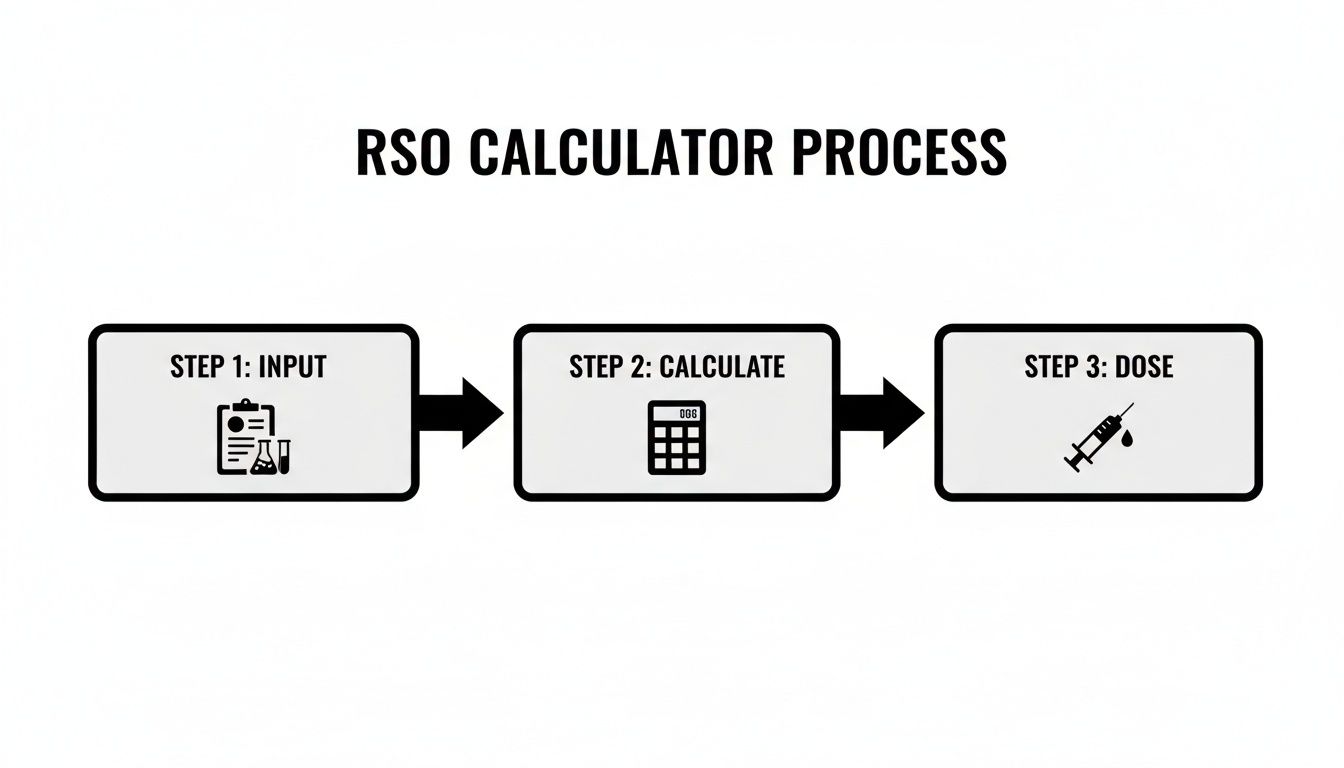
As you can see, the entire system hinges on accurate inputs to generate a reliable dose you can confidently administer every single time.
Why Concentration Dictates Everything
The potency of your RSO is the single most important variable here. Two syringes can look identical, but if one contains 65% total cannabinoids and the other contains 85%, the amount of oil needed for the same dose will be completely different. Simply put, the more concentrated the oil, the less you'll need.
Let's run through a real-world example. Say your target dose is 20 mg.
- With 65% RSO: You would need approximately 0.031 mL of oil.
- With 85% RSO: You would only need about 0.024 mL for that same 20 mg dose.
It might not seem like a huge difference, but over the course of a full regimen, those tiny variations add up quickly. A good dosage calculator does this math for you, ensuring every dose is perfectly aligned with your plan, no matter what product you're using.
Translating Rice Grains into Reliable Metrics
For years, the "grain of rice" was the go-to measurement. It was a helpful starting point, but its lack of standardization is a major flaw. One person's "grain" is another's half-grain. To bring more consistency to the table, we now translate that visual cue into concrete numbers.
A commonly used conversion is that one rice-grain-sized piece of RSO is about 30 mg of product mass. Some guides even use weight-based formulas to calculate a daily dose, which for a 150 lb person could land anywhere from 7.5 mg to 30 mg per day. This is exactly where a calculator becomes essential—it takes these old-school concepts and refines them with your product’s specific lab data, giving you accuracy that a visual estimate just can't match.
Your wellness journey deserves precision. A calculator's ability to convert a milligram target into a measurable volume removes the single biggest variable in RSO dosing, empowering you to follow your plan with complete accuracy.
Mastering the Syringe Markings
Once the calculator gives you a target volume in milliliters, your focus shifts to the oral syringe itself. These are typically marked in tiny increments, often down to 0.01 mL. Those little lines are your guide to perfect dosing.
Getting a feel for measuring such small amounts takes a little practice. RSO is thick and sticky, so you’ll need to apply slow, steady pressure to the plunger to get it right.
Here are a few tips from experience:
- Warm the Syringe: If the oil is too stiff, just hold the capped syringe in your hand for a few minutes. Your body heat will make it more fluid and much easier to dispense accurately.
- Expel Air Bubbles: Before measuring, point the syringe upward and gently tap it. Any air bubbles will rise to the top. Slowly push the plunger to expel the air before drawing your dose.
- Use a Magnifying Glass: Seriously, those markings are tiny. A magnifying glass can be a lifesaver, helping you ensure the plunger is aligned perfectly with your target measurement.
By combining the power of an RSO oil dosage calculator with careful measurement, you gain complete control over your regimen. For more hands-on advice, check out our guide on how to use RSO and other dosage timing tips. This approach makes sure every dose is consistent, repeatable, and perfectly aligned with your goals.
Listening to Your Body: The Art of Dose Adjustment
An RSO dosage calculator gives you a fantastic, data-backed starting point. But that's all it is—a start. Think of it less like a rigid prescription and more like a detailed map for a hike. The map shows you the best path, but you’re the one who has to feel the terrain under your feet and decide when to speed up, slow down, or take a different trail. Your body provides the most critical feedback, and learning its language is the key to mastering your RSO regimen.

This methodical process of adjustment is called titration. It’s the real-world application of the "start low, go slow" mantra, turning you from a passive user into an active participant in your own wellness. The calculator’s plan is your guide, not your boss.
Your Most Powerful Tool: The Dosing Journal
Honestly, the single most effective thing you can do is keep a simple dosing journal. This doesn't need to be fancy—a small notebook or even the notes app on your phone is perfect. A journal transforms vague feelings into concrete data, helping you connect the dots and spot patterns you'd otherwise miss.
By tracking your experience day by day, you create a personalized feedback loop. This little logbook becomes invaluable for making confident, informed decisions about whether to increase, decrease, or hold your current dose steady.
I recommend tracking these four simple things every time you take a dose:
- Date and Time: Being precise helps you see how timing impacts your day.
- Dose Amount (mL): Write down the exact volume you took from the syringe.
- Observations: Jot down a few notes on how you feel—physically and mentally—at the 1, 2, and 4-hour marks.
- Overall Response: A simple 1-10 rating on your comfort level can be surprisingly insightful over time.
This habit is what separates guessing from true fine-tuning.
How to Interpret Your Body's Feedback
As you keep your journal, you'll start to pick up on clear signals. Recognizing what your body is telling you is the whole point of this exercise. It's a conversation, and even small adjustments to your dose can lead to big changes in your overall experience.
The goal is to find your "sweet spot"—that ideal dose that gives you the support you're looking for without any unwanted side effects.
At RSOhelp.com, we emphasize this mindful, self-aware approach because it puts you in the driver's seat. The RSO oil dosage calculator provides the safe starting point, but your own awareness is what truly personalizes and perfects the process.
Let’s get into the specifics of what to look for and what to do next.
Signs It Might Be Time to Adjust
Think of this as a quick-reference guide for turning your body's signals into clear, actionable steps.
| Signal You're Experiencing | What to Do Next | The Thinking Behind It |
|---|---|---|
| Feeling great, but effects wear off too fast. | Hold Steady: Keep the dose the same, but try taking it more often (e.g., every 8 hours instead of 12). | This tells you the dose amount is right, but you need to adjust the frequency for more consistent coverage. |
| Experiencing minimal or no noticeable effects. | Increase Slightly: Nudge your next dose up by a tiny amount, like 0.005 mL, and see how that feels. | A slow, gradual increase is the safest way to find an effective dose without accidentally taking too much. |
| Feeling drowsy, dizzy, or uncomfortably "heavy". | Decrease Slightly: Back off on your next dose by a small fraction and stay there for a few days to see how you feel. | These are classic signs you've gone just past your personal tolerance. A tiny reduction is usually all it takes to fix it. |
| Consistently feeling comfortable and supported. | Hold Steady: You've probably found a great dose for now. Stick with this amount for a while to establish a solid baseline. | Consistency is your friend. Once you find what works, give your body time to acclimate before making any other changes. |
This patient, methodical process ensures your journey with RSO is both comfortable and effective. When you combine the precision of an RSO oil dosage calculator with the wisdom of your own body, you create a powerful wellness strategy that's truly yours.
Your Checklist for a Responsible RSO Journey
Starting an RSO regimen is a big step, one that calls for careful planning. While a good RSO oil dosage calculator gives you the numbers, a truly successful journey is built on a foundation of responsible choices. Think of this checklist as your final pre-flight check, designed to help you move forward with confidence.
Your well-being is the top priority. The best tools in the world are only as good as the professional guidance and high-quality products you pair them with.
Talk to a Qualified Health Professional
Before you do anything else, it is highly advisable to have a conversation with a healthcare provider who is knowledgeable about your health situation. A doctor or clinician can look at your full health picture, consider any potential interactions with other things you are taking, and offer a level of personalized advice an online tool simply can't match.
This is a key part of a responsible plan. They can help you set realistic goals and provide a clinical perspective that ensures you're starting on solid ground.
Your wellness journey should be a partnership between you, your healthcare provider, and the best information available. A calculator offers a roadmap, but a doctor helps you interpret it safely, ensuring you navigate any bumps in the road with expert support.
Insist on Third-Party Lab-Tested Products
The quality of your RSO is everything. Never settle for a product that doesn't come with a recent and comprehensive Certificate of Analysis (COA) from an independent, third-party lab. This document is your only real proof of what's in that syringe.
A legitimate COA is your window into the product, verifying a few critical details:
- Cannabinoid Potency: It confirms the exact percentages of THC, CBD, and other cannabinoids. This is absolutely essential for getting your calculations right with an RSO oil dosage calculator.
- Purity: It shows that the oil has been screened for things you definitely don't want, like pesticides, heavy metals, or leftover solvents from the extraction process.
Without that lab report, you’re flying blind. An untested product doesn't just make accurate dosing impossible; it can expose you to potential issues. This is especially critical for anyone exploring specific protocols, and you can learn more about the role of RSO in cancer protocols from our detailed guide.
At RSOhelp.com, our entire mission is to provide clear, reliable information that supports you every step of the way. We firmly believe that an informed person is an empowered one. The best path forward is always a combination of precise tools, professional advice, and high-quality, verified products.
Your health journey is personal, and having the right support makes all the difference. At RSOhelp.com, we provide free consultations to connect you with trusted, lab-tested RSO and expert guidance to help you move forward with confidence. Learn more and get the support you deserve.