A good tincture dosage chart is your best friend for getting a quick, reliable estimate of how much to take. It should clearly show the milligrams (mg) per dropper and per drop for common product strengths, giving you a safe and measurable starting point.
Quick Tincture Dosage Reference Chart
Figuring out the right tincture dose can feel like guesswork, but a reference chart cuts through the confusion. The idea is simple: match your product's total potency to a specific, measurable amount so you have full control right from the start.
Knowing the relationship between the total potency listed on the bottle and the actual amount in each drop is the key to accurate dosing. When you're using tinctures to support your health, precision matters. This is where a chart becomes an essential tool, especially when you're dealing with more concentrated formulas.
Understanding the Numbers
The table below breaks down the most common potencies you'll find in a standard 30mL tincture bottle. It shows the approximate milligrams (mg) you get in a full 1mL dropper and in a single drop. Think of this as your starting point. Remember, titration—the process of adjusting your dose slowly over time—is crucial for finding what works for you.
For more personalized guidance, the experts at RSOhelp.com offer consultations to help you navigate your options safely and effectively.
Quick Reference Tincture Dosage Chart (For a 30mL Bottle)
This table provides estimated dosages for common tincture potencies, showing mg per mL and per drop.
| Total Potency (in 30mL Bottle) | Mg per Full Dropper (1mL) | Approximate Mg per Drop |
|---|---|---|
| 500 mg | 16.7 mg | 0.8 mg |
| 1000 mg | 33.3 mg | 1.7 mg |
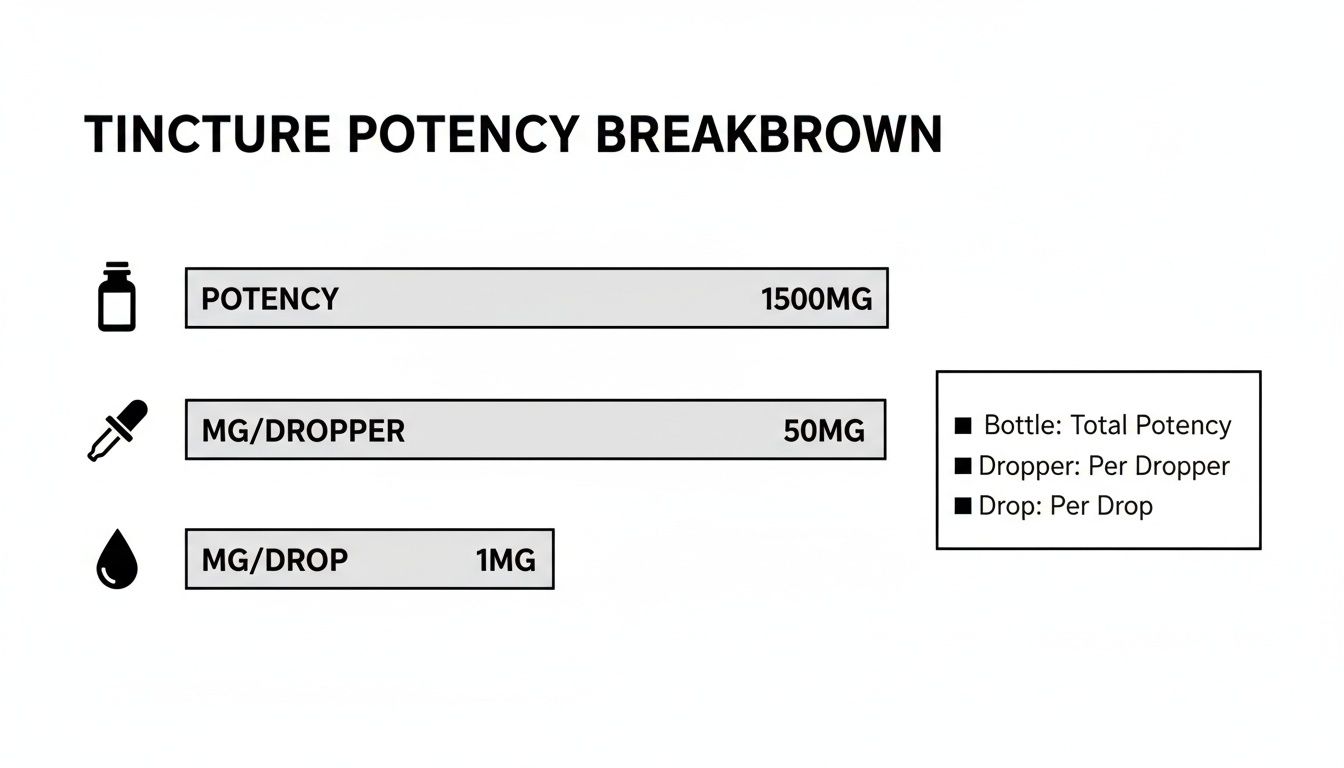
| 1500 mg | 50 mg | 2.5 mg |
| 2000 mg | 66.7 mg | 3.3 mg |
| 3000 mg | 100 mg | 5.0 mg |
The chart makes it clear that a higher total potency in the bottle means a much more concentrated dose in every single drop. This visualization helps connect the dots.
While this table is a fantastic quick reference, the following sections will dive deeper into the calculations and titration plans you'll need to fine-tune your regimen.
Understanding Tincture Potency and Concentration
Before you can even look at a dosage chart, you have to know what the numbers on your tincture bottle are telling you. Getting a handle on terms like potency, concentration, and herbal ratios is the bedrock of using these products safely and effectively. These numbers define the tincture's strength, which impacts every single dose you take.
A product's potency is the total amount of the active ingredient in the entire bottle—for example, 1500mg of cannabinoids. Concentration, however, tells you how much of that ingredient is packed into a specific amount of liquid, almost always measured in milligrams per milliliter (mg/mL). The difference is crucial. You could have two identical 30mL bottles, but if one contains 500mg and the other has 3000mg, their concentrations are worlds apart.
Knowing this distinction is what keeps you from making dosing mistakes and allows you to follow any dosage chart or titration plan accurately.
The Role of Herbal Ratios in Potency
When dealing with herbal extracts, especially certain full-spectrum oils, you might see a ratio like 1:5 on the label. This isn't just industry-speak; it's a classic way to describe concentration based on the weight of the raw plant material compared to the volume of the liquid (the solvent) used to extract it.
So, a 1:5 ratio simply means one part of the herb was extracted into five parts of solvent. This method has been a cornerstone of herbal medicine for a very long time. In fact, historical tincture standards show that these ratios are essential for proper dosing, with 1:5 ratios being the most common for dry herb tinctures since the 1800s.
This particular ratio was developed to provide around 200 milligrams of herb in a single 1 mL dropper, a dose considered perfect for consistent therapeutic support. This history is still relevant for potent, full-spectrum cannabis oils, where a 1:5 ratio often aligns with these time-tested formulas.
From Potency to Practical Dosing
Once you know the concentration (the mg/mL), you can finally turn the recommendations on a dosage chart into a real, measurable dose. Whether your bottle gives you a total milligram count or an herbal ratio, the end goal is always the same: figure out the mg/mL.
With that number in hand, you can use your dropper to measure out a dose with confidence. This is why understanding potency isn't just a technical detail—it’s the single most important step toward getting consistent and predictable results. If you're making your own products, you might find our guide on how to make cannabinoid oil helpful, as it puts these very principles into practice.
The mission at RSOhelp.com is to give you clear, straightforward information so you can make the best decisions for your own wellness journey.
How to Accurately Calculate Your Tincture Dosage
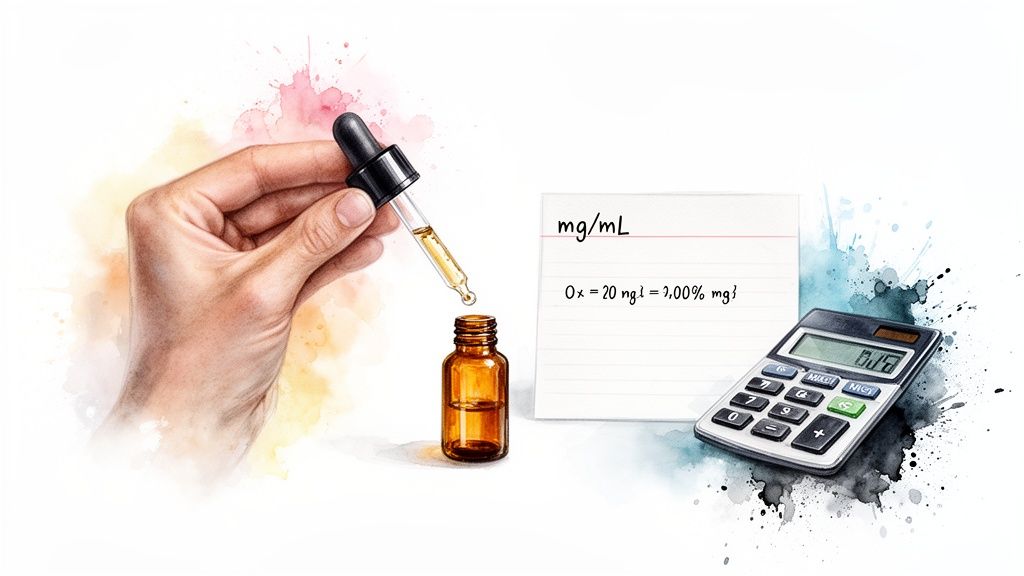
While our reference charts are great starting points, knowing how to calculate your own dosage gives you complete control and precision. To move beyond estimates, you just need two key numbers from your tincture's label or lab report: the total milligrams (mg) of the active compound and the total bottle size in milliliters (mL).
With these two figures, you can determine the exact concentration—the mg/mL—which is the bedrock of any accurate dosage. This empowers you to measure the exact amount you need to meet your goals, a skill that's absolutely vital for any serious wellness protocol, especially when dealing with potent concentrates.
Finding Milligrams Per Milliliter (mg/mL)
First things first, let's nail down the concentration of your tincture. This number tells you exactly how many milligrams of the active ingredient are packed into every single milliliter of liquid. The formula couldn't be simpler.
Formula 1: Calculating Concentration
Total Milligrams in Bottle ÷ Total Milliliters in Bottle = Milligrams per Milliliter (mg/mL)
This one calculation is your key to unlocking precise dosing. Once you know the mg/mL, any standard 1mL dropper becomes a perfect measurement tool.
A Practical Calculation Example
Let's walk through a real-world scenario. Say you have a 30mL bottle of tincture that contains a total of 1500mg of active compounds.
- Total Milligrams: 1500mg
- Total Volume: 30mL
- Calculation: 1500mg ÷ 30mL = 50mg/mL
The result? Every full 1mL dropper from this bottle delivers a consistent 50mg dose of the active ingredient. This number puts you in the driver's seat.
Calculating Milligrams Per Drop
For micro-dosing or making very fine adjustments, you'll want to know the potency of a single drop. While dropper designs vary slightly, the accepted industry standard is 20 drops per 1mL. We can use this to get even more granular with our dosing.
Formula 2: Calculating Potency Per Drop
Milligrams per Milliliter (mg/mL) ÷ Drops per Milliliter = Milligrams per Drop (mg/drop)
Let's stick with our previous example, where the tincture has a concentration of 50mg/mL:
- Concentration: 50mg/mL
- Drops per Milliliter (Standard): 20
- Calculation: 50mg/mL ÷ 20 drops = 2.5mg per drop
Now you know that each individual drop provides about 2.5mg. If your target dose was 10mg, you would simply count out four drops (4 drops x 2.5mg/drop = 10mg). For those who'd rather skip the math, you can use the best edible dosage calculator to handle the conversions for you.
Mastering these simple formulas allows you to create a personalized dosage plan for any tincture you use. Believing that knowledge is power, RSOhelp.com provides tools and education to help you dose with confidence and support your journey to wellness.
Building Your Personal Titration Plan
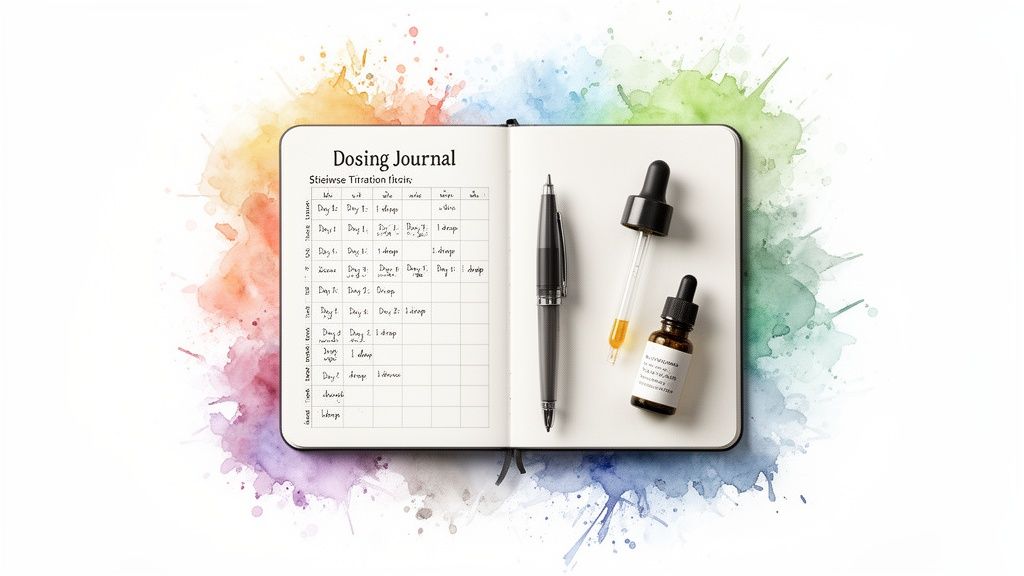
Finding the right dose isn't about pulling a magic number from a chart; it's a personal process of listening to your body. The most effective way to do this is through titration, which is simply the method of starting with a very small dose and slowly increasing it over time. This classic "start low and go slow" approach is the gold standard for a reason—it’s safe, effective, and puts you in control.
Titration gives your body time to acclimate, which dramatically reduces the chances of feeling overwhelmed. More importantly, it helps you zero in on your unique "therapeutic window"—that perfect dose where you get the benefits you want without any unwanted side effects.
For anyone serious about achieving specific health goals, this structured method is essential. Take a potent full-spectrum extract, for example. A common starting point might be just a quarter-dropper (around 7-8 drops) of a 60-90% potency extract, gradually increasing as tolerance builds. This isn't a new concept; it mirrors historical herbalist practices, like the scaling protocols used for echinacea.
In fact, many individuals find that ratio-guided dosing leads to better outcomes by helping reduce side effects through following lab-tested guides. You can discover more insights about these historical dosing protocols on HerbalGoddessMedicinals.wordpress.com.
The Cornerstone of Titration: Your Dosage Journal
The single most valuable tool you'll have on this journey is a dosage journal. It’s where you turn subjective feelings into objective data, creating a roadmap that guides your next steps. A good journal empowers you to make adjustments with real confidence.
It doesn’t need to be fancy. A simple notebook or a notes app on your phone is perfect. The only rule is to be consistent.
What to Record in Your Journal:
- Date and Time: Note the exact time you take each dose.
- Dosage Amount: Be precise. Write down both drops and milligrams (e.g., "4 drops, 10mg").
- Product Details: Keep track of the tincture name and its potency.
- Effects (Positive and Negative): Document how you feel at different intervals—30 minutes, 1 hour, and 2 hours after your dose. This is crucial feedback.
- Other Factors: Jot down anything else that might have an impact, like what you ate that day.
This practice is the best way to understand how your body responds. If you're unsure where to even begin, check out our guide on determining how much CBD you should take.
A Sample Titration Schedule
Here’s a sample plan to show you what the "start low, go slow" method looks like in practice. Think of this as a conservative starting point—feel free to adjust it based on your own experience.
Titration Principle: "The goal is to find the minimum effective dose. Listen to your body and remember that consistency is more important than speed."
Sample 7-Day Starting Plan:
- Days 1-3: Start with a true microdose, like 2.5mg, once a day in the evening. Get everything down in your journal.
- Days 4-7: If you feel good but aren't getting the results you want, bump the dose up slightly to 5mg once a day. Keep tracking everything meticulously.
- Week 2 and Beyond: From here, continue increasing your dose by small amounts (2.5mg to 5mg) every 3-4 days until you find that sweet spot.
This gradual process helps ensure your experience is controlled and positive. The team at RSOhelp.com is dedicated to providing the educational resources you need to build a titration plan that works for you.
Factors That Influence Your Tincture Dosage
A tincture dosage chart is a great place to start, but it's just that—a start. Finding the right dose for you is a personal journey because everyone's body is different. A handful of key factors determine how you'll respond to a tincture, which explains why a dose that's perfect for a friend might not be right for you at all.
Think of it less like a rigid prescription and more like a process of discovery. When you understand these variables, you can move beyond generic recommendations and start fine-tuning a routine that truly fits your body and your wellness goals. This mindful, personalized approach is what makes all the difference.
Your Unique Body Chemistry
Your own biology is the biggest piece of the puzzle. This is exactly why a "one-size-fits-all" dose just doesn't exist in the world of tinctures.
- Body Weight and Metabolism: Your weight affects how compounds are distributed throughout your system. On top of that, a faster metabolism might process the tincture more quickly, meaning you may need to adjust the timing or amount of your dose to get the desired effect.
- Tolerance: Have you used similar products before? If so, you may have built up a tolerance. This simply means you might need a bit more to achieve the same results as someone who is brand new to it.
- Your Personal Goals: Why you're taking the tincture is a huge factor. The dose needed for general daily wellness support will almost certainly be different from the amount someone might use for a more specific, persistent issue.
How You Take It Matters: Administration and Bioavailability
The way you take your tincture has a direct impact on how well it works. The key term here is bioavailability, which is just a technical way of saying how much of the good stuff actually gets into your bloodstream to have an effect. Your administration method is a primary driver of this.
Key Insight: The most effective method is usually sublingual administration. This means holding the tincture under your tongue for 60-90 seconds before you swallow. This lets the compounds absorb directly into your bloodstream through the rich network of capillaries there, bypassing the digestive system for a faster, more potent result.
If you just swallow the tincture immediately or mix it into food or a drink, it has to go through your liver first. This "first-pass metabolism" can break down and reduce the amount of the active compounds that make it into your system. Understanding this distinction is crucial for getting consistent and predictable results.
By keeping these personal factors in mind, you can use a tincture dosage chart the way it was intended: as a reliable guide, not an unbreakable rule. For more personalized support, the team at RSOhelp.com offers guidance to help you navigate your path to wellness safely and effectively.
Tincture Dosing Safety and Best Practices
As you get comfortable with using tinctures, especially the more potent ones, safety should always be top of mind. Responsible use isn't just about nailing the math on a dosage chart; it's about building smart habits that protect you and keep your product effective. This ensures every experience is controlled, positive, and gets you the results you're looking for.
The whole process starts with making an informed choice. Your first priority has to be finding products that are pure, potent, and honest about what's in the bottle. This is where third-party lab testing becomes absolutely essential—it verifies the product's strength and confirms it's clean.
Sourcing High-Quality, Lab-Tested Products
Honestly, the most critical safety step you can take is to work with an organization that believes in transparency. Any reputable brand will gladly provide a Certificate of Analysis (COA) from an independent lab. Think of this document as your proof of quality.
A COA will confirm a few vital details:
- Potency Verification: It validates the exact amount of active compounds, so you know your dosage calculations are based on real numbers.
- Purity Screening: It screens for unwanted elements like pesticides, heavy metals, or leftover solvents from extraction.
- Terpene Profile: For full-spectrum products, it breaks down the specific terpenes, which play a big role in the tincture's overall effects.
Finding reliable educational resources is a great starting point. For example, platforms like RSOhelp.com are committed to guiding users toward providers who offer meticulously lab-tested products. This empowers you to make decisions based on transparency and safety, not just marketing.
Storage and Handling Best Practices
You’ve invested in a quality product, so you’ll want to store it properly to maintain its potency and shelf life. The biggest threats to the stability of active botanical compounds are heat, light, and air, all of which can cause them to degrade and lose effectiveness.
To protect your tincture and ensure every dose is as potent as the last, just follow these simple rules:
- Keep it Cool and Dark: A cupboard or pantry, away from direct sunlight and heat, is the perfect spot.
- Ensure it is Tightly Sealed: Make sure the cap is on tight after every use. This simple step prevents oxidation from air exposure.
- Maintain a Stable Temperature: Avoid big swings in temperature. You don't usually need to refrigerate tinctures, but it can help keep them fresh for longer if you plan on storing them for a while.
Finally, and this is important, always talk to a qualified healthcare professional before starting any new wellness product. This is especially true if you are pregnant, nursing, or taking other medications. A professional can advise you on potential interactions and help you build a plan that truly supports your health goals. It's a fundamental part of responsible self-care.
Tincture Dosing: Your Questions Answered
When you're first getting started with tinctures, or even if you've been using them for a while, practical questions always come up. How long will it take to kick in? What if I take too much? Can I just mix it in my coffee? Getting these answers sorted out is key to feeling confident and in control of your dosing plan.
Let’s walk through some of the most common questions we hear. Think of this as the practical advice you need to use any tincture dosage chart effectively and find what works for you.
How Long Does It Take for a Tincture to Work?
The time it takes to feel the effects comes down to one simple thing: how you take it. Your method of administration is the biggest variable, and you can use it to your advantage.
-
Sublingual (Under the Tongue) for a Faster Kick-in: If you hold the oil under your tongue for 60-90 seconds, you're using a shortcut. The active compounds get absorbed right into your bloodstream through the capillaries there, bypassing your digestive system entirely. Most people feel the effects much quicker this way, usually within 15 to 45 minutes.
-
Oral (Swallowing) for a Slower, Gradual Effect: Swallowing the tincture right away or mixing it into your food or drink sends it through your digestive tract. Just like an edible, it has to be metabolized by your liver first. This is a much slower route, and you can expect to wait anywhere from 45 to 120 minutes to feel anything.
Remember, your own metabolism and whether you've eaten recently will also play a role. Understanding this difference is crucial for timing your doses correctly.
What Should I Do If I Take Too Much?
First things first: stay calm. If you've accidentally taken a larger dose than you meant to, the effects are temporary. While it can be uncomfortable, consider it a learning experience that really drives home the "start low, go slow" rule.
Find a quiet, comfortable spot where you can relax and ride it out. Sipping on some water and having a light snack can help. It's wise to avoid driving or operating any heavy machinery. Most importantly, grab your dosage journal and make a note of how much you took and how you felt. This information is incredibly valuable for fine-tuning your dose moving forward.
Can I Mix My Tincture Into Food or Drinks?
Absolutely. This is a great option if you're not a fan of the tincture's taste. Just be aware that doing so completely changes how your body absorbs it.
When you add a tincture to your food or a beverage, you're turning it into an edible. It will have to go through your liver, which means the onset will be delayed to that 45-120 minute window. The effects might also feel different or less intense than they do with sublingual dosing. If you're going this route, I'd suggest starting with a lower dose than you normally would until you see how your body responds.
How Do I Know When I Have Found My Correct Dose?
Finding the right dose isn't about taking more; it's a process of careful observation. You're looking for what we call the therapeutic window—that sweet spot where you get the benefits you want without any unwelcome side effects.
The goal is to find the minimum effective dose, not the maximum tolerable one. A detailed dosage journal is your best friend in this process.
By tracking your dose, the time you take it, and how you feel both physically and mentally, you'll start to see patterns. You'll know you've found your dose when you're getting consistent, positive results without any downsides. For more tailored support in creating a plan, the folks at RSOhelp.com offer excellent resources.
Here at RickSimpsonOil.info, we're committed to providing clear, reliable education to help you make confident decisions about your health. For one-on-one support and access to verified, lab-tested product sources, we offer a free RSO consultation. You can learn more at https://ricksimpsonoil.info.