
When you're dealing with something as concentrated as an RSO tincture, figuring out the right dose is absolutely critical. A good THC tincture dose calculator is your best friend here. It takes the product's potency (usually in mg or a percentage) and the volume you're using (in mL) and translates it all into a precise, reliable milligram amount per serving. This simple step completely removes the guesswork from the equation, ensuring your regimen is based on solid math, not just a roll of the dice.
Why You Can't Afford to Guess With RSO Tinctures
With a powerful extract like Rick Simpson Oil (RSO), precision isn’t a nice-to-have; it's a must for your health and well-being. The old advice of using "a drop the size of a grain of rice" just doesn't cut it anymore. Why? Because the strength of cannabis products has skyrocketed, and what worked years ago could be overwhelming today.
Everyone's body, tolerance level, and the specific product they're using are different. This is exactly why a dedicated thc tincture dose calculator has become such an indispensable tool. It helps you move past vague recommendations and build a therapeutic plan based on actual data from your product.
By plugging in a few numbers, you get a personalized starting point that perfectly aligns with the golden rule of cannabis use: "start low and go slow." This calculated approach is the only way to achieve consistent, repeatable, and beneficial results.
The Problem with "Winging It"
Guessing your dose can lead to an inconsistent experience. Take too much, and you might feel uncomfortable or overwhelmed. Take too little, and you might not get any therapeutic benefit at all, which can be incredibly frustrating. The whole point is to find that "sweet spot"—your unique therapeutic window—and that journey has to start with an accurate number.
The cannabis landscape has changed dramatically. Consider this: back in 1995, the average THC content in cannabis was around 4%. Fast forward to 2022, and that number has soared to over 16%. You can find more details on these potency trends and their implications from NIH studies. This massive shift is precisely why we need modern tools that account for lab-tested potency and why a careful, gradual titration plan is the standard for RSO.
Before you even touch a calculator, you need to gather some key pieces of information. This table breaks down what you'll need to know to get an accurate and helpful calculation.
Key Factors That Influence Your RSO Dose
| Factor | What It Means | Why It Matters for Your Calculation |
|---|---|---|
| Product Potency | The concentration of THC (or other cannabinoids) in your oil, usually given as a percentage (%) or in milligrams per milliliter (mg/mL). | This is the most critical input. An error here will throw off the entire calculation and could lead to a significantly incorrect dose. |
| Bottle Size | The total volume of liquid in the tincture bottle, typically measured in milliliters (mL). Common sizes are 15 mL, 30 mL, or 60 mL. | Knowing the total volume helps the calculator determine the potency per drop or per milliliter if it's not explicitly stated. |
| Serving Size | The amount of tincture you plan to take at one time. This could be a specific number of drops or a volume like 0.25 mL or 0.5 mL. | This is what you're trying to solve for. You need to know how many milligrams of THC are in your chosen serving. |
| Your Experience | Your personal tolerance level with THC, which is influenced by past use, metabolism, and individual sensitivity. | While not a direct input for the calculator, your experience level dictates your starting dose. A beginner should start much lower than a seasoned user. |
Having these details ready will make the process smooth and ensure the number you get from the calculator is one you can trust.
Your Path to Confident Dosing
Using a reliable online tool takes the anxiety out of the process. Instead of wondering if you're taking the right amount, you can measure each serving with confidence, knowing it’s based on the exact specs of your product.
A calculated dose is more than just a number; it's your commitment to an informed and effective wellness strategy. It replaces anxiety with assurance, allowing you to focus on your health goals.
By truly understanding the factors that influence your dose—from the concentration of your oil to how your own body responds—you are taking control of your health regimen. Let's walk through how to gather your inputs, make sense of the results, and create a beneficial plan that works for you.
Getting Your Numbers Straight for the Dose Calculator
Any dose calculator is only as good as the information you feed it. Think of it like a recipe—if you get the ingredient amounts wrong, the final dish won't turn out right. To get a truly accurate and helpful result from a THC tincture calculator, you need to pull a few key details from your RSO product first.
This isn’t rocket science, but it does demand a little bit of detective work. Let's walk through exactly what you need to find and where to look.
What's the Potency?
The most critical piece of the puzzle is your product's potency. This number tells you exactly how much THC is packed into that oil. You'll usually find it presented in a couple of common ways on the label:
- As a percentage (%): You might see something like "70% Total THC." This simply means that in every gram (1000 mg) of oil, there are 700 mg of pure THC.
- As milligrams per milliliter (mg/mL): Some products make it even easier, stating the concentration directly, like "30 mg/mL." This is the most straightforward format for dosing.
Your best friend here is the product’s Certificate of Analysis (COA). This is a lab report that breaks down the exact cannabinoid content. If you’re making your own RSO, getting a handle on potency is just as important. For a deeper dive into that, check out this guide on how to make cannabinoid oil to understand what affects the final strength.
Our THC tincture dose calculator at RSOhelp.com, for example, is built to handle these different inputs without any fuss.
As you can see, the interface is designed to be clear and simple, letting you plug in your product's details for a quick, reliable calculation.
Total Volume vs. Serving Size: What’s the Difference?
This is where people often get tripped up. It’s crucial to know the difference between the entire bottle's volume and the amount you intend to take in one sitting.
Total Volume (mL)
This is the full amount of liquid in the bottle. Tinctures typically come in standard sizes like 15 mL, 30 mL, or 60 mL. You’ll find this printed right on the label. This number is key for calculating the overall concentration of the oil.
Serving Size (mL)
This is the specific amount of oil you’re actually measuring out for a single dose. Most droppers that come with tinctures have measurement markers, usually in 0.25 mL increments, all the way up to 1.0 mL. This is the number you need to figure out how many milligrams of THC are in that specific dose.
Here’s the bottom line: The calculator uses the Total Volume to figure out the potency per milliliter. Then, it uses your Serving Size to tell you exactly how many milligrams are in your personal dose. Nailing these two inputs is non-negotiable if you want an accurate result.
A Quick Real-World Example
Let's say you have a new RSO tincture. Here’s how you'd gather your info before touching the calculator:
- Find the Potency: You look at the box and find the lab report, which confirms the entire bottle contains 1200 mg of Total THC.
- Find the Total Volume: The bottle’s label clearly states it’s a 30 mL bottle.
- Decide on a Starting Dose: You're following the golden rule: "start low and go slow." So, you decide to begin with a tiny 0.25 mL serving.
That’s it. You have your three numbers. You’d pop "1200 mg" into the total THC field, "30 mL" as the total volume, and "0.25 mL" as your serving size. The thc tincture dose calculator instantly tells you how many milligrams of THC are in that 0.25 mL dose. This simple, methodical approach takes the guesswork out of the equation, empowering you to dose with confidence.
Putting the Tincture Dose Calculator to Work: Real-World Examples
Theory is one thing, but seeing the numbers in action is where the confidence really builds. Let's walk through a few common scenarios to get a practical feel for how the thc tincture dose calculator works. You'll see how small changes in the inputs can make a big difference in the final dose and why every detail matters.
This simple breakdown shows the three key pieces of information you'll always need to start.
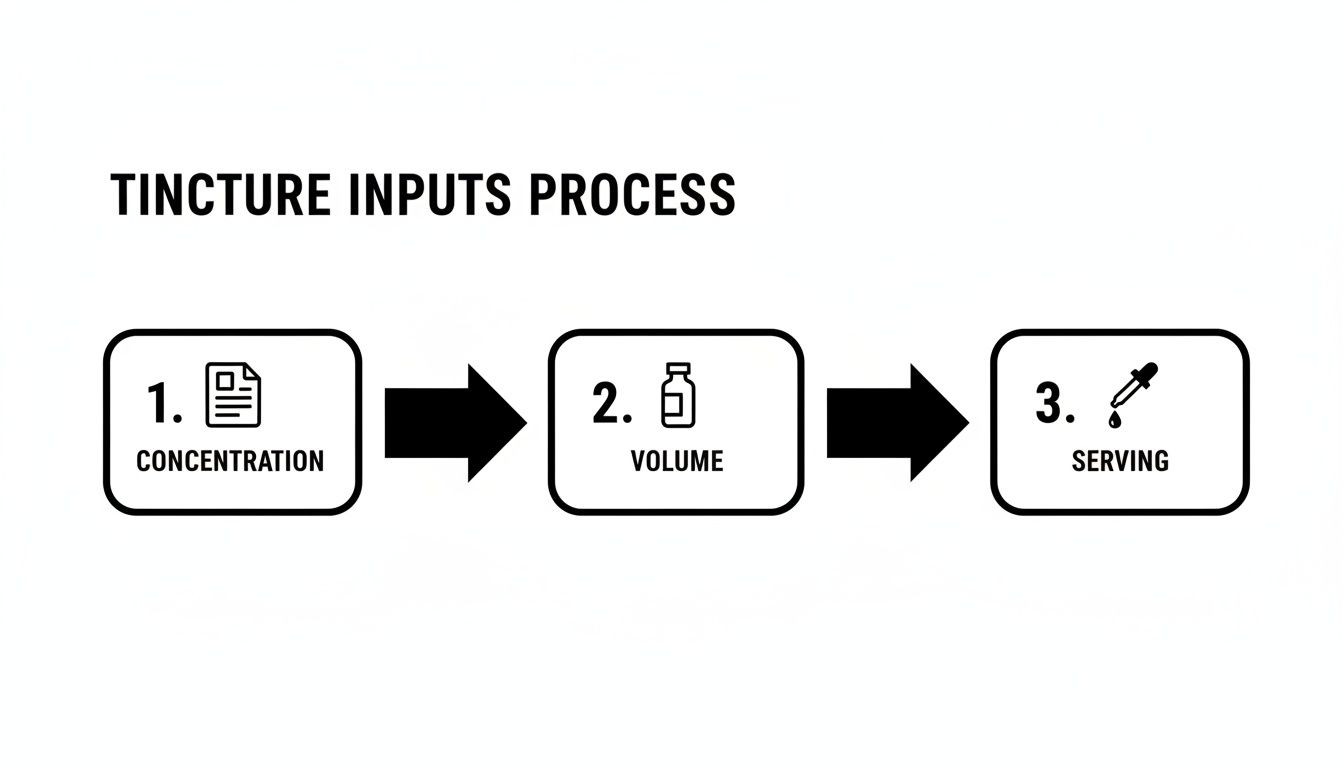
As you can see, it all comes down to your product's potency, the size of the bottle, and the amount you plan to take.
The Core Formula for Tincture Dosing
Every calculation, no matter how complex, boils down to one simple formula. Getting this part right is the key to consistent, predictable dosing. Think of it as the engine powering the calculator.
Total THC (mg) / Total Volume (mL) = THC per mL
Once you've figured out the concentration—the amount of THC in each milliliter—you can easily calculate the dose for any serving size, from a full dropper down to a single drop.
Example 1: The Cautious Beginner
Let’s imagine someone trying RSO for the first time. Their goal is to start with a very low microdose to see how their body responds. Thankfully, they have a product with clear lab-tested labeling, which is non-negotiable for proper dosing.
- The Product: A 30 mL bottle of RSO tincture.
- Total THC: The lab report shows the entire bottle has 600 mg of THC.
- The Goal: Start with a tiny 0.25 mL serving.
First, we need to find the potency per milliliter:
600 mg THC / 30 mL = 20 mg/mL
With that number, we can calculate their starting dose:
20 mg/mL * 0.25 mL = 5 mg of THC
That small 0.25 mL serving delivers a precise 5 mg of THC. This gives them a reliable, low-dose starting point to begin their journey. This isn't just a random number; a 5 mg dose is often used as a standard unit in clinical research. For therapeutic uses, established protocols often suggest starting as low as 2.5 mg and slowly working up to a maximum of 40 mg per day. It just goes to show that even in a clinical setting, starting low and going slow is the gold standard.
Example 2: The Experienced User Titrating Up
Now, let's consider someone who's been taking a 5 mg dose for a while. They’re getting good results but feel a slight increase might offer more support.
- The Product: Same 30 mL bottle with 600 mg of THC (so, we know it's 20 mg/mL).
- The Goal: Increase the dose to 0.50 mL.
Using the concentration we already know, the math is simple:
20 mg/mL * 0.50 mL = 10 mg of THC
By doubling their serving volume, they've perfectly doubled their THC intake to 10 mg. This is a perfect example of titration—making small, controlled adjustments to find the dose that works best for you. For anyone looking to map out a similar plan, a reliable tincture dosage chart can be a fantastic visual tool.
Example 3: Working with a High-Potency Concentrate
Finally, what about a much stronger product? It's common to find pure RSO in a syringe, and with these high concentrations, accuracy is absolutely critical.
- The Product: A 1-gram RSO syringe (which is roughly 1 mL).
- Total THC: Lab results show a potency of 75% THC, meaning the 1-gram syringe contains 750 mg of THC.
- The Plan: To make dosing easier, the user mixes the entire syringe into a 30 mL bottle of a carrier oil, like MCT.
- The Goal: Take a 0.5 mL serving of this new homemade tincture.
First, let's figure out the concentration of the diluted mixture:
750 mg THC / 30 mL = 25 mg/mL
Now, we can find the dose in their 0.5 mL serving:
25 mg/mL * 0.5 mL = 12.5 mg of THC
Each 0.5 mL serving of their custom tincture will provide a 12.5 mg dose of THC. This shows just how essential a thc tincture dose calculator is when dealing with potent concentrates. It’s the tool that allows you to turn a powerful, raw extract into a manageable and precisely dosed therapeutic product.
How You Take Your Tincture Changes Everything
Getting a number from a THC tincture dose calculator is a fantastic first step. It gives you a precise, reliable starting point. But here’s something you absolutely need to know: that number reflects the THC in the dropper, not what your body actually absorbs.
The real magic is in understanding bioavailability. It’s a technical-sounding word, but it just means the amount of a substance that makes it into your bloodstream to have an effect. How you take your tincture is the single biggest factor that influences this.
Simply swallowing the oil is a completely different game than holding it under your tongue. This is exactly why two people can take the identical dose and have wildly different experiences. Mastering your method is the key to getting the consistent, predictable results you're after.
The Sublingual Advantage: Under the Tongue
The most effective way to use a tincture is sublingually—placing the oil directly under your tongue and just letting it sit there for a minute or two. Why? That area is packed with tiny blood vessels called capillaries, creating a direct on-ramp for cannabinoids to enter your bloodstream.
This direct-to-bloodstream route is a game-changer for a couple of reasons:
- It works faster. By skipping the scenic route through your digestive system and liver, the effects come on much more quickly.
- It’s more potent. It avoids the "first-pass effect" in the liver, where a good chunk of THC gets broken down and filtered out before it can do its job. More of the good stuff gets where it needs to go.
My Go-To Tip: I always advise people to hold the tincture under their tongue for at least 60 to 90 seconds before swallowing. This gives those cannabinoids plenty of time to work their way through the thin membranes and into your system.
Honestly, the longer you can hold it, the better. If you swallow too quickly, you've essentially just turned your fast-acting tincture into a slow-acting edible.
What Happens When You Just Swallow It?
If you drip your tincture into a drink or just gulp it down, its journey through your body is completely different. Instead of a direct entry, it has to run the gauntlet of your stomach and intestines before getting processed by the liver.
This digestive route is far less efficient and has much lower bioavailability. A lot of the THC is lost along the way, meaning a smaller percentage of your carefully measured dose ever makes it to your bloodstream. This is a perfect example of why learning how THC can be absorbed through different pathways is crucial for getting it right.
Think about it this way: when taken sublingually, a tincture can start working in as little as 15 to 30 minutes. But if you swallow that same dose, you're looking at an onset time much closer to edibles, which can easily take 1-2 hours to kick in.
This quick comparison table really drives home how much your chosen method matters.
How Your Administration Method Impacts Onset and Duration
This comparison shows how different ways of taking your tincture affect how quickly it works and how long the effects last, helping you choose the best method for your needs.
| Method | Typical Onset Time | Typical Duration | Bioavailability Factor |
|---|---|---|---|
| Sublingual (Under the Tongue) | 15-45 minutes | 4-6 hours | High |
| Ingestion (Swallowing) | 60-120 minutes | 6-8+ hours | Low to Moderate |
| Topical (On the Skin) | Varies (20+ minutes) | Varies (Localized) | Varies by Product |
At the end of the day, using a good THC tincture dose calculator gives you the starting number. From there, using the sublingual method correctly is what ensures you get the most out of every last milligram.
Finding Your Dose: The "Start Low and Go Slow" Method
Getting that initial number from a THC tincture dose calculator is a great first step, but it’s just that—a starting point. The real work, and where you'll find true therapeutic success, is in what comes next. It’s all about embracing the time-tested principle of "start low and go slow."
This methodical process is called titration, and it's the safest, most effective way to discover what your body actually needs.
Think of titration as a conversation with your body. You’re making small, gradual adjustments to your dose over time, paying close attention to the feedback you get. The goal isn't to see how much you can take; it's to find the smallest possible amount that gives you the relief you’re looking for. This patient approach prevents you from feeling overwhelmed and lets your system gently adapt.
How to Build a Titration Schedule That Works for You
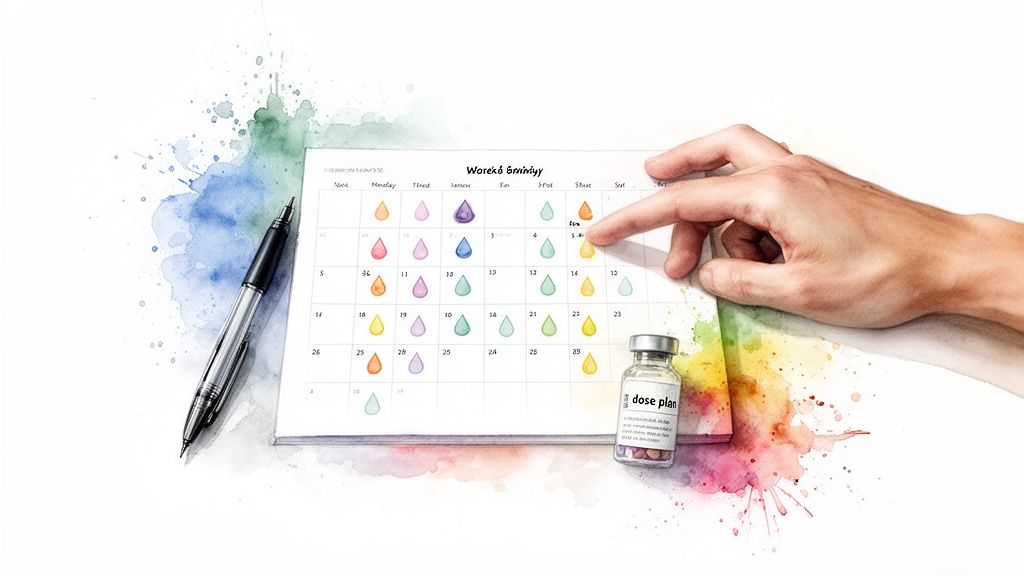
Your personal titration plan will be unique, but the basic framework is universal: start with a very low dose, stick with it for a few days to see how you feel, and only then consider a small, measured increase if you haven't reached your goals.
Here’s a sample schedule you can adapt, using a common starting point of 2.5 mg:
- Days 1–3: Take 2.5 mg twice daily (morning and evening). It's incredibly helpful to jot down a few notes in a journal about how you're feeling.
- Days 4–6: If the initial dose was well-tolerated but you think a bit more could help, you can increase it to 5 mg twice a day.
- Days 7–9: Stay at 5 mg. If you’ve found relief, this might be your sweet spot! If you're close but not quite there, you could consider another small bump to 7.5 mg twice a day.
This isn't a race. Your ideal dose is simply the minimum amount needed to consistently achieve your therapeutic goals. Patience and observation are your best tools here.
Once you find that dose—your personal "sweet spot"—the goal is to stay there. There's no one-size-fits-all answer, which is precisely why this careful, self-guided process is so critical for long-term success.
Microdosing: The Art of Subtle, All-Day Relief
For many people, the goal isn't a noticeable psychoactive effect. It’s about getting gentle, background relief from nagging symptoms like discomfort or inflammation. This is where microdosing shines.
A microdose is a tiny, sub-perceptual amount of THC, usually in the 1 mg to 2.5 mg range. It works behind the scenes, helping to smooth out the rough edges of your day without causing any impairment or interfering with your responsibilities.
This is another area where a THC tincture dose calculator becomes indispensable. Let's imagine you have a potent tincture where a tiny 0.25 mL serving delivers 10 mg of THC. If your goal is a 2 mg microdose, trying to eyeball that would be a shot in the dark.
The calculator does the math for you, showing that you need exactly 0.05 mL. This level of accuracy is what turns a powerful concentrate into a predictable, manageable tool for daily wellness. By planning a consistent microdosing schedule, you can maintain a stable level of cannabinoids in your system, supporting your body’s natural balance day in and day out.
Common Questions About Dosing RSO and Tinctures
When you're first getting started with RSO and tinctures, it's natural to have a lot of questions. Getting clear, practical answers is the key to feeling confident and moving forward on your health journey. Let's walk through some of the most frequent concerns I hear from people.
The idea here is to swap that uncertainty for solid understanding, giving you the information you need to move forward effectively.
What Should I Do If I Take Too Much?
It happens. If you find you've taken a stronger dose than you intended, the first thing to do is find a calm, comfortable place where you feel safe. The most important thing to remember is that the feelings of unease or dizziness are temporary—they will pass.
Staying hydrated is always a good idea, and a light snack can help too. I often suggest putting on some calming music or a favorite movie to help ground you. Some people also report that taking a dose of CBD can help counteract the more intense effects of THC. Under no circumstances should you drive or operate machinery. If you feel your symptoms are severe, don't hesitate to seek professional medical advice.
This kind of experience is exactly why the "start low and go slow" mantra is so critical. A precise thc tincture dose calculator helps you begin with a known quantity, drastically reducing the risk of an uncomfortable overdose.
How Does My Body Weight Affect the Dose?
This is a great question because it's a bit counterintuitive. While body weight and metabolism are huge factors for many other substances, their influence on a cannabis dose is surprisingly indirect. What matters far more is your individual endocannabinoid system, your personal sensitivity, and your current tolerance level.
A calculator gives you an accurate starting point based on the product's actual potency, not a rough guess based on your size. The real fine-tuning happens when you start your titration process and pay close attention to how your body responds. This methodical approach is infinitely more reliable than trying to eyeball a dose based on weight.
Can I Use a Calculator for My Homemade Tinctures?
You absolutely can, but there's a huge asterisk here. The calculator's accuracy is only as good as the numbers you put into it, and for homemade tinctures, that means knowing the exact potency of your final product. For the calculation to be truly reliable, you need a lab test to confirm the final THC percentage or mg/mL concentration.
Without a professional lab report, any dose you calculate is just a shot in the dark. This can be wildly inaccurate and may not lead to consistent therapeutic results. For genuine peace of mind, it is always advisable to work with professionally made, lab-tested products where the potency is clearly labeled.
How Often Should I Re-evaluate My Dose?
It’s a great habit to check in on your dosage from time to time. Your body’s needs and tolerance levels aren't static; they can and do change. If you start to notice your usual dose isn't delivering the same effects it used to, it's probably time for a little reassessment.
This doesn’t always mean you need more. In fact, sometimes a short tolerance break—even just 48 to 72 hours—can reset your cannabinoid receptors. After a quick break, you might find that a lower dose becomes effective again. The best tool you have for this is a simple journal where you track your dose, timing, and effects. It's the only way to truly understand when and how to adjust for the best results.
At RSOhelp.com, our entire mission is to give you the tools and knowledge for a safe and successful journey with cannabis. For more personalized guidance and to connect with a community that gets it, visit us at https://ricksimpsonoil.info.