Distilling cannabis oil is a sophisticated purification method that uses precise heat and vacuum pressure to isolate cannabinoids like THC and CBD from everything else in the plant. The result is an incredibly potent, refined oil called distillate. But this process also removes many of the plant's other beneficial compounds, so it's important to understand the trade-offs before deciding if this high-purity approach is right for your health goals.
The Science Behind Cannabis Oil Distillation
At its core, cannabis distillation is pure chemistry. It’s not a kitchen recipe; it’s a lab procedure that leverages a simple principle: different compounds boil at different temperatures. By carefully heating raw cannabis extract inside a deep vacuum, a technician can vaporize specific cannabinoids, leaving behind the heavier, less desirable materials.
This process is incredibly effective at stripping out impurities. We’re talking about things like:
- Waxes and plant lipids
- Chlorophyll (which gives extracts a harsh, "green" taste)
- Residual solvents or pesticides
That vacuum is the real hero here. Without it, the high heat required to vaporize cannabinoids would just scorch them. A vacuum dramatically lowers their boiling points, allowing for a gentle separation that preserves their integrity. This is precisely why distillation is not a DIY endeavor—it requires specialized, expensive equipment and a serious understanding of the science.
Distillate Versus Whole-Plant Extract
The final product of all this refinement is a thick, clear, golden liquid: distillate. It's famous for its staggering potency, often testing above 90% total cannabinoids, making it the perfect base for products that demand consistency and purity.
This level of refinement has made a huge impact on the market. In fact, distillates and other refined oils now account for a massive 43.2% of the entire cannabis concentrate market. That figure alone tells you how much value both producers and consumers place on clean, potent, and predictable products.
But that purity comes at a price. The very process that scrubs out impurities also removes the plant's aromatic compounds—the terpenes and flavonoids. These molecules do more than just provide flavor and aroma; many believe they work together with cannabinoids to produce a more holistic, synergistic outcome known as the "entourage effect."
When a Simpler Approach Is Better
While distillation creates a powerful, isolated cannabinoid product, it strays far from the plant's natural chemical makeup. For anyone looking to experience the full spectrum of benefits the cannabis plant has to offer for their health, a whole-plant extract is almost always a better fit.
Key Takeaway: In the world of cannabis wellness, "purity" doesn't automatically mean "better." The best product is the one that aligns with your personal health goals. For many people, that means embracing all the compounds the plant offers, not just one or two isolated ones.
This is where alternatives like Rick Simpson Oil (RSO) really shine. RSO is a full-spectrum extract made with a much simpler process designed to preserve the plant's original profile of cannabinoids, terpenes, and other valuable molecules. It’s a completely different philosophy, one that values the whole plant for wellness.
To give you a clearer picture, let's compare the two side-by-side.
Comparing RSO vs Distillate: A Quick Look
| Attribute | Rick Simpson Oil (RSO) | Distilled Cannabis Oil |
|---|---|---|
| Composition | Full-spectrum; retains most cannabinoids, terpenes, and flavonoids. | Isolated cannabinoids; typically 90%+ THC or CBD. |
| Appearance | Dark, thick, tar-like consistency. | Clear, viscous, golden or amber liquid. |
| Flavor/Aroma | Strong, earthy, and plant-like. | Odorless and tasteless (terpenes are removed). |
| Production | Simple solvent extraction; can be made at home (with caution). | Complex, multi-step process requiring lab-grade equipment. |
| Best For | Users seeking the full "entourage effect" and whole-plant benefits. | Products requiring high potency, consistency, and no cannabis flavor. |
As you can see, they are fundamentally different products for different purposes. Distillate is about isolating a single compound, while RSO is about capturing the plant's entire chemical snapshot for health.
For those curious about the whole-plant approach to wellness, RSOhelp.com is an invaluable resource. They offer consultations to help you find high-quality, lab-tested RSO, providing a much safer and more reliable path to health than attempting complex lab procedures at home. You can also dive deeper into various methods in our guide on THC extraction oil.
A Look Inside a Distillation Lab
Stepping into the world of cannabis oil distillation is a serious commitment, one that demands a deep investment in scientific-grade equipment. This isn't a weekend DIY project. We're talking about a sophisticated, interconnected system where every single component is vital for both safety and the quality of the final product. Getting a clear picture of this setup really drives home the technical and financial hurdles involved.
The journey begins with a crude cannabis extract that has already been refined through winterization and decarboxylation. This is your starting material. It's carefully placed into the boiling flask, a round-bottomed glass container that rests inside a heating mantle. The mantle is key—it delivers precise, even heat, which is absolutely essential to avoid creating hot spots that could scorch your valuable oil.
Once things heat up, the distillation process kicks into gear. The lighter cannabinoid molecules vaporize and rise from the flask into the distillation head. Think of this complex piece of glass as the command center for the entire operation. It directs the vapor and holds a thermometer to keep a close, accurate eye on the temperature.
Why Vacuum is a Game-Changer
Now, let's talk about the single most critical piece of this entire setup: the vacuum pump. Without a powerful vacuum, the temperatures needed to boil cannabinoids would be so high they would simply degrade or burn. You'd be destroying the very compounds you're trying to isolate. The vacuum drastically lowers the boiling points of THC, CBD, and other cannabinoids, letting them turn to vapor at much safer, lower temperatures.
A deep, consistent vacuum isn't just a "nice-to-have" in cannabis distillation—it's everything. It's what protects the integrity of the cannabinoids and allows you to produce a pure, clean final product without heat damage.
This vacuum is what creates the "short path" the vapor travels. From the distillation head, the cannabinoid vapor moves straight to the condenser, which is a glass coil chilled by a circulating fluid. When the hot vapor hits this cold surface, it instantly turns back into a liquid—and that liquid is your purified distillate. From there, the fresh oil drips down into a set of receiving flasks, allowing the operator to collect different cannabinoid fractions as they come off without ever breaking the vacuum seal.
The Essential Components and What They Do
Every piece of glassware and equipment has a specific job, and they all have to work together perfectly. Here’s a quick rundown of the core parts of a typical short-path distillation system:
- Heating Mantle: Provides controlled, even heat to the boiling flask. This prevents scorching and keeps the vaporization rate steady.
- Boiling Flask: This is where you put the crude cannabis oil to be heated and distilled.
- Distillation Head: Guides the cannabinoid vapor from the boiling flask to the condenser and holds the thermometer for precise temperature monitoring.
- Condenser: A chilled glass coil that cools the hot cannabinoid vapor, turning it back into a liquid distillate.
- Receiving Flasks: These collect the purified distillate as it drips from the condenser, making it possible to separate different cannabinoid fractions.
- Vacuum Pump: Creates the low-pressure environment needed to drop the boiling points of cannabinoids, protecting them from thermal degradation.
This intricate setup makes it crystal clear why distilling cannabis oil belongs in a controlled lab environment, run by trained professionals. The investment in equipment alone can easily run into the tens of thousands of dollars, and running it safely requires a solid grasp of chemistry and fluid dynamics.
The technical skill and high cost are massive barriers for anyone just looking to support their personal wellness. For most people, the goal isn't to become a lab technician—it's to find a safe, effective product. This is precisely why turning to a trusted, ready-made, full-spectrum oil is a much more practical and safer route. For a look at a simpler, more accessible method, you can check out our guide on how to make cannabinoid oil with a whole-plant philosophy.
When it comes to your wellness journey, the focus should really be on the quality of the final product, not on mastering a complex manufacturing process. A source like RSOhelp.com can connect you with providers of high-quality, lab-tested RSO, giving you the full benefits of the cannabis plant without taking on the risks, costs, and complexity of laboratory distillation.
The Distillation Process from Start to Finish
Diving into cannabis oil distillation is a serious undertaking, one that requires the precision of a laboratory chemist long before you even fire up the still. Let’s walk through the entire process, not as a DIY manual, but to highlight the complexity and significant risks involved. This is a job for trained professionals, and for anyone focused on wellness, there are far safer paths, like sourcing a verified, full-spectrum product like RSO.
The journey doesn't start with the still. It begins with a thick, unrefined crude extract—a messy mix of cannabinoids, terpenes, waxes, fats, and chlorophyll. To get that beautiful, high-purity golden distillate, all the undesirable stuff has to go.
Preparing the Crude Oil for Distillation
First up is a process called winterization. You start by dissolving the crude extract in a solvent, usually ethanol, and then plunging the solution into a deep freeze. We're talking sub-zero temperatures for anywhere from 24 to 48 hours. This intense cold forces the heavier fats, lipids, and plant waxes to solidify and fall out of the solution, making them easy to filter off. What you’re left with is a much cleaner, more workable oil.
After that comes a crucial heating step: decarboxylation. In its raw state, cannabis contains cannabinoids in their acidic forms, like THCA and CBDA. To unlock their active effects, you need to convert them into THC and CBD. This is done by carefully heating the oil, which has the added benefit of purging any volatile solvents left over from winterization.
A Quick Word on Safety: Let's be clear. You're working with flammable solvents, intense heat, and specialized glassware under vacuum. This combination creates an extremely hazardous environment. Every single one of these prep steps introduces risks that can lead to catastrophic failure without expert knowledge and proper safety gear. This is industrial chemistry, not a kitchen experiment.
The Journey Through the Still
With the crude oil finally prepped, it's time for the main event: short-path distillation. The clean, decarboxylated oil is loaded into the boiling flask and gently heated under a deep vacuum. This one-two punch of heat and low pressure is the secret sauce. It allows different compounds to vaporize at temperatures far below their normal boiling points, which is critical for preventing them from degrading or burning.
As the temperature slowly climbs, the operator has to be on high alert. Different compounds in the oil will start to vaporize based on their volatility.
- The lightest, most volatile compounds—the terpenes—are the first to go. These are often collected in a separate, chilled condenser so they can be added back to products later for flavor and aroma.
- As the heat rises, the target cannabinoids like THC and CBD begin to vaporize. This is the main fraction you’re after.
- Finally, the heavyweights like chlorophyll, leftover lipids, and other plant gunk are left behind in the boiling flask as waste.
The diagram below gives a simplified look at how the material flows through the core components of a distillation setup.
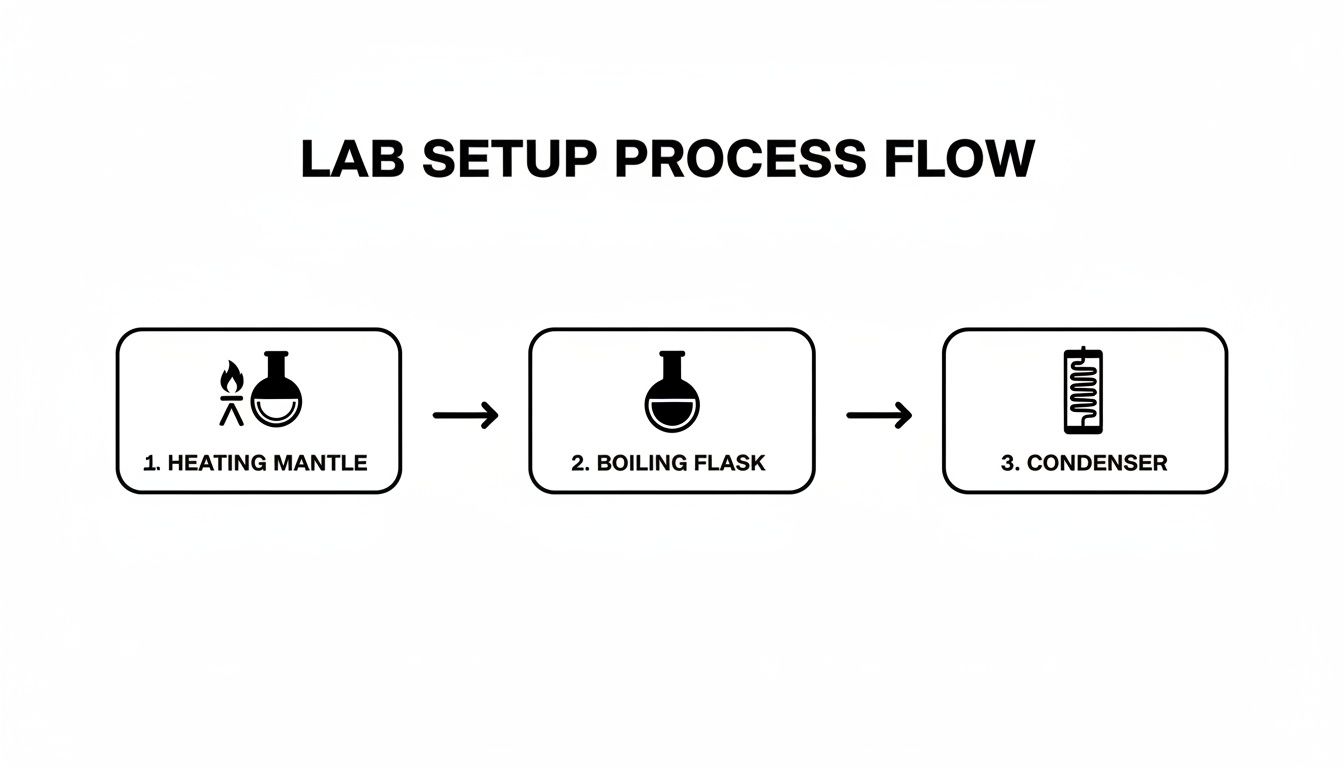
This visual shows the basic pathway: the oil is heated, turns to vapor, and is then cooled back into a liquid, separating and purifying it in the process.
Fractional Separation: The Art of the Process
The cannabinoid vapor travels a "short path" over to a condenser, where it cools and turns back into a pure, liquid distillate. This is where the real skill comes in. The art of separating different compounds is called fractional distillation.
Because different cannabinoids have slightly different boiling points, a skilled operator can isolate them into separate "fractions" by meticulously controlling the temperature and swapping out collection flasks at precisely the right moment. It demands constant vigilance and a feel for the equipment. A small drift in temperature or vacuum pressure can smear the fractions together, compromising the purity of the final product.
To get a sense of the precision needed, here are the approximate temperature targets operators are aiming for under vacuum.
Key Temperature Ranges in Cannabis Distillation
This table outlines the approximate boiling points for major cannabinoids and terpenes under vacuum, illustrating the precision required during the fractional collection phase of distillation.
| Compound | Approximate Boiling Point (Under Vacuum) | Notes |
|---|---|---|
| THC | 155–157°C (311–315°F) | Primary psychoactive compound; the main target fraction. |
| CBD | 160–180°C (320–356°F) | Boiling point is slightly higher than THC, allowing for separation. |
| CBN | 185°C (365°F) | Often indicates older or degraded material; appears in a later fraction. |
| Terpenes | 120–150°C (248–302°F) | Varies widely by specific terpene; these are the first volatile compounds to come off. |
This data shows just how tight the windows are for separating one compound from another.
The enormous global demand for these pure extracts drives this entire industry. Valued at USD 16.40 billion, the global cannabis extract market is projected to skyrocket to USD 68.13 billion, showing just how much commercial interest there is in these advanced products. You can dig deeper into what’s fueling this growth in the full report on cannabis extract market trends.
This whole high-stakes process sends a clear message: distilling cannabis oil is a complex, hazardous, and expensive endeavor. It is not a casual hobby but a serious scientific discipline. For individuals focused on personal health, attempting this is both unnecessary and unsafe. The smart, effective choice is to rely on professionally made, lab-verified products. Sourcing a high-quality RSO from a trusted resource like RSOhelp.com gives you access to the plant's benefits without ever stepping foot in a lab.
How to Spot High-Quality Distillate
You've probably heard that when it comes to cannabis distillate, you should "look for the gold." But the truth is, not all golden oils are created equal. You’ll see a whole spectrum of colors out there, from a light, almost clear straw-yellow to a deep, rich amber. These colors can give you some initial clues, but they absolutely do not tell the whole story.
A light, pale-yellow color is often a good sign. It usually means the starting material was top-notch and the distillation run was exceptionally clean. On the other hand, don't immediately write off a darker amber oil. It doesn't automatically signal a bad product; it could just mean the starting material was a bit older or the oil saw some heat or light, causing a little oxidation.
Now, if you see very dark, murky, or greenish colors, those are definite red flags. That’s a clear sign that impurities like chlorophyll made it through the process.
Clarity is just as important. High-quality distillate should be crystal clear and completely translucent. If you see any cloudiness or little specks floating around, that tells you fats, waxes, or other junk weren't properly removed during winterization and distillation.
Beyond a Visual Inspection
While color and clarity are a good first check, relying on your eyes alone is a massive gamble. Distilling cannabis oil is a complex, sensitive process. Even a perfectly executed run can have issues that are completely invisible.
The real measures of quality are purity and potency, and you can only confirm those with a lab test.
Several common problems can easily compromise the final product, none of which you can see:
- Equipment Contamination: Glassware that isn't meticulously cleaned can leach old residues straight into your new batch.
- Poor Separation: If the temperature and vacuum levels aren't dialed in just right, undesirable compounds can get pulled over with the cannabinoids, tanking the purity.
- Residual Solvents: Incomplete purging before distillation can leave behind trace amounts of ethanol or other solvents.
A simple visual check will never catch these things. An oil can look beautifully golden and clear but still be loaded with contaminants or have a much lower potency than you think.
The only way to truly know the quality, purity, and safety of any cannabis oil is to see a third-party lab report, known as a Certificate of Analysis (COA). For anyone serious about their health, this document is non-negotiable.
A proper COA gives you the complete chemical breakdown. It verifies the cannabinoid profile, confirming the potency of THC, CBD, and other compounds. Crucially, it also screens for a full panel of potential contaminants—pesticides, heavy metals, and residual solvents—to ensure the product is clean and safe.
The Importance of Transparency and Trust
This is where the line between a professional, verified product and something from an unknown source becomes crystal clear. The risks of using an oil without a COA are just too high. You have absolutely no idea what you're actually putting into your body.
That’s precisely why resources like RSOhelp.com exist. We get it—navigating the world of cannabis oil can be confusing and frankly, a little intimidating. Their entire mission is to cut through that noise and connect people with trusted providers who put safety and transparency first.
Every single provider they partner with supplies a full, current Certificate of Analysis for their products. This commitment to third-party verification is your assurance that you’re getting an oil that’s not just potent but also pure. For anyone seeking the therapeutic benefits of cannabis, that level of trust is everything. Choosing a lab-tested RSO through a reliable source provides peace of mind and a much safer, more effective way to reach your wellness goals.
RSO: A Simpler Path to Whole-Plant Wellness
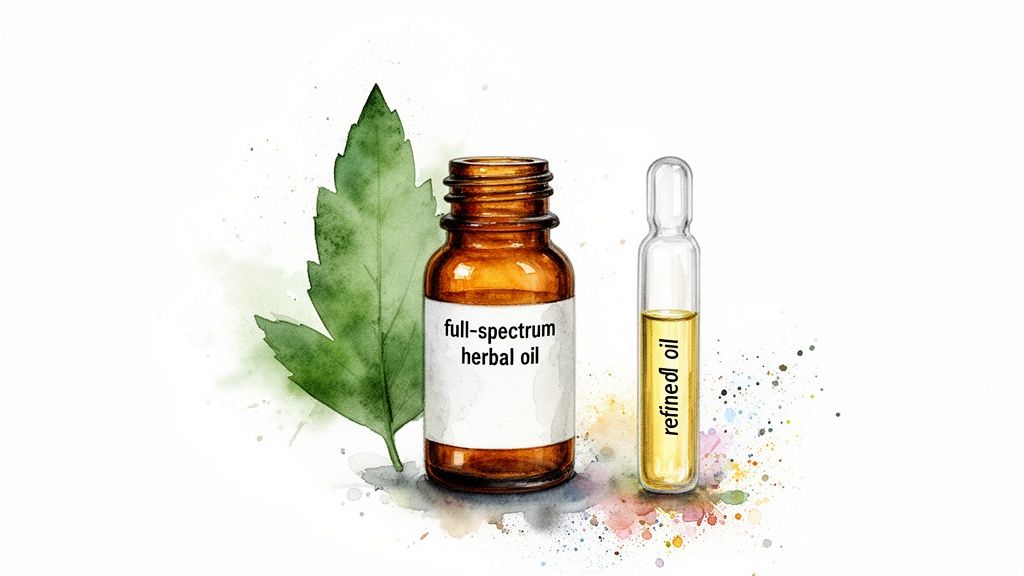
After diving into the high-tech, demanding process of distilling cannabis oil, you start to see that extreme refinement has its trade-offs. The process doesn't just strip away impurities; it also removes a whole host of compounds that create the plant's natural synergy. For anyone more interested in holistic wellness than sheer potency, there's a much more accessible and powerful alternative: Rick Simpson Oil (RSO).
RSO is built on a completely different philosophy. Forget isolating specific cannabinoids. The entire point of RSO is to capture the plant’s full chemical profile. This whole-plant approach leans heavily on the theory of the entourage effect, which suggests that all the plant's components—cannabinoids, terpenes, and flavonoids—work in concert, creating a result that’s greater than the sum of its parts.
Many believe this natural synergy is where the plant's true therapeutic potential lies. Distillation, by its very nature, breaks this team apart, leaving behind a potent but chemically one-dimensional product. RSO does the opposite, preserving that complex interplay and delivering an experience much closer to how the plant exists in nature.
The Power of a Full-Spectrum Extract
Opting for RSO over distillate is a conscious choice to embrace a more natural wellness strategy. It sidesteps the harsh refinement stages, focusing instead on delivering the plant’s complete spectrum of compounds in a single, concentrated oil. The method is simpler, and it also speaks to a growing desire for products that respect the plant's inherent complexity.
This shift isn't just anecdotal. You can see the demand for concentrated cannabinoid products reflected in market trends. The cannabidiol (CBD) oil extract market, for example, is on track to hit an incredible USD 67.63 billion, with an annual growth rate of 21.5%. This explosive growth underscores just how much interest there is in the plant's therapeutic compounds. You can read more about the CBD extract market's expansion to see the full picture.
For anyone putting health first, the real goal isn't just potency—it's effectiveness. RSO provides a path to wellness that is safer, more practical, and potentially more beneficial because it harnesses the complete power of the plant.
The great thing is, the process for creating RSO is far less complicated than lab-grade distillation, making it a realistic option for personal use. If you want to see just how different the production is, you can check out our guide on how to make RSO. It walks you through a much more direct and straightforward extraction method.
Your Trusted Resource for Quality RSO
Navigating the world of cannabis oil can feel overwhelming, but you don’t have to go it alone. The complexities of distilling cannabis oil really highlight why it’s so important to lean on trusted experts for your wellness needs. This is exactly where RSOhelp.com can be a game-changer.
They offer free consultations to help you understand the benefits of full-spectrum oil and can connect you with reliable sources for high-quality, lab-tested RSO. By choosing this route, you get the plant's full potential without the risks, massive costs, or technical headaches of distillation. It’s simply a smarter, more direct path to your wellness goals.
Common Questions About Cannabis Oil and RSO
When you're exploring cannabis extracts, a few key questions always seem to pop up. It's especially common when you start comparing something as complex as distillate with a whole-plant option like RSO. Let's clear up some of the confusion so you can feel confident about what you're choosing.
Think of this as a quick debrief on the things that really matter: safety, what makes these oils different, and how you can be sure you're getting a quality product.
Is It Safe to Attempt Distilling Cannabis Oil Myself?
Let me be blunt: trying to distill cannabis oil at home is a terrible idea. It's extremely hazardous and something that should never be attempted by an untrained individual. You’re dealing with a dangerous mix of high heat, intense vacuum pressure, and flammable materials that can go wrong in an instant.
Proper distillation requires specialized, lab-grade equipment that is very expensive, not to mention serious training to handle the risks of implosion, fire, or chemical exposure. The risks just don't add up for personal use. It’s far safer—and more effective—to get your products from a trusted source. That way, you know what you're getting is clean and accurately dosed, without turning your home into a danger zone.
Safety always comes first. Distillation is a complex industrial process for a reason. Leave it to the trained professionals working in controlled lab environments.
What Is the Main Difference Between Distillate and RSO?
The biggest difference comes down to what’s left in the final product and the philosophy behind making it.
Distillate: Think of this as an isolation. The goal is to purify and concentrate a single cannabinoid, like THC or CBD, stripping away almost everything else. You get a very potent, predictable oil, but it's a narrow snapshot of the plant.
RSO (Rick Simpson Oil): This is the opposite—it's a full-spectrum extract. The entire point of its creation is to capture everything the plant has to offer: the full range of cannabinoids, terpenes, flavonoids, and other compounds.
Many people lean toward RSO because they're looking for the holistic benefits of the whole plant. This ties into the "entourage effect," which is the idea that all these different compounds work better together, creating a synergy that you just can't get from an isolated cannabinoid.
How Can I Verify the Quality of My Cannabis Oil?
You can look at an oil's color and clarity, but that won't tell you the whole story. The only way to truly know what you’re getting is to see a third-party Certificate of Analysis (COA).
This lab report is your proof of quality. It breaks down the exact cannabinoid profile and, just as importantly, confirms the oil is clean. A good COA is non-negotiable and should always screen for:
- Pesticides
- Heavy metals
- Residual solvents
- Mold and microbes
Any reputable producer will have these reports readily available for every batch. It’s a sign of transparency and a commitment to safety, taking all the guesswork out of the equation for you.
If you're looking for personalized support or want to connect with verified U.S. sources for organic, lab-tested RSO, RSOhelp.com is a great resource. They offer free consultations to help guide you. You can learn more by visiting the Rick Simpson Oil informational site.