Creating your own Rick Simpson Oil (RSO) involves extracting the full spectrum of compounds from the cannabis plant. The result is an incredibly concentrated and potent oil. While the process might seem straightforward on the surface, it demands serious respect for safety—you're often working with flammable solvents—and a solid grasp of the chemistry to end up with a clean, effective product.
What Is RSO and Why Is It So Potent?
Before we get into the nuts and bolts of how RSO is made, it’s important to understand what makes this oil unique. RSO isn't just another cannabis extract; it’s a full-spectrum powerhouse, meaning it captures the complete profile of cannabinoids, terpenes, and other valuable plant compounds.
This complete chemical picture is the secret to its legendary potency. Unlike distillates or CBD isolates that target single compounds, RSO delivers the "entourage effect." This is the idea that all these components work together in synergy, potentially amplifying the oil's therapeutic effects. For many people, this synergy is what makes RSO such a compelling option.
The oil is usually very dark and thick, almost like tar. This consistency is a tell-tale sign of its whole-plant origins and minimal processing. It's a specific type of Full Extract Cannabis Oil (FECO), prized for its high THC content, which is typically the dominant cannabinoid.
The Origins and Purpose of the Oil
The story behind RSO is a personal one. It started with a Canadian engineer named Rick Simpson, who, back in 2003, was diagnosed with a form of skin cancer. After conventional treatments were unsuccessful for him, he turned to a homemade cannabis extract. He applied it directly to the growths on his skin and, according to his account, they disappeared in a few days. His story lit a fire, sparking worldwide interest in RSO as a serious therapeutic tool.
This backstory really highlights the oil's intended purpose. It wasn't created for recreation but as a concentrated, no-frills wellness product.
For anyone looking into RSO, remembering its origin is crucial. It was born from a personal health crisis, with the singular goal of concentrating the plant's full potential into a simple, administrable form.
Safety and Quality First
While Rick Simpson's story is inspiring, we have to approach making RSO with a modern focus on safety and purity. The original methods can be quite dangerous in a home setting and don't guarantee a product free from solvent residues or other contaminants.
This guide is designed to help you make informed decisions, not to provide a risky DIY recipe. In today's market, true quality and safety are best achieved through professional production and independent, third-party lab testing.
Our mission is to provide educational resources that help people find trusted, professionally made oils that are pure, potent, and safe. Your health is too important to risk on anything less.
The Hidden Dangers of Making Your Own RSO
You can find a tutorial for just about anything online, and making RSO is no exception. While those videos might make it look easy, they often gloss over the very real, very serious dangers involved. This isn't just about a kitchen mishap; we're talking about a chemical process that uses highly volatile substances in an environment that was never designed for it. The potential for things to go catastrophically wrong is much higher than you might think.
The most immediate threat? The solvents. Chemicals like isopropyl alcohol and ethanol are incredibly flammable, and their vapors are even more so. The process requires you to heat the solvent to evaporate it away, which releases a dense, invisible cloud of combustible fumes.
This creates a ticking time bomb right in your home. That cloud of vapor can be ignited by almost anything—a spark from your refrigerator's compressor, static from your clothes, or the pilot light on your stove. The result isn't just a fire; it can be a violent explosion. Professional labs use specialized, spark-proof equipment and industrial ventilation for a reason. Your rice cooker and kitchen fan just can't compete.
Health Risks That Go Beyond the Flames
Let's say you manage to avoid a fire. You're still not out of the woods. Those solvent fumes you're boiling off are toxic. Breathing them in can cause everything from dizziness and headaches to serious respiratory irritation and, with enough exposure, long-term neurological issues. Without a proper lab-grade ventilation hood, you're bathing yourself and your home in these harmful chemicals.
And what about the final product? Getting every last drop of solvent out of the finished oil is incredibly difficult without equipment like a vacuum oven. Any residual solvent that gets left behind ends up in your RSO.
When you ingest oil that's still contaminated with isopropyl alcohol or other solvents, you're introducing toxins directly into your body. This can lead to damage to your liver, kidneys, and central nervous system—turning something you're using for your health into a source of harm. It completely defeats the purpose.
Why a Controlled Lab Environment Is Non-Negotiable
The difference between a home kitchen and a professional lab isn't just about fancy equipment; it's a massive gap in safety and quality control. Licensed producers operate under strict safety protocols for a reason.
- Closed-Loop Systems: Professionals use sealed extraction systems that keep solvent vapors contained. This practically eliminates the risk of an explosion because the fumes never enter the open air.
- Proper Ventilation: Labs have explosion-proof ventilation systems designed to pull toxic fumes out of the building safely.
- Purity Testing: Every single batch of professionally made oil is sent to a third-party lab. They test it to make sure it's completely free of residual solvents, pesticides, and other junk you don't want in your body.
- Personal Protective Equipment (PPE): Lab technicians are kitted out in respirators, safety goggles, and solvent-resistant gloves to protect them from any chemical exposure.
The few dollars you might save by trying this at home just aren't worth the risk. The cost of a fire, an explosion, or long-term health problems from contaminated oil will always be greater than the price of a professionally made product. This isn't baking; it's volatile chemistry. For your own safety and peace of mind, the only responsible choice is to find a lab-verified RSO. If you need help finding reliable sources, educational platforms like RSOhelp.com can offer the guidance you need to find a clean, safe, and effective product.
Understanding Solvents And Their Inherent Risks
When you're learning how to make RSO, your choice of solvent is the single most important decision you'll make—and it's where things can go wrong fast. The solvents you often see mentioned in older, do-it-yourself guides are typically isopropyl alcohol, ethanol, and naptha. Each one comes with its own set of serious hazards that become much more dangerous in a home setting.
Frankly, these chemicals are not interchangeable. Their risks go well beyond just being flammable. Naptha, for example, is a petroleum product that’s not only incredibly volatile but also toxic to handle and inhale. Isopropyl alcohol might be a common household item, but its fumes are highly flammable and can be harmful in any space without industrial-grade ventilation. Even food-grade ethanol demands extreme caution to prevent a fire or explosion, especially when heat is involved.
The real problem in any non-laboratory setting is trying to manage these volatile organic compounds (VOCs) safely. Without professional, spark-proof equipment and proper ventilation, the moment you start heating a solvent to evaporate it, you release a dense, invisible cloud of highly combustible vapor. This is precisely how home extractions turn into disasters.
This image neatly sums up the three biggest dangers you face when attempting to make your own RSO.
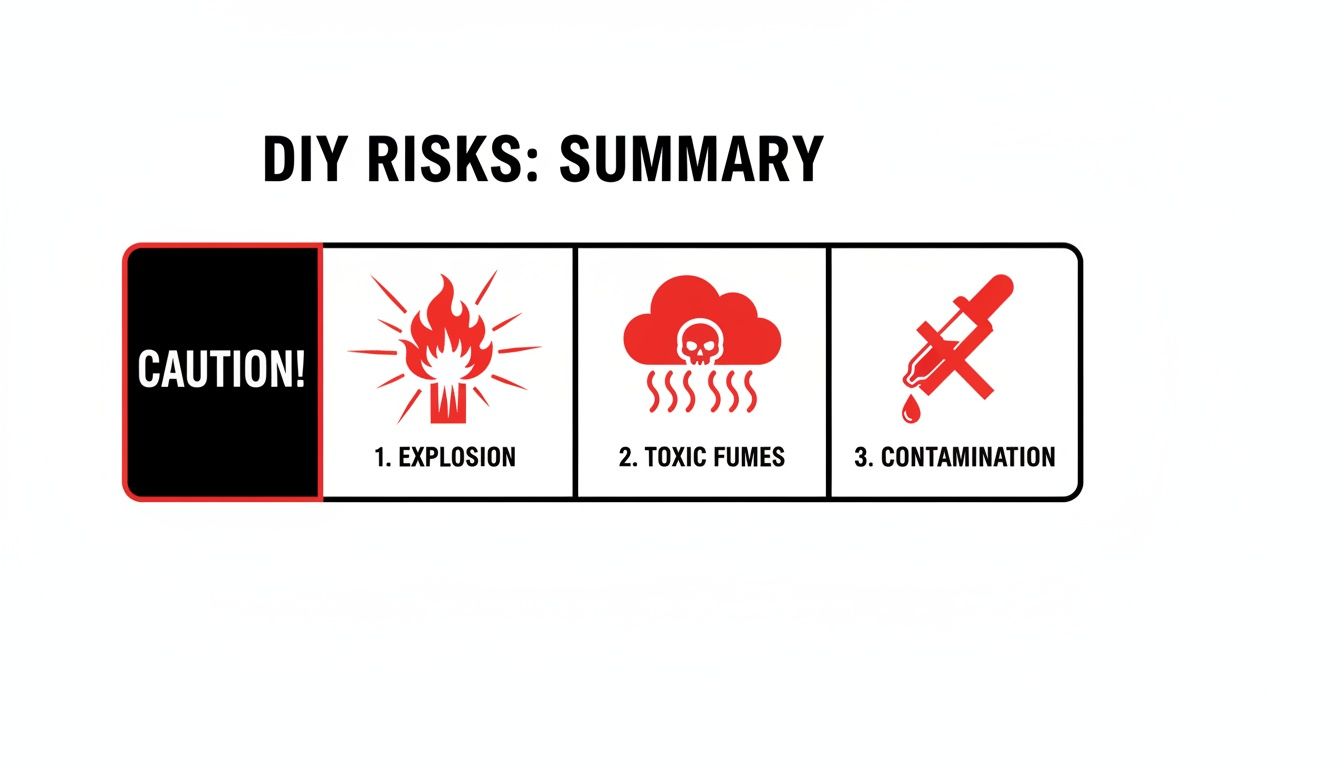
As you can see, the risks of explosion, breathing in toxic fumes, and ending up with a contaminated product are all deeply connected and always present in a DIY scenario.
The Problem With Residual Solvents
Beyond the immediate danger of an explosion, there's a quieter but equally serious risk: residual solvents. These are microscopic traces of the solvent that get trapped in the thick, sticky oil, even after you think you've purged it all. In a home kitchen, it's virtually impossible to get every last bit of these chemicals out.
Professional labs get around this by using special gear like vacuum ovens, which lower the solvent's boiling point. This lets them gently pull out every remaining molecule without destroying the delicate cannabinoids and terpenes. Without that kind of technology, you’re almost guaranteed to have a final product contaminated with industrial chemicals—completely defeating the purpose of using RSO for your health.
Ingesting oil tainted with leftover isopropyl alcohol or naptha means you're putting toxins directly into your body. This doesn't just cancel out the potential benefits; it can create entirely new health issues.
A Closer Look At Common DIY Solvents
To truly grasp the danger, it helps to put these solvents side-by-side. Each has properties that make it unsuitable and flat-out unsafe for making extracts at home. The classic Rick Simpson Oil recipe involves a simple extraction, often using 99% isopropyl alcohol on about 1 pound of dried cannabis to produce around 60 grams of oil. This oil can have THC levels hitting 70-80%. You can learn more about how the extraction process impacts RSO potency and purity to see why professional methods matter so much.
The table below breaks down the specific hazards of each common solvent.
DIY Solvent Hazard Comparison
| Solvent | Primary Hazard | Purity Challenge | Recommendation |
|---|---|---|---|
| Isopropyl Alcohol | Highly flammable vapors that can easily ignite from a spark or open flame. | Can leave behind toxic residues if not fully purged, which is difficult without specialized vacuum equipment. | Not Recommended for Home Use |
| Naptha | Extremely volatile and toxic; fumes can cause serious respiratory and neurological damage. | A harsh industrial solvent that is very difficult to purge completely, leaving a dangerous and contaminated oil. | Extremely Dangerous; Avoid Completely |
| Ethanol | Flammable, though generally considered safer than isopropyl alcohol or naptha. | Food-grade ethanol is less toxic, but still challenging to purge fully, and non-food-grade versions contain additives. | Requires Professional Equipment; Not for DIY |
The takeaway here is crystal clear. Every one of these solvents introduces a level of risk that is simply unacceptable outside of a controlled, professional lab. Making a safe and effective THC extraction oil requires extensive knowledge and specialized equipment. Trying to do this at home is a gamble with your health and safety that just isn't worth taking.
Why Lab-Tested RSO Is the Only Safe Choice
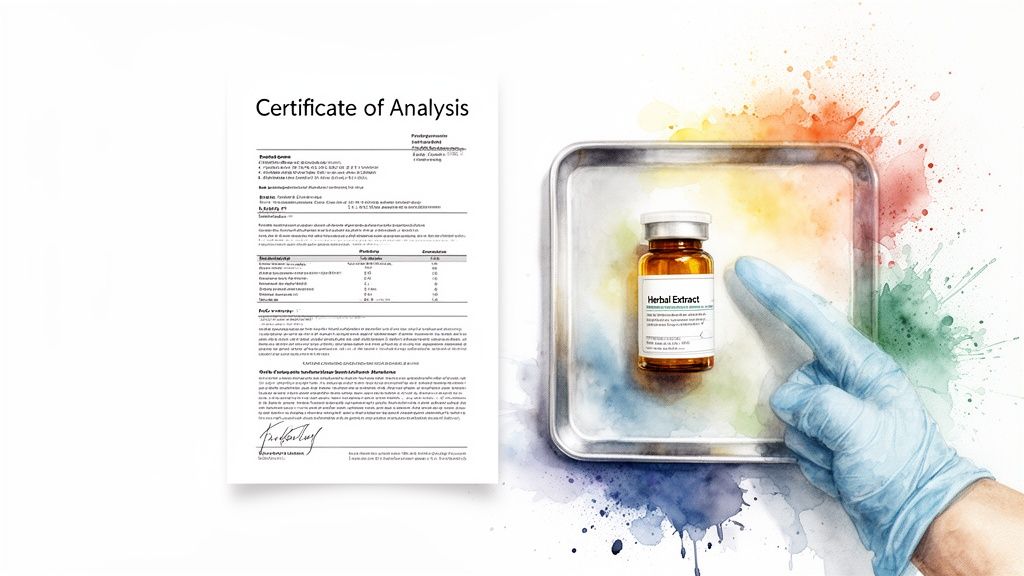
After weighing the serious risks of making your own RSO, the responsible path forward becomes pretty clear. Getting your hands on professionally made, lab-tested oil isn't just about convenience—it's an absolute must for anyone using it therapeutically. You simply can't put a price on the peace of mind that comes from knowing exactly what you're taking.
When you choose a lab-tested product, you're no longer just a user; you're an informed consumer. It gives you the power to verify what's going into your body, making sure the oil is not just potent but, more importantly, free from the very contaminants that could undermine your health goals. This is the only way to guarantee the safety and consistency you need.
Reading the Fine Print: Your Certificate of Analysis
The key to this confidence is a document called a Certificate of Analysis (CoA). Think of it as a detailed report card for your RSO, issued by an accredited third-party lab. It breaks down the exact chemical makeup of a specific batch, serving as your ultimate proof of quality and safety. Any producer worth their salt will provide one without hesitation.
If a seller can't—or won't—provide a current CoA for the batch you're interested in, consider it a massive red flag and walk away.
What to Look For on a CoA
At first glance, a CoA can look like a wall of scientific jargon. But once you know where to look, it’s actually quite simple to understand. The report is usually split into a few key sections, each giving you critical info about the product's quality.
Here's what you need to zero in on:
- Cannabinoid Potency: This is where you'll see the concentration of compounds like THC and CBD, typically shown as a percentage or in milligrams per gram (mg/g). This confirms the product’s strength so you can dose accurately every time.
- Terpene Profile: Terpenes are the aromatic compounds responsible for the plant's scent and flavor, but they also contribute to its therapeutic effects. This section tells you which terpenes are present and in what amounts, offering clues about the oil's potential benefits.
- Purity Testing Results: This is, without a doubt, the most important part of the CoA. It’s the section that screens for nasty contaminants that have no business being in a therapeutic product.
A comprehensive CoA is the gold standard for transparency. It's the only way to be absolutely certain that your RSO is clean, potent, and free from the residual solvents, pesticides, and heavy metals that are common risks in unregulated products.
The Critical Purity Panels
Let's dig a little deeper into those purity tests, because this is where you confirm the oil was made safely and professionally.
1. Residual Solvents Analysis
This test checks for any leftover chemicals from the extraction, like ethanol or isopropanol. You're looking for a result that says "ND" (None Detected) or simply "Pass." This confirms the oil was purged correctly using professional-grade equipment.
2. Pesticide Screening
The cannabis plant is a known bioaccumulator, meaning it can easily absorb chemicals from its growing environment. This panel tests for dozens of common pesticides, ensuring the starting material was clean.
3. Heavy Metals Testing
Just like with pesticides, the plant can pull heavy metals like lead, arsenic, and mercury from the soil. This test confirms the oil is free from these highly toxic elements.
The reality is, the market is flooded with subpar products. Counterfeit risks are real—a shocking 15% of online sales fail purity tests. In contrast, verified sources deliver 99% accuracy on their THC/CBD claims. For perspective, RSO's bioavailability can be up to 2x higher than that of edibles, putting its potency in the same league as solventless extracts like rosin, though its therapeutic profile is quite different. You can dive deeper into the global hash oil market and its quality standards to learn more.
Your Bridge to Verified Quality
Trying to navigate this on your own can feel overwhelming, but you don't have to go it alone. The end goal is to connect with a producer who holds themselves to these strict standards with every single batch. This is where getting some expert guidance can make all the difference.
Services from trusted educational platforms like RSOhelp.com can act as your bridge to verified, high-quality producers. A simple consultation can connect you with sources that offer clean, organic, multi-strain oils—all backed by comprehensive CoAs. It takes the guesswork and the risk out of the equation, so you can focus on your wellness with total confidence in the product you’re using.
A Practical Guide to RSO Dosing for Beginners
Alright, you've done your homework and have a safe, lab-verified RSO in hand. Now comes the most important part: figuring out how to use it correctly. This isn't something to rush. How you dose the oil is just as critical as its quality, especially since RSO packs such a potent punch.
The golden rule here, and you'll hear it everywhere for good reason, is to “start low and go slow.” This isn't just a catchy phrase; it's the single most important piece of advice for anyone new to RSO. A tiny amount can have a surprisingly strong effect, and jumping in with too much is the fastest way to an overwhelming, unpleasant experience. We want to avoid that completely.
Your goal is to find what’s called the minimum effective dose. In simple terms, it's the smallest possible amount that gives you the relief or benefits you're looking for. This dose is deeply personal—it depends on your unique body chemistry, your previous experience with cannabis, and what you're hoping to achieve.
Finding Your Starting Dose
For anyone just starting out, the universal recommendation is a dose no bigger than a single grain of rice. That’s it. It might seem minuscule, but with an extract this concentrated, it's the perfect starting point to let your body get acquainted with its effects.
Take this small dose once a day, usually in the evening so you can see how you feel in a relaxed setting. Stick with this same dose for at least a few days before even thinking about increasing it. This gives your system time to adjust and gives you a clear picture of how you're responding.
The point of this initial phase isn't to feel a powerful, intoxicating high. It's about gently introducing these potent therapeutic compounds to your body. Patience is everything right now.
How to Take RSO
The way you administer the oil can change how quickly it’s absorbed and the kind of effects you feel. There are a couple of common methods.
- Taking it Orally: This is how most people use RSO. You can squeeze the tiny "grain of rice" dose from the syringe onto a small bite of food, like a cracker or a piece of fruit, and swallow it. Another popular trick is to place it directly under your tongue (this is called sublingual administration) and hold it there for a minute or two, which helps it absorb into the bloodstream a bit faster.
- Applying it Topically: You can also apply RSO directly to your skin for localized issues. When used this way, it’s absorbed right where you put it and generally won’t produce any intoxicating effects, making it a great option for targeted relief without the head high.
For most therapeutic goals, people start with oral ingestion because it allows the cannabinoids to work throughout the entire body.
A Slow and Steady Titration Schedule
After sticking with the initial "grain of rice" dose for several days, you can start to gradually increase the amount if you feel you need more. This process is called titration, and it’s all about making small, planned adjustments over time.
For instance, you might move up to a grain-of-rice-sized dose twice a day, then eventually three times a day. You can get a much more detailed breakdown of this schedule by exploring established RSO oil dosing protocols. This deliberate approach is the key to finding your sweet spot without overdoing it.
Pay close attention to how your body feels. I always recommend keeping a simple journal. Note the dose, the time you took it, and any effects—good or bad. This little logbook becomes your personal map, helping you make smart decisions about what’s working.
Common Questions About Finding and Using RSO Safely
When you're exploring RSO for health reasons, a lot of questions pop up. It's completely normal. Getting straight answers is the first step to feeling confident and safe, so let's tackle the big ones.
The main takeaway here is always going to be the same: prioritize safety, find a reputable source, and don't take unnecessary risks. Let's clear up some of the most common points of confusion.
Is It Legal to Make RSO at Home?
This is a huge one, and the answer is usually no. Even if cannabis is legal for personal use where you live, that legality rarely covers doing chemical extractions in your kitchen.
There's a very good reason for this: public safety. The process involves boiling off highly flammable solvents like alcohol. These types of regulations exist to prevent the very real, very dangerous fires and explosions that can happen when volatile chemicals are mishandled outside of a controlled lab setting.
Trying to make RSO yourself means you're operating completely outside the regulated system designed to protect everyone. To stay safe and within the bounds of local rules, the only realistic path is to buy lab-tested products from a licensed, reputable source.
What’s the Difference Between RSO and FECO?
You’ll hear these two terms thrown around, sometimes interchangeably. They're similar, but there's a key difference you should know.
FECO stands for Full Extract Cannabis Oil. It’s a general term for any oil made to preserve the entire profile of the plant—all the cannabinoids, terpenes, and other natural compounds.
RSO, or Rick Simpson Oil, is really a specific type of FECO. The original recipe called for solvents like isopropyl alcohol or even harsher chemicals like naphtha.
Today, the term FECO often implies a more modern and professional product. Most reputable producers now use safer, food-grade ethanol in controlled lab environments. So, while all RSO is technically a form of FECO, not all FECO is made with the old-school RSO method. Choosing a lab-tested FECO usually means you're getting a cleaner, higher-quality oil.
How Can I Be Sure the RSO I Find Is Safe?
This is the most important question, and the answer is surprisingly simple: the Certificate of Analysis (CoA). A CoA from a third-party lab is the only way to know for sure that an RSO or FECO product is safe.
Think of it as the product's report card. It's non-negotiable proof of quality. It doesn't just show you the potency of THC and CBD; more importantly, it confirms the oil is free from dangerous contaminants. A proper CoA should always test for:
- Residual Solvents: Proof that all the extraction chemicals have been properly removed.
- Pesticides: Shows that the cannabis plants used were clean.
- Heavy Metals: Confirms the oil is free from toxins that the plant might absorb from the soil.
If a seller can't—or won't—provide a current CoA for the specific batch you're buying, walk away. Period. This is why trusted educational resources like RSOhelp.com are so important; they help connect people with vetted suppliers who understand and meet these critical safety standards.
Why Is Using a Rice Cooker So Dangerous?
The original RSO method infamously suggested using a rice cooker to boil off the solvent. We now know this is an incredibly dangerous and outdated practice that you should never, ever try.
Here’s why: when you heat a flammable liquid like alcohol in an open appliance, it creates a dense, invisible cloud of highly combustible fumes. These fumes are heavier than air and will sink, filling up a room from the floor up.
All it takes is a single spark to ignite that vapor cloud and cause a catastrophic flash fire or explosion. Where does the spark come from? It could be the rice cooker's own heating element, a nearby outlet, static from your clothes, or the pilot light on your water heater.
Professional labs use specialized equipment like spark-proof heating mantles and rotary evaporators inside explosion-proof fume hoods. A kitchen appliance in a poorly ventilated room is a recipe for disaster. Please, for your own safety and the safety of everyone in your home, never attempt this.
Here at RickSimpsonOil.info, our commitment is to give you the knowledge you need to make safe, informed choices. Our free consultation service is designed to connect you with verified sources for organic, lab-tested oils that come with a full Certificate of Analysis.
Don't leave your health to chance. Learn more and get the guidance you need at RickSimpsonOil.info