
When you're working with a potent extract like RSO, a dosage calculator isn't just a nice-to-have gadget—it's your most important tool. It’s what separates a safe, effective experience from a shot in the dark. A good calculator helps you translate the lab numbers on your product into a precise, measurable dose, which is critical when the line between therapeutic and overwhelming can be razor-thin.
Why Guessing Your Dose is Never the Answer

Starting with a full-spectrum extract can feel a bit like exploring a new frontier. You’ve got this small syringe of thick, dark oil, and you know it has incredible wellness potential. But there's also that big question: How much is the right amount? Answering that question correctly is the key to a successful journey, and "eyeballing it" just won't cut it.
This is where an edible dosage calculator becomes indispensable. It takes the guesswork and anxiety out of the equation and gives you a clear, calculated plan. Without one, you're risking a negative first experience that could turn you away from something that might have brought significant relief.
A Tale of Two Journeys
Let's imagine someone named Alex, who's hoping to manage chronic symptoms with a concentrated cannabis oil.
In one scenario, Alex squeezes out a small dab, thinking, "That looks about right." Unfortunately, the dose is far too strong. The experience is uncomfortable and intense, leaving Alex convinced the oil isn't the right choice.
Now, let's rewind. This time, Alex uses a simple edible dosage calculator. After entering the oil's potency (found on the lab report) and a tiny starting serving size—maybe the size of half a grain of rice—the calculator spits out a precise milligram amount. Alex starts with this tiny, controlled dose and feels only mild effects, if any. The introduction is gentle, allowing the body to acclimate without any stress.
Over the next week, Alex uses the calculator to slowly increase the amount, keeping notes in a journal. This methodical approach helps find the minimum effective dose needed for relief. The goal is achieved without ever feeling overwhelmed. The oil didn't change between these two stories; the process did.
The goal is never to take as much as you can handle. It’s to find the smallest amount necessary to get the job done. This "minimum effective dose" principle is the cornerstone of any sustainable wellness plan.
Putting You in Control of Your Health
Here at RSOhelp.com, our mission is to empower you with knowledge. We know your health journey is deeply personal, and you need tools designed for therapeutic support. Our guides are built to walk you through every step, from deciphering lab reports to calculating your exact intake.
This focus on precision and safety is what truly defines a therapeutic approach. It turns a powerful, and sometimes intimidating, concentrate into a predictable and manageable wellness tool. Once you learn to calculate your dose accurately, you gain total control over your experience. This is especially crucial when you’re starting with doses as small as 5-10 mg. If you’re curious about what these initial amounts feel like, you can learn more about the effects of a 10mg edible in our detailed guide.
Ultimately, dosing carefully is about respect—respect for the plant's potency, and more importantly, respect for your own body. Taking a few moments to calculate is the first step toward a safe and effective path forward.
Getting Your Numbers Straight for the Calculator
Any good calculator is only as smart as the numbers you feed it. Think of it this way: you can't get an accurate result without accurate inputs. Before you can dial in your perfect RSO dose, you’ve got to do a little homework and pull three key pieces of information from your product.
This is your pre-flight check, the part that ensures every calculation is grounded in fact, not guesswork. You'll need the total cannabinoid potency, the total weight of the extract, and the size of dose you plan to take. Let's walk through where to find each one and what it actually means.
Nailing Down the Total Cannabinoid Potency
The most critical number you need is the Total Cannabinoid Potency. This is almost always shown as a percentage of THC (or whatever primary cannabinoid you're tracking). It tells you exactly how much of the "active ingredient" is packed into the oil. You'll find this on the product’s Certificate of Analysis (COA)—the lab report that verifies what’s inside.
For instance, a good, clean RSO might test at 75% THC. This means for every 100 milligrams of oil, 75 milligrams are pure THC. Any reputable brand will provide a COA. If you can't find one, it's a major red flag, because without it, you're just guessing at what you're consuming.
Finding the Total Product Weight
Next up is the Total Weight of the extract in the syringe or container. The industry standard for RSO is a 1-gram syringe, which is crucial to remember because 1 gram equals 1000 milligrams (mg). The calculator needs this number in milligrams, so this conversion is key.
Always double-check the packaging to be sure. While 1 gram is common, you might find other sizes. Knowing the total weight allows the calculator to figure out how much total THC is in the entire product you purchased.
Deciding on Your Serving Size
Finally, you need to input your target Serving Size. This is the most personal piece of the puzzle and where the classic advice—"start low and go slow"—really comes into play. For anyone new to RSO, a starting dose the size of a single grain of rice is the standard recommendation.
So, how much is that? A grain of rice is typically estimated to be around 25 milligrams of oil. It's vital to understand this is the weight of the oil itself, not the THC. The calculator will take that 75% potency we talked about earlier and tell you how much THC is actually in that 25 mg serving. This is how you build a safe and effective regimen from the ground up.
A successful wellness plan isn’t about taking a huge amount; it’s about finding the smallest, most consistent dose that gives you the relief you’re looking for. This calculator is your guide to finding that sweet spot without the risk of an overwhelming experience.
Modern tools like an edible dosage calculator are a direct evolution of the tried-and-true RSO protocols. The original regimen often starts with tiny, rice-grain doses (which might only be 8-10mg of actual THC) taken every eight hours, doubling every four days as tolerance builds. Putting this process into a calculator helps people avoid the rough side effects—like intense nausea or anxiety—that an estimated 15-20% of users report from accidentally taking too much. This focus on precision has been a game-changer for many individuals on their wellness journeys.
To make this even simpler, here’s a quick guide on how to read your RSO label and plug the information into the calculator.
How to Read Your RSO Label for Accurate Calculations
This table shows you where to find the essential information on a lab-tested RSO product and how to enter it into the dosage calculator.
| Label Information | What It Represents | Where It Goes in the Calculator |
|---|---|---|
| Total THC % | The concentration of the main active cannabinoid. | Potency Field |
| Net Weight (e.g., 1g) | The total amount of oil in the syringe. | Total Weight Field (enter as 1000 mg) |
| Serving Size | Your intended individual dose (e.g., "grain of rice"). | Serving Size Field (enter as 25 mg) |
Once you have these three numbers locked in, you have everything you need for the calculator to do its job and give you a reliable, accurate dosage.
The Simple Math Behind Your Dose
You don't need to be a math whiz to figure out your RSO dosage. At its core, an edible dosage calculator just automates a couple of simple steps to give you a clear, reliable number. Let's pull back the curtain and walk through the basic math so you can feel confident in every calculation.
The first, and most crucial, step is turning the cannabinoid percentage from your product’s lab report into a concrete number of milligrams. This tells you exactly how much of the active compound you have to work with. From there, figuring out your serving size is a piece of cake.
From Potency to Milligrams
The journey from a percentage to a milligram value is the bedrock of accurate dosing. Most RSO or FECO comes in a standard 1-gram syringe, which is equal to 1000 milligrams (mg). The potency percentage on the Certificate of Analysis (COA) tells you what portion of that total weight is pure THC.
Here’s the straightforward formula the calculator uses:
(Total Weight in mg) x (THC Potency %) = Total THC in mg
Let's run through a real-world example. Say you have a 1-gram (1000 mg) syringe of oil, and the lab report shows it contains 80% THC.
- Calculation: 1000 mg x 0.80 = 800 mg of THC
That's it. Your entire 1-gram syringe holds a total of 800 mg of THC. Knowing this total is the key to everything that follows. You've just turned an abstract percentage into a real, tangible quantity that you can now divide into individual servings.
The infographic below breaks down the key inputs a dosage calculator needs to do this work for you.
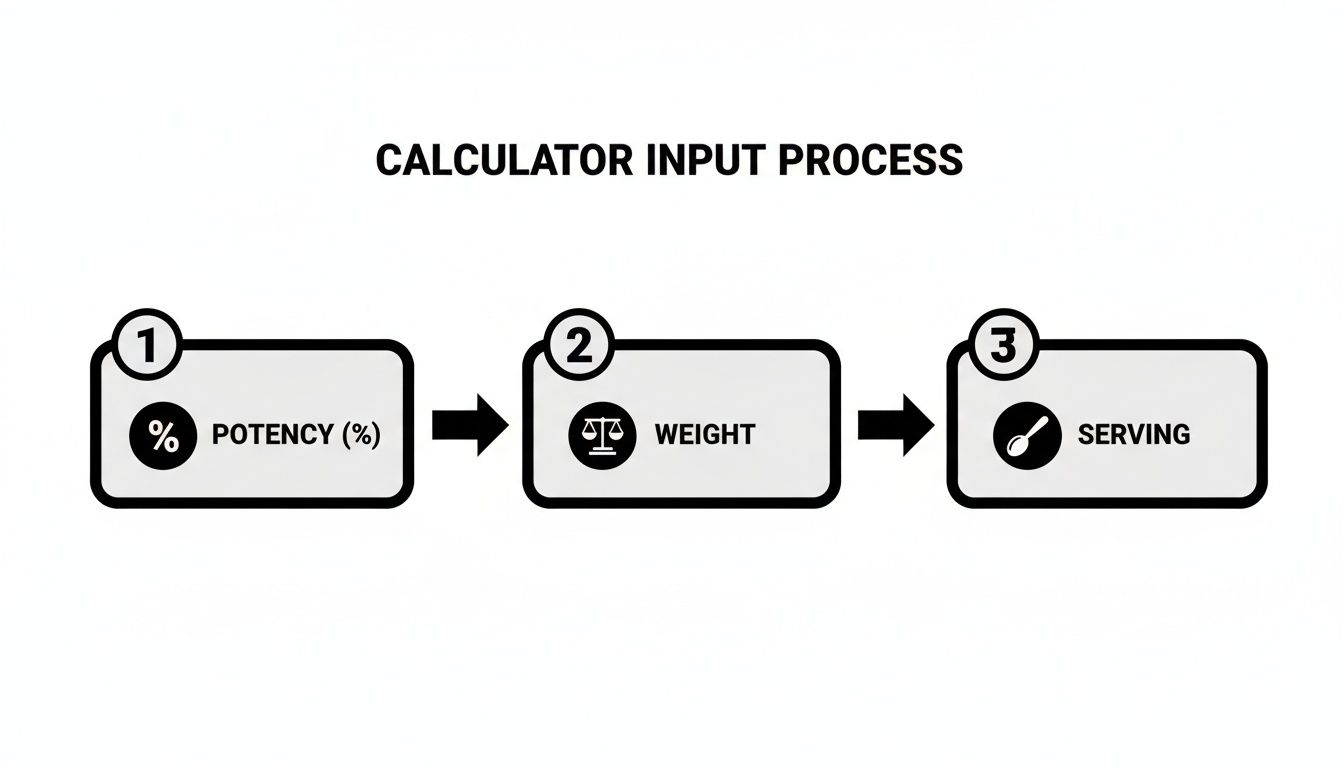
As you can see, potency, total weight, and your desired serving size are the three pillars of a solid dosage calculation.
Figuring Out Your Number of Servings
Once you know the total THC in your syringe, the next step is figuring out how many individual servings you can get from it. This part is all about your personal goals and what starting dose feels right for you.
Let’s stick with our example of the syringe containing 800 mg of total THC. If you're new to RSO or following a careful titration plan, a common starting point is around 10 mg of THC per serving.
The calculator simply divides the total THC by your desired dose:
- Calculation: 800 mg Total THC / 10 mg per Serving = 80 Servings
Just like that, you know your 1-gram syringe provides 80 individual 10 mg servings. This kind of clarity is empowering. It lets you plan your regimen for weeks, ensuring you have consistency and control over your experience. If you need a refresher on edible THC dosage in milligrams, our guide on how to determine your ideal THC mg dosage is a great resource.
The math isn't complicated, but it's powerful. This precision has become more vital than ever. The global cannabis oil market, which hit USD 1,206 million in 2024, is projected to surge to USD 7,782 million by 2032—a massive compound annual growth rate (CAGR) of 31.3%. This explosive growth shows just how many people, from first-time users to long-time health seekers, are looking for safe, reliable ways to use potent extracts like RSO.
When you understand these simple calculations, you move beyond guesswork. You can see exactly how the calculator gets its numbers, which builds trust and helps you truly own your health journey.
Fine-Tuning Your Regimen With Advanced Concepts
Once you have a handle on the basic math, you can start refining your approach. Mastering your RSO regimen isn't just about knowing how much to take; it’s about understanding how your body actually puts it to use. Two of the most important concepts to get a grip on are bioavailability and titration.
Think of bioavailability as your body’s efficiency rate—the dose you swallow isn't the same as the dose your body ultimately absorbs. Titration, on the other hand, is the art of finding your perfect dose by making small, gradual adjustments over time. When you combine these two ideas, you transform a simple dosing plan into a truly personalized strategy.
Maximizing Absorption with Bioavailability
Bioavailability is just a technical term for the percentage of a substance that actually makes it into your bloodstream. When you eat an edible or take RSO orally, it has to pass through your digestive system and liver first. This journey, known as the "first-pass effect," takes a toll and significantly reduces the amount of active cannabinoids your body can use.
For orally consumed oils like RSO, bioavailability is typically estimated to be somewhere between 10% and 20%. What does that mean in the real world? If you take a 10 mg dose, your body might only absorb and utilize 1 to 2 mg of it.
This is a critical piece of the puzzle. You might need a higher calculated dose to feel the effects you're looking for, simply because only a fraction of it gets into your system. Understanding this helps you make smarter decisions when adjusting your regimen.
One of the easiest ways to boost the bioavailability of cannabinoids is to take them with a little healthy fat. Cannabinoids are lipophilic, which means they are fat-soluble. Pairing your dose with foods like avocado, nuts, olive oil, or coconut oil can help your body absorb a much greater amount.
The Art of Titration: Finding Your Sweet Spot
Titration is the absolute cornerstone of a safe and effective regimen. It’s a methodical process where you start with a tiny dose and slowly increase it over days or weeks until you find the minimum amount that gives you the results you want. This "start low, go slow" approach is the best way to avoid uncomfortable effects while letting your body adapt.
An edible dosage calculator becomes your best friend during this process, allowing you to plan your increases with precision. For instance, if you start with a 5 mg dose, you can use the calculator to figure out exactly how to measure a 7 mg or 10 mg dose for your next step up.
Here’s what a sample titration schedule might look like:
- Days 1-3: Begin with a 5 mg dose of THC once per day. Pay close attention to how you feel and keep notes in a journal.
- Days 4-6: If you’re tolerating the initial dose well but aren't getting the desired effects, increase it to 7.5 mg daily.
- Days 7-9: Continue increasing by 2.5 mg every few days, always listening to your body.
- Ongoing: Once you hit a dose that delivers noticeable benefits without any unwanted side effects, you've found your sweet spot. You can stay at this dose or continue titrating if your needs change.
The rise of user-friendly tools has been a game-changer for people turning to RSO, especially as the market for cannabis oils is projected to explode from USD 1,280 million in 2025 to USD 7,782 million by 2032. Despite this growth, consumer surveys reveal that 40% of users still find dosing to be their biggest hurdle. To learn more about these market trends, you can find great insights on ABN Newswire. Calculators close this knowledge gap by factoring in key variables like bioavailability, helping you get better results.
By pairing a solid understanding of bioavailability with a patient titration strategy, you put yourself in the driver's seat of your wellness journey. This thoughtful approach is the key to an effective and sustainable experience.
Practical Tips for Safe and Consistent Dosing
Using a dosage calculator gives you an excellent, reliable starting point. But the real art and science of a successful RSO regimen come from how you apply that knowledge to your daily life. A calculated number is just the beginning; building a safe, consistent, and positive routine is what truly matters.
From years of helping people on their health journeys, we know that consistency is king. Taking your dose around the same time each day helps maintain stable cannabinoid levels in your system. This simple habit leads to much more predictable and sustained effects, allowing your body to acclimate properly and reducing the chance of surprises.
The Power of a Dosage Journal
One of the most powerful tools you can use is a simple dosage journal. Seriously, don't skip this. It doesn’t have to be fancy—a small notebook or a notes app on your phone is perfect. Documenting your journey is invaluable for fine-tuning your regimen over time.
For each dose, you’ll want to track a few key things:
- The Dose: Note the exact milligram amount you took, based on your calculator's output.
- The Time: When did you take it? This helps identify patterns in onset and duration.
- How You Felt: A few words about your physical and mental state before and a few hours after.
- Other Factors: Did you eat a big meal? Were you particularly active? Jot down anything that might have an impact.
This practice turns your personal experience into hard data, empowering you to make smart adjustments. You’ll quickly see how small changes impact your results, letting you dial in the perfect routine for your specific needs.
What to Do If You Take Too Much
Even with careful planning, mistakes happen. It’s possible to accidentally take more than you intended. The most important thing is to stay calm and remember that the uncomfortable feelings are temporary. They will pass.
If you find yourself in this situation, here are a few things that can help you feel more comfortable:
- Hydrate. Sip on water or a calming herbal tea.
- Find a quiet spot. Lie down in a comfortable room with low light.
- Distract yourself. Put on some soothing music, a familiar movie, or try some deep breathing exercises.
- Have a light snack. Some people find a simple snack helps them feel more grounded.
Understanding onset times is also key to prevention. If you're new to edibles, our guide on how long it takes for gummies to activate offers some great context for timing your dose safely.
Reinforcing the Golden Rule
If you take away just one thing, let it be this: start low and go slow. This principle is the absolute foundation of a safe and successful experience. Your body is unique, and finding the right dose is a personal journey of discovery, not a race.
An edible dosage calculator is the perfect tool for starting this journey correctly. It gives you the precision to begin with a true microdose—maybe just 2.5 mg to 5 mg—and increase gradually from there.
This patient, methodical approach ensures your experience is always controlled, positive, and focused squarely on your well-being. By combining precise calculations with consistent habits and mindful self-monitoring, you can build a wellness routine that is both safe and profoundly effective.
Common Questions About Dosing Concentrated Cannabis Oil
Let's be honest: even with the best dosage calculator, turning those numbers into a real-world, consistent regimen can feel tricky. You're not alone if you've run into a few practical snags. Over the years, we've heard the same questions pop up again and again.
Here are some straightforward answers to help you navigate those common hurdles with confidence.
How Can I Accurately Measure a Tiny Dose?
This is probably the biggest challenge for anyone starting out. When your target is a 5 mg or 10 mg dose—often the size of a single grain of rice—trying to eyeball it from a syringe is a recipe for frustration and inconsistency.
Here's a simple technique we always recommend:
- Squeeze a small, thin line of oil onto a piece of parchment or wax paper.
- Grab a clean toothpick or a dab tool and use it to slice that line into smaller, equal-sized pieces.
- For instance, if you dispense a line that looks like it's about four grains of rice, you can carefully cut it into four individual doses.
This little trick removes the guesswork and gives you way more control. It ensures that when you're starting low and slow, your doses are actually as consistent as you think they are.
What If My Product Has No Lab Report?
If you have a product without a Certificate of Analysis (COA) or any listed THC percentage, you're essentially flying blind. A lab report is the only real assurance you have of what’s inside—both in terms of potency and purity. Without it, any number you plug into an edible dosage calculator is a complete shot in the dark.
Our best advice is to always seek out lab-verified products. But if you're in a situation where you must use an untested product, you're doing so entirely at your own risk. Start with a dose smaller than the head of a pin and wait at least a few hours to see how you feel. We cannot stress this enough: it's not a recommended practice. Safety and predictability are everything when you're using cannabis for your health.
Can This Calculator Work for Other Products?
The core math—turning a percentage into a milligram amount—is pretty universal. So yes, you could adapt the logic for something like a tincture, but you’ll need to adjust your inputs.
With a tincture, the key numbers are the total cannabinoid content of the bottle (say, 1000 mg of THC) and the total volume of liquid (like 30 ml). From there, you'd figure out the potency per milliliter (1000 mg / 30 ml = 33.3 mg/ml) and use a measured dropper to dose. The principle is the same, but the variables are different.
While the logic holds up, a tool built specifically for oil concentrates like RSO is always going to be the most direct and error-proof way to go for that product. Always double-check that your inputs match the product you're working with.
How Long Should I Wait Before Taking More?
Patience isn't just a virtue here; it's a requirement. The delayed onset of edibles is real. Since the cannabinoids have to make their way through your digestive system, it can take anywhere from 60 minutes to over two hours to feel the full effects.
You absolutely must wait at least two to three hours after your first dose before even thinking about taking more. Redosing too early is how "dose stacking" happens—the first dose finally peaks just as the second one is kicking in, which can make for a very uncomfortable and overwhelming experience. It's the most common mistake newcomers make. Give your body plenty of time to respond.
For more in-depth guides and tools to support you, RickSimpsonOil.info has the resources you need to use RSO safely and effectively. Feel free to explore our articles or book a free consultation for personalized support from experts you can trust.
Learn more and find the guidance you need at RickSimpsonOil.info