
When you boil it down, the real difference between delta-9 and delta-10 is all about the experience and potency you're looking for. Delta-9 THC is the classic, heavy-hitter most people associate with cannabis. On the other hand, Delta-10 THC is a much lighter, more energetic, and clear-headed alternative. Your choice really depends on what you need: serious therapeutic support or just a subtle lift to get you through the day.
Understanding The Core Differences Between Cannabinoids
The world of cannabinoids can feel a bit crowded, but getting to know the main compounds is the best way to make a smart choice for your wellness routine. Delta-9-tetrahydrocannabinol (Delta-9 THC) and Delta-10-tetrahydrocannabinol (Delta-10 THC) are two cannabinoids from the cannabis plant. While their names are almost identical, the way they affect your mind and body couldn't be more different.
Delta-9 THC is the most famous psychoactive compound in cannabis, and for good reason—it’s the most abundant. It's the one responsible for the powerful, sometimes sedating, and deeply relaxing effects many people rely on for significant wellness support. Its bond with the body's endocannabinoid system is strong and direct.
In contrast, Delta-10 THC is considered a minor cannabinoid, which just means it shows up in very small amounts naturally. People often describe its effects as being more like a Sativa strain: energizing, creative, and uplifting, but without the intensity of Delta-9. This has made it a go-to for those who want to avoid a strong "high" while still getting some of THC's benefits.
Delta-9 vs Delta-10 At a Glance
To make the delta-9 vs delta-10 comparison even simpler, seeing their main traits side-by-side can be incredibly helpful. This table breaks down the key distinctions between these two cannabinoids at a quick glance.
| Feature | Delta-9 THC | Delta-10 THC |
|---|---|---|
| Primary Effect | Potent, relaxing, euphoric | Mild, energizing, uplifting |
| Psychoactive Potency | High | Low to moderate |
| Typical Use Case | Evening relaxation, deep therapeutic support | Daytime focus, creativity, mood enhancement |
| Natural Abundance | High (major cannabinoid) | Very Low (minor cannabinoid) |
| Legal Source | Marijuana or Hemp (<0.3%) | Hemp-derived |
This quick comparison highlights that your choice really comes down to the specific outcome you’re aiming for.
Why These Distinctions Matter
Knowing the difference is key to matching a cannabinoid to your specific goals. The decision isn't about which one is "better," but which is the right tool for the job.
For someone dealing with significant health challenges, the sheer potency of Delta-9 is often the deciding factor. But for an individual who is sensitive to THC or needs to stay sharp during the day, Delta-10 offers a much more manageable and gentle path.
Making an informed choice is the best way to ensure your experience is both safe and effective. Here at RSOhelp.com, our goal is to give you clear, evidence-based guidance so you can navigate these options with confidence. This foundation will help you better understand the more detailed scientific and practical comparisons we'll explore next.
How Molecular Structure Dictates User Experience
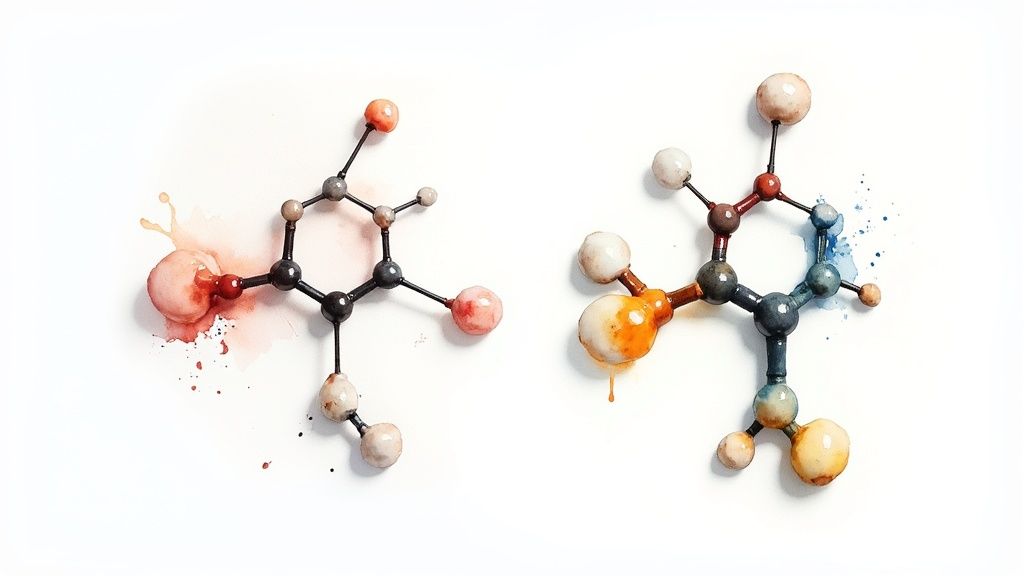
At a glance, you’d be forgiven for thinking Delta-9 and Delta-10 THC are the same thing. They share an identical chemical formula, but a tiny, almost invisible difference in their atomic structure is the very reason they feel so different. The secret is the placement of a single double bond on their carbon chain.
This subtle shift is everything in the delta-9 vs delta-10 conversation. It’s like having two keys that look identical, except one groove is off by a millimeter. One key fits the lock perfectly and turns with ease; the other only goes in part-way, creating a much weaker connection. That’s precisely how these two cannabinoids interact with your body’s receptors.
The Role of The Double Bond
The make-or-break difference is where this double bond sits. Its position dictates how well each molecule can bind to the CB1 receptors in our endocannabinoid system, which are concentrated in the brain and central nervous system.
- Delta-9 THC: The double bond is on the ninth carbon atom of its molecular chain. This structure is a perfect match for our CB1 receptors, allowing it to form a strong, stable connection.
- Delta-10 THC: Here, the double bond has shifted over to the tenth carbon atom. This seemingly minor change alters the molecule's shape just enough to form a much weaker, less stable bond with those same CB1 receptors.
This difference in binding affinity isn't just a chemistry footnote; it’s the fundamental reason Delta-9 is so potent and why Delta-10 offers a gentler ride. A stronger bond translates directly to more intense psychoactive and therapeutic effects. For a deeper dive into how cannabinoid structures activate, our guide comparing THCa vs Delta-9 is a great next step.
From Molecular Shape to Real-World Effects
The practical results of this tiny structural variance are huge. We’ve known for decades that Delta-9 THC is the main psychoactive driver in cannabis. Delta-10, on the other hand, is a newer discovery and is quickly gaining a reputation as a milder alternative. The key takeaway is simple: Delta-9’s bond at the ninth carbon makes it a powerhouse at the brain’s CB1 receptors, while Delta-10’s bond at the tenth carbon leads to a much weaker connection and less intense effects.
This all translates directly to the user's experience.
Because Delta-9 binds so effectively, it delivers the classic, powerful effects we associate with cannabis: deep relaxation, strong euphoria, and noticeable shifts in perception. This potency is precisely why it’s a cornerstone for so many wellness regimens.
Delta-10's weaker interaction means it stimulates the endocannabinoid system more gently. The result is often described as uplifting and energizing, typically without the cognitive "fog" or heavy sedation that can come with stronger doses of Delta-9. This makes it an attractive option for people who want to stay mentally sharp and productive while still getting the benefits of a cannabinoid.
Ultimately, that single atomic shift is what gives you the choice between a profound, immersive experience and a subtle, functional lift.
Comparing The Subjective Effects and Overall Potency
While the molecular science gives us the blueprint, the real story in the delta-9 vs delta-10 debate is all about the user experience. How these compounds actually feel—their subjective effects and overall potency—is what truly matters when you're trying to match a cannabinoid to your wellness goals. The experiences they offer are worlds apart, catering to very different needs.
Delta-9 THC is the original, the classic cannabis experience. Its effects are known for being powerful and, for many, a profound psychoactive journey. People often report intense euphoria, a deep physical relaxation that can feel like it's melting away tension, and a noticeable shift in sensory perception. Colors might seem a bit brighter, music more immersive.
On the other hand, Delta-10 offers a much different vibe. Its interaction with the body’s receptors is far gentler, leading to an experience that’s more functional and less likely to feel overwhelming. Many describe it as energizing and uplifting, delivering a clear-headed boost that can spark creativity and focus without the heavy cognitive fog that sometimes comes with Delta-9.

Situational Use Scenarios
Thinking about when and why you might use each one really brings their different roles into focus. This isn't just about picking the "stronger" one; it's about matching the effect to the occasion.
- For Daytime Productivity and Creativity: This is where Delta-10 shines. Its subtle, stimulating effects can sharpen your focus for a work project or help you brainstorm new ideas without becoming a distraction. It's the kind of cannabinoid you might reach for to make a mundane Tuesday afternoon a little more engaging.
- For Evening Relaxation and Unwinding: Delta-9 is the undisputed champ here. After a long, draining day, its potent relaxing qualities can quiet a racing mind and help your body settle into a state of deep rest. It's perfect for kicking back with a movie, getting lost in an album, or just unplugging from the day's pressures.
- For Deep Therapeutic Support: For those dealing with more significant wellness challenges, the robust effects of Delta-9 are often more appropriate. Its strength is a key reason it's explored for managing more intense discomfort or promoting truly restorative sleep. You can learn more about the therapeutic effects of Delta-9 in some of our other articles.
A Closer Look at Potency Differences
The difference in strength between these two isn't just a minor detail; it's significant. Delta-9 THC binds with serious force to the brain's CB1 receptors, and that powerful connection is the foundation of its well-known effects. In contrast, Delta-10's slightly different molecular shape means it forms a much weaker bond, which directly translates to a milder, more manageable high.
This difference in receptor affinity is everything. Delta-9’s tight grip can be up to 30 times more effective at binding than some of its analogs, creating a truly potent experience. The shifted double bond in Delta-10 drastically reduces this affinity, producing effects that users often describe as a 'fun, moderate' high. User surveys back this up, showing that while 70% of users may prefer Delta-9 for its powerful euphoria, Delta-10 is highly valued by those looking to sidestep heavy intoxication. You can see more data on these cannabinoid user preferences for yourself.
The core takeaway is that potency really dictates suitability. Think of Delta-9 as a powerful tool for significant impact, while Delta-10 is more like a gentle instrument for making subtle adjustments to your mood and energy.
Your Individual Biochemistry Plays a Role
It's absolutely crucial to remember that we're all wired differently. Factors like your metabolism, body weight, existing tolerance, and the unique landscape of your own endocannabinoid system will all shape your personal experience. What feels incredibly relaxing to one person might feel way too sedating for another.
Because of this variability, the golden rule is to always start with a low dose, especially when you’re trying a new cannabinoid for the first time. This gives you a chance to see how your body responds before you gradually increase the amount to find your sweet spot. This mindful, patient approach is a cornerstone of the philosophy here at RSOhelp.com, ensuring you have a safe and positive journey toward your wellness goals.
Aligning Cannabinoids With Your Wellness Goals
When it comes to choosing between cannabinoids, the real question isn't "which one is better?" but rather "which one is right for my specific needs?" The whole delta-9 vs delta 10 debate comes down to practical application. Your personal wellness goals should be the compass that guides your decision, whether you’re looking for powerful relief or just a gentle lift to get through the day.
Delta-9 THC is the heavy hitter. Its potency and well-documented effects make it a serious contender for people managing more significant health challenges. Because of its strong bond with the endocannabinoid system, it’s often the go-to for situations that demand robust support, like chronic discomfort, severe nausea, or appetite loss. When you need something substantial, Delta-9 is typically the more effective tool for the job.
On the other hand, Delta-10 offers a completely different vibe. Its effects are much milder and tend to be more energizing, positioning it as a great option for tackling less intense, day-to-day issues. Many people find it helpful for taking the edge off stress or lifting a low mood, especially when they can't afford to sacrifice mental clarity or productivity.
Matching Cannabinoids To Specific Symptoms
The best way to decide is to think of these cannabinoids as different tools in a toolkit, each suited for a particular task.
- For Significant Symptom Management: If you're trying to manage deep-seated discomfort or a stubborn lack of appetite, Delta-9’s powerful effects are usually the more direct route. Its capacity for profound relaxation can be exactly what’s needed in these scenarios.
- For Daily Stress and Mood Support: For those just looking to ease the tension of a stressful day without feeling couch-locked, Delta-10 is often a better fit. Its uplifting qualities can help cultivate a more positive, balanced outlook, making daily responsibilities feel a bit less daunting.
Considering A Broader Wellness Strategy
It’s also smart to think about how these compounds fit into your overall health routine. True wellness rarely comes from a single magic bullet; it's usually a combination of supportive practices. This is especially true if you’re using full-spectrum products, which pack in a whole symphony of cannabinoids and terpenes that work in concert.
For example, someone following a regimen with full-extract cannabis oil might use a small dose of Delta-10 during the day for focus and energy, while reserving their main full-spectrum product for the evening to promote deep, restorative rest. You can learn more about the composition of full-extract cannabis oil right here on our site. This kind of layered strategy allows for more tailored support that adapts to the different demands of your day.
The key is to think about your entire day. If you need to remain functional and engaged from morning to evening, a less potent cannabinoid like Delta-10 might be more appropriate for daytime use. If your primary goal is to find rest and relief at the end of the day, Delta-9's potent effects are better suited for that window.
Thinking strategically turns these compounds from blunt instruments into precise tools for well-being. This trend toward customized cannabinoid use is backed by emerging research. A 2023 study focusing on Delta-8 users—a cannabinoid with a similarly mild profile to Delta-10—found that around 50% of people were using it for specific health reasons. They were looking for relief from things like panic attacks, stress, and chronic pain, seeing it as a gentler alternative to Delta-9 with fewer side effects. This data clearly shows a growing demand for cannabinoid options that provide genuine support without being overwhelming—a role Delta-10 seems perfectly suited to fill.
Navigating Legal Frameworks and Staying Safe
Trying to figure out the legal status of cannabinoids can feel complicated. When it comes to delta-9 vs delta-10, the entire legal conversation boils down to a complex web of federal and state laws, with one key distinction: where the cannabinoid came from.
It all goes back to the 2018 U.S. Farm Bill. This single piece of legislation federally legalized industrial hemp, defining it as any cannabis plant containing no more than 0.3% Delta-9 THC by dry weight. This simple number effectively split the cannabis plant into two legal camps: "hemp" (at or below the threshold) and "marijuana" (anything above it). This opened up a massive legal pathway for cannabinoids derived from hemp, including Delta-10.
Because Delta-10 is typically synthesized from hemp-derived CBD, it often has a clearer legal path to market than its more famous cousin. While Delta-9 from marijuana is still a federally controlled substance, a curious technicality allows for hemp-derived Delta-9 products to be sold, as long as they adhere to that strict 0.3% limit. This has led to the flood of hemp-based products we see today.
State Laws Can Change Everything
But federal law is only part of the picture. The Farm Bill gave states the power to write their own rules, and many have taken a much stricter approach. Some states have specifically banned or heavily restricted intoxicating hemp-derived cannabinoids like Delta-10, creating a confusing patchwork of regulations across the country.
These laws are always in flux, so it's absolutely critical to check the specific rules in your state before making a purchase. What’s sold legally in one state could cause issues in another. Staying informed is just part of being a responsible consumer.
Your Safety in an Emerging Market
This legal gray area has created a market that's a bit like the Wild West—largely unregulated. This puts the responsibility squarely on your shoulders to make sure the products you buy are safe and legitimate. Without strong federal oversight, the quality, purity, and even the potency of what's advertised can be all over the map.
This is where doing your homework is non-negotiable. Your single most important tool for this is the Certificate of Analysis (COA).
A COA is an independent, third-party lab report that verifies exactly what's in a product. It's the only real proof you have that the label is accurate and that the product is free from nasty stuff like pesticides, heavy metals, or leftover solvents.
Here at RSOhelp.com, we put safety and transparency above all else. We believe everyone has a right to clean, honestly labeled products. That's why we urge you to only buy from brands that provide a complete, up-to-date COA for every single batch they produce. This simple step protects your health and ensures your experience is a good one.
By 2023, Delta-8—which is structurally very similar to Delta-10—had become the most popular hemp-derived THC, with Delta-10 following close behind. Both exploded in popularity thanks to the legal loophole in the 2018 U.S. Farm Bill. You can read more about how cannabis-derived products are viewed legally to get a deeper sense of the nuances. Ultimately, making a smart choice isn't just about knowing what you're taking—it's about knowing it's safe.
Making An Informed Choice For Your Needs
So, how do you actually choose between delta-9 and delta-10? It really boils down to what you’re trying to accomplish. The "right" cannabinoid is simply the one that fits your wellness goals and the specific moment, whether you need powerful therapeutic relief or just a gentle lift to get you through the day.
The easiest way to think about it is to match the cannabinoid to the time of day and what you need to get done. Your choice should align with the demands of the situation.
Situational Recommendations
-
Choose Delta-10 For Daytime And Creative Pursuits: If you're looking for a boost in focus, a spark of creativity, or just an elevated mood without feeling weighed down, Delta-10 is the clear winner. Its effects are often described as energizing and clear-headed, making it a great companion for work projects, social events, or artistic hobbies where you need to stay sharp.
-
Opt For Delta-9 For Evening Relaxation And Deep Support: When your goal is to truly unwind, tackle significant discomfort, or sink into deep relaxation, nothing quite matches the potency of Delta-9. Its profound effects are best reserved for evenings or days off when you can fully disconnect and give your mind and body a chance to recover.
Think of it this way: Delta-9 is your powerful tool for evening and serious therapeutic needs, while Delta-10 is the functional, uplifting option for your daytime hustle.
Dosing For A Safe And Effective Experience
No matter which one you pick, approaching dosing with a bit of mindfulness is key to a good experience. This is non-negotiable if you’re new to either of these compounds or just know you have a lower tolerance.
The golden rule here is to start low and go slow. A dose of just 2-5mg is a conservative and safe place to begin. This gives you a chance to see how your body reacts before you slowly increase the amount. The goal is to find your personal sweet spot—that perfect dose that gives you the benefits you want without any unwelcome side effects.
For our community at RSOhelp.com, these cannabinoids can also play a role in a broader, full-spectrum regimen. A small dose of Delta-10 could provide that daytime lift without getting in the way of a more potent evening protocol, giving you tailored support around the clock.
This decision tree helps visualize how to choose products safely, especially when the market isn't well-regulated. The main takeaway? Prioritize third-party lab testing.
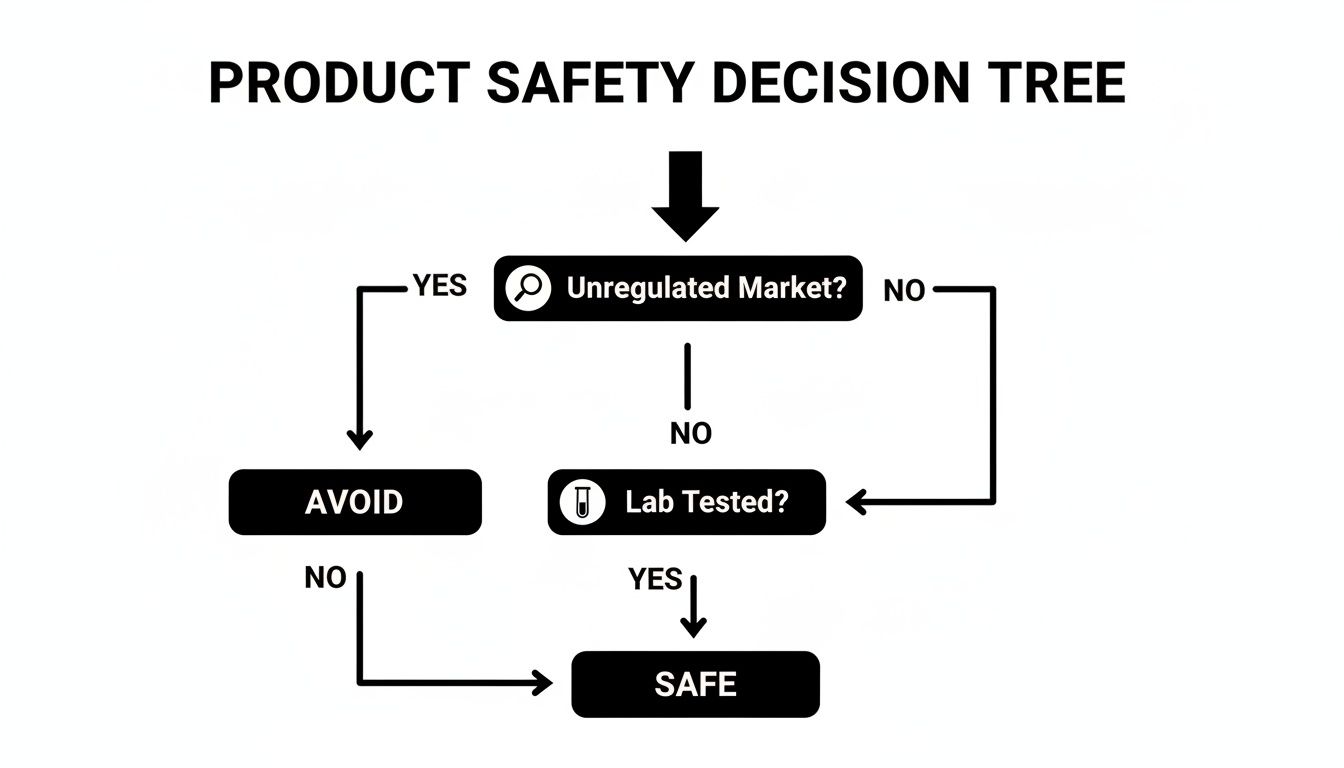
The image drives home an important point: a product’s safety is entirely dependent on verified lab results that confirm its purity and potency.
This cautious approach is backed by science. For instance, a 2023 study found that a 20mg vaped dose of Delta-9 could cause peak cognitive impairments of up to -30% in the accuracy of certain tasks. Milder compounds like Delta-10, on the other hand, are known for producing far less noticeable cognitive effects, which is why they’re better suited for functional daytime use. You can learn more about these pharmacodynamic differences online. By keeping these factors in mind, you can make these cannabinoids a safe and effective part of your wellness plan.
Tying Up Loose Ends: Your Questions Answered
Even after a detailed comparison, you might still have a few questions about how delta-9 and delta-10 THC stack up in the real world. Let's clear up some of the most common ones.
Which Is Stronger, Delta-9 Or Delta-10?
There’s no contest here: Delta-9 THC is significantly stronger than its delta-10 counterpart. It all comes down to chemistry. Delta-9’s molecular shape gives it a high affinity for the brain's CB1 receptors, creating a powerful bond that results in much more intense psychoactive effects.
Delta-10, on the other hand, provides a far more subtle experience. People often describe its effects as energizing and lucid, which makes it a great starting point for anyone who finds traditional delta-9 too potent or sedating.
Is Delta-10 A Good Choice For Daytime Focus?
Absolutely. In fact, many people specifically seek out delta-10 for daytime use. Users consistently report that it delivers an uplifting, Sativa-like boost that helps with creativity and concentration, but without the mental fog that delta-9 can sometimes cause.
Its gentle psychoactivity makes it a practical option for work, social gatherings, or creative sessions where you need to stay sharp and engaged.
Think of it this way: Delta-9 is often for unwinding at the end of the day. Delta-10 is for getting things done during it. The difference really comes down to functionality.
How Can I Be Sure A Delta-10 Product Is Safe?
This is a critical question, especially since the market for hemp-derived cannabinoids isn't tightly regulated. The single most important document you need to check is the third-party lab report, also known as a Certificate of Analysis (COA).
Any reputable brand will make these COAs easy to find for every product. A proper COA doesn't just confirm cannabinoid potency; it proves the product is clean and free from harmful contaminants you don't want to ingest.
Look for tests that screen for:
- Pesticides
- Heavy metals
- Residual solvents from the manufacturing process
If a company can't or won't provide a recent COA, walk away. It's the only real way to know that what you’re buying is safe and accurately labeled.
At RSOhelp.com, our mission is to empower you with clear, evidence-based information for your health journey. If you need personalized guidance on full-spectrum cannabis oils, you can find our free educational resources and consultations at https://ricksimpsonoil.info.