

Yes, THC can absolutely be absorbed through the skin. But whether it stays local or travels throughout your body is a completely different story—and it all comes down to the product you’re using. A standard cannabis-infused lotion is designed to work right where you put it, while a transdermal patch is engineered to push THC into your bloodstream for systemic effects.
How THC Interacts with Your Skin
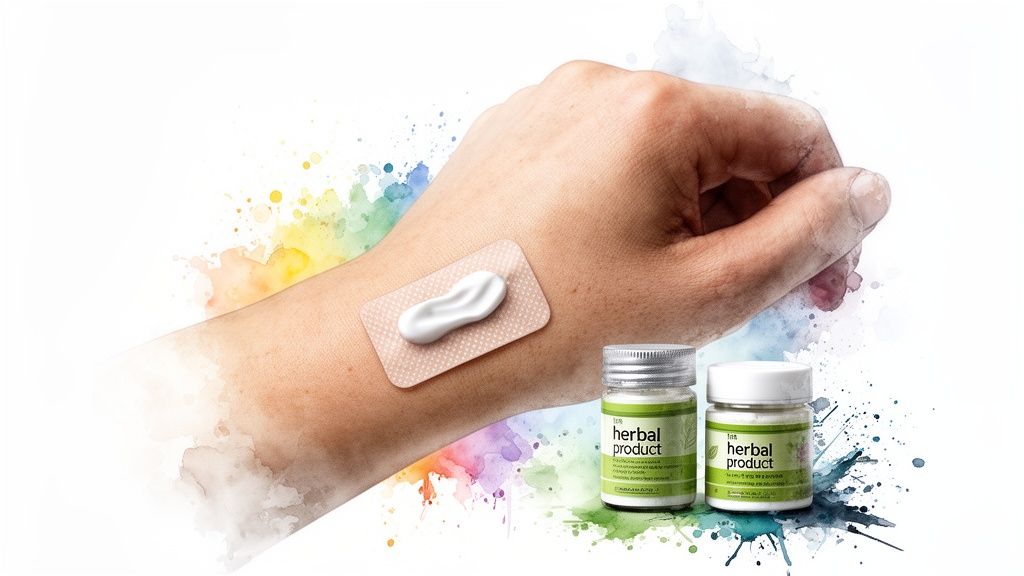
Think of your skin as an incredibly effective security guard. Its main job is to keep things out, which makes it a tough barrier to get past. For a molecule like THC to get through, it needs the right credentials, and that’s where the formulation of a product becomes everything.
The real question isn't just if THC can get through the skin, but how it gets through and what it does once it’s there.
There are two distinct pathways for THC when applied to the skin, each with a very different goal.
Topical vs. Transdermal THC Application At a Glance
To make this clear, let's break down the key differences between a standard topical and a more advanced transdermal product. This quick comparison should help you understand why two products that go on your skin can have such wildly different effects.
| Feature | Topical Application (e.g., standard lotions) | Transdermal Application (e.g., specialized patches, enhanced RSO) |
|---|---|---|
| Primary Goal | Localized relief on the skin and underlying tissues. | Systemic (full-body) effects. |
| Depth of Penetration | Interacts with cannabinoid receptors in the skin layers (epidermis and dermis). | Passes through all skin layers to reach the capillaries and bloodstream. |
| Enters Bloodstream? | No. The active compounds do not reach systemic circulation. | Yes. Designed specifically to enter the bloodstream. |
| Psychoactive Effects | None. | Possible, depending on the dose and individual metabolism. |
| Common Product Types | Creams, balms, salves, lotions, massage oils. | Patches, specialized gels, and enhanced oils formulated with permeation enhancers. |
| Typical Use Case | Managing localized discomfort or skin conditions in a specific area. | A slow, sustained-release method for whole-body effects without inhalation or ingestion. |
| Formulation Strategy | Uses carrier oils to help cannabinoids interact with local receptors. | Includes permeation enhancers (chemicals that make the skin temporarily more porous). |
Ultimately, knowing whether you need local relief or a systemic effect is the first step in choosing the right product. While both are "topicals" in the sense that you apply them to your skin, their internal journey and end results couldn't be more different.
What About Potent Extracts Like RSO?
Potent, thick extracts like Rick Simpson Oil (RSO), also called Full Extract Cannabis Oil (FECO), are often considered for skin application because they are so concentrated. But just smearing raw RSO on your skin isn't a guarantee of effective absorption.
The formulation is still king. How well the cannabinoids can even begin to interact with your skin depends heavily on the carrier oils and other ingredients mixed with the extract.
For anyone looking into these more advanced applications, reliable information is crucial. Educational platforms like RSOhelp.com offer valuable guidance on using concentrated cannabis oils safely, always focusing on informed wellness practices rather than making direct health claims.
The Science Is In: THC Skin Absorption Is Real
For a long time, the idea that THC could actually enter the bloodstream through the skin was more theory than fact. But the science has finally caught up.
A groundbreaking 2023 pharmacokinetic study was the first of its kind to prove that THC from a transdermal patch can be absorbed through human skin and show up in detectable levels in the blood. If you're interested in the details, you can read more about this groundbreaking study on THC skin absorption and its findings. This research settles the debate: with the right delivery technology, THC can definitely cross the skin barrier and circulate systemically.
Your Skin's Built-in Fortress
Before we can answer the big question—"can you absorb THC through your skin?"—we need to take a quick look at what it’s up against. Your skin is far more than just a simple covering; it’s an incredibly sophisticated, multi-layered shield designed to keep intruders out and vital moisture in.
The main line of defense is the outermost layer, called the stratum corneum. A great way to think of it is like a tightly sealed brick wall. The "bricks" are dead skin cells (corneocytes), and the "mortar" holding everything together is a rich mixture of natural fats, or lipids. This design is exceptionally good at preventing most things from getting through.
So, for any substance to breach this wall, it needs a special key. This is where THC has a bit of an edge.
The Problem with Getting Past the Wall
Molecules like THC are lipophilic, which is a fancy way of saying they are “fat-loving.” Since the mortar in our skin's brick wall is made of lipids, THC molecules are naturally drawn to it. They can buddy up with this fatty barrier in a way that water-based compounds just can't.
But that’s only half the battle. While its fat-loving nature helps THC get to the front door, it runs into another big problem: its size. The molecules are just too large. The bricks and mortar of the stratum corneum are packed so tightly that big molecules have a tough time squeezing through the microscopic gaps.
Think of it this way: THC has the right chemical password to get to the gate (it's fat-soluble), but it's physically too big to fit through the keyhole. This is the exact problem that well-designed topicals are engineered to solve.
For a product to work, it has to do more than just contain THC. It needs a formulation that can help temporarily loosen that mortar or find a way to escort the molecule through the barrier.
What Affects Your Skin's Defenses?
It's also important to remember that your skin isn't the same every day. A handful of personal and environmental factors can make this natural shield stronger or weaker, which in turn affects how well any topical product is going to work for you.
Here are three of the biggest factors at play:
- Skin Condition: Healthy, intact skin is your body's best defense. But things like cuts, scrapes, rashes, eczema, or even just really dry, cracked skin can create tiny gaps in that brick wall. These breaches can lead to more absorption than you might intend, so it's always smart to apply topicals only to healthy skin.
- Hydration: Skin that's well-hydrated is more flexible and can be a bit more permeable than skin that's parched and tight. When your skin has enough moisture, its barrier is in top shape, but it may also allow for a more consistent and even absorption of fat-soluble compounds.
- Warmth and Blood Flow: Ever notice how a warm bath seems to make lotions soak in better? Applying a warm compress or gently massaging an area before putting on a topical can boost local blood flow and make the skin a little more receptive.
Understanding these variables helps explain why two people can have different experiences with the same product, or why your own results might vary from day to day. While a great formulation can help overcome these inconsistencies, they always play a role. At the end of the day, getting the most out of a THC topical starts with respecting the powerful fortress that is your skin.
The Science of How THC Penetrates the Skin
So, if our skin is such an amazing gatekeeper, how do effective THC topicals actually get through? It’s not magic—it’s just clever formulation science. You can’t simply mix THC into a generic lotion and expect results. The cannabinoid molecules are big and fat-loving (lipophilic), which means they tend to get stuck in the skin's oily outer layer.
To get around this, product formulators have to act like strategists, finding ways to create temporary openings in that "brick wall" of the stratum corneum. This is where penetration enhancers come into the picture. These are specialized ingredients that help escort compounds like THC across the skin’s defenses.
Think of them as microscopic keys. They gently and temporarily unlock the tight connections between your skin cells, creating tiny pathways for larger molecules to slip through to the deeper layers where they can get to work.
This flowchart gives you a simple visual of how cannabinoids must navigate the skin's natural barrier.
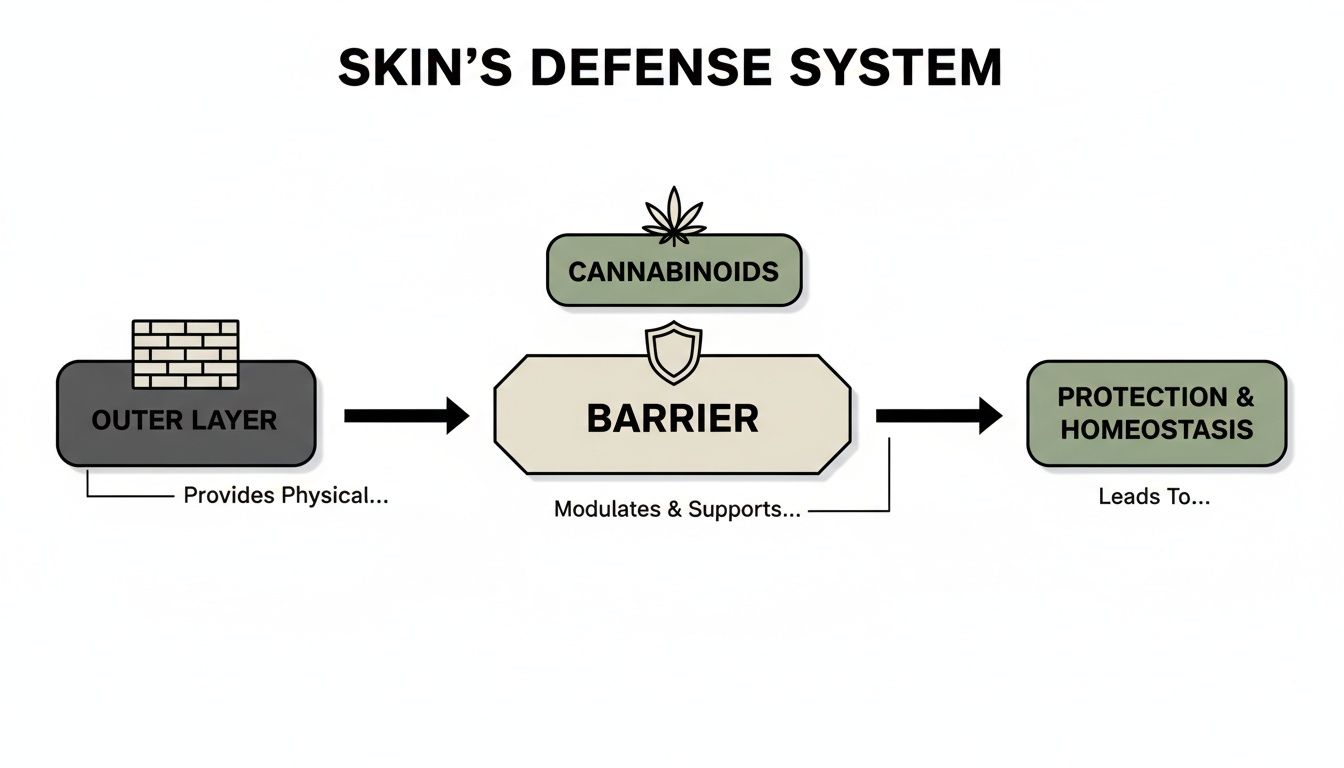
As you can see, bypassing that tough outer layer is the central challenge, which is exactly why sophisticated formulation is non-negotiable for an effective product.
Unlocking the Skin with Natural Allies
Not all penetration enhancers are synthetic chemicals made in a lab. In fact, some of the best ones are natural compounds found right inside the cannabis plant itself—specifically, terpenes.
These aromatic molecules do a lot more than just give cannabis its signature smell. Certain terpenes, like limonene, myrcene, and pinene, can actually interact with the skin's lipid barrier, making it a bit more fluid and permeable. When they're part of a topical formula, they can give THC a significant absorption boost.
Other common natural enhancers include:
- Essential Oils: Many essential oils, like eucalyptus and peppermint, are rich in terpenes that double as natural penetration enhancers.
- Solvents: Certain alcohols, like ethanol, can temporarily disrupt the skin's oily structure, opening up pathways for cannabinoids to pass through.
- Fatty Acids: Oleic acid, which you'll find in olive oil, is another well-known enhancer that improves how well fat-soluble compounds are absorbed.
A well-crafted topical, especially a high-quality full-spectrum extract, uses a blend of these elements that work together synergistically. The real art is improving absorption without causing skin irritation, a delicate balance that requires real expertise. You can dive deeper into how different methods preserve these crucial compounds in our guide on THC oil extraction.
Shrinking Molecules for Better Access
Another smart strategy for getting THC through the skin involves changing the size of the THC particles themselves. This is where nano-emulsions come in. This advanced technique breaks down cannabinoid oils into incredibly tiny droplets, often smaller than 100 nanometers. To put that in perspective, a single human hair is about 80,000-100,000 nanometers wide.
By making the THC particles so small, they can more easily navigate the microscopic pathways of the stratum corneum. Instead of trying to force their way through the skin's defenses, they can simply slip past them. This dramatically increases the bioavailability of the topical, making sure more of the active ingredient actually reaches its target.
Solid research backs up just how important these formulation strategies are. A key study from 2022 that quantified THC skin permeation found that up to 15-20% of the applied dose could cross into the skin's receptor compartments over a 24-hour period. That same study showed that particle size was a game-changer: nano-emulsions under 200 nm demonstrated 2.5 times higher absorption than their larger-particle counterparts. This really highlights the scientific precision required to make a topical that truly works.
Ultimately, whether THC can be absorbed through the skin effectively comes down to the intelligence behind the product's design. This is why turning to educational resources like RSOhelp.com is so valuable; they emphasize the importance of lab-verified, scientifically sound formulations that deliver predictable and reliable results for your wellness journey.
Making RSO Work for You Topically
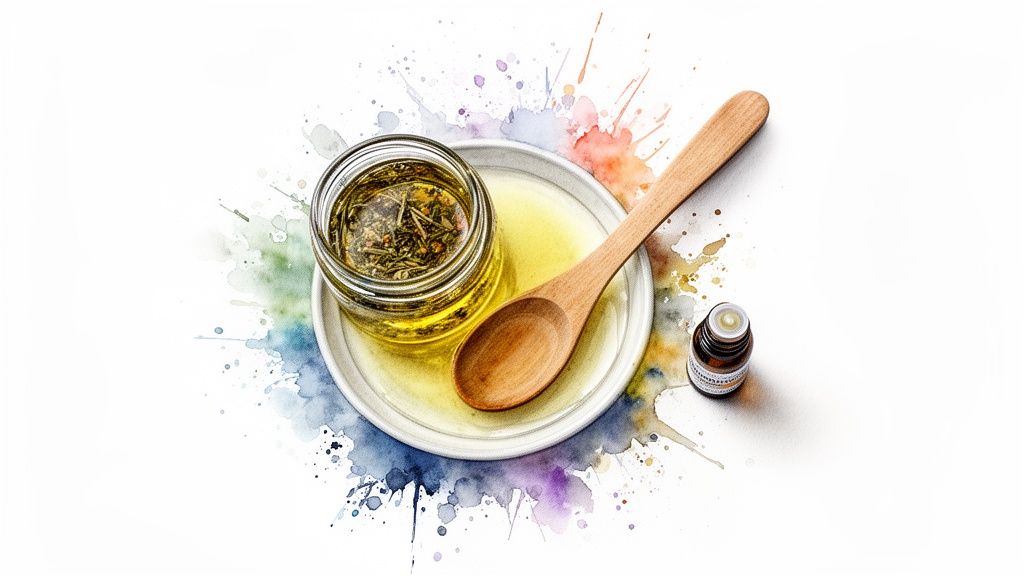
Many people who turn to concentrated cannabis extracts eventually wonder about applying Rick Simpson Oil (RSO) directly to their skin. While RSO is a powerful, full-spectrum product loaded with cannabinoids and terpenes, its raw form is a real hurdle for topical use. The problem is its consistency—it’s thick, sticky, and tar-like, making it nearly impossible for the skin to absorb on its own.
If you just smear straight RSO on your skin, you’re not likely to see the results you’re hoping for. The cannabinoids will mostly just sit on the surface, blocked by the skin’s protective outer layer. To unlock RSO's topical potential, you have to prepare it properly by blending it into a carrier formula that improves both its texture and its ability to sink in.
This is a non-negotiable step. Without it, you're essentially wasting a valuable product and missing out on what it could do.
How to Create an Effective RSO Topical at Home
The secret to making RSO work topically is diluting it with a good carrier oil. This simple step thins the thick extract, making it easy to spread and helping its valuable compounds get to work on your skin. Think of the carrier oil as a delivery truck, designed to get the cannabinoids past that initial skin barrier.
The carrier you choose matters, as different oils bring their own unique properties to the table, which can complement the RSO beautifully.
Here are a few of the best carrier oils to work with:
- Coconut Oil: This is a fantastic choice because it's rich in fatty acids, making it a great moisturizer with skin-soothing properties. Since it’s semi-solid at room temperature, it helps create a lovely, balm-like texture.
- Olive Oil: A classic for a reason. Olive oil contains oleic acid, which is a known natural permeation enhancer. That means it helps fat-soluble compounds like THC absorb better.
- Shea Butter or Cocoa Butter: If you want a thicker salve or cream, these are your go-to options. They are incredibly moisturizing and form a protective layer on the skin, giving the cannabinoids more time to be absorbed.
For anyone just starting out, it's helpful to understand what makes this extract unique in the first place. You can get a solid foundation by reading this detailed guide on Rick Simpson cannabis oil, which covers its various applications.
Upgrading Your Formula with Terpenes
To give your homemade RSO topical an extra edge, you can mix in certain essential oils. Many of these are packed with terpenes—the same aromatic compounds we talked about earlier that are found in the cannabis plant itself. Some terpenes are natural penetration enhancers, meaning they can temporarily make the skin more receptive to cannabinoids.
Just a few drops of the right essential oil can make a real difference.
When you’re creating a topical, you’re aiming for synergy. The carrier oil improves the feel and spreadability, while certain terpenes can help boost absorption. This combination ensures the cannabinoids are delivered more effectively to the local cannabinoid receptors in your skin.
Consider adding a drop or two of one of these:
- Peppermint Oil: It contains menthol, which not only creates a pleasant cooling sensation but can also increase blood flow to the area, potentially helping with absorption.
- Eucalyptus Oil: This oil is rich in a terpene called eucalyptol, known for its soothing qualities and its ability to help other compounds penetrate the skin.
- Lavender Oil: A popular choice for its calming scent, lavender oil contains linalool, a terpene that is also recognized for its soothing effects on the skin.
Our goal is always to provide safe, practical wellness strategies that help you get the most from your RSO. By carefully preparing it with the right carrier and enhancing it with beneficial terpenes, you can create a personalized topical that’s designed for maximum benefit.
Practical Applications and Safety Guidelines
Knowing the science behind THC skin absorption is one thing, but putting that knowledge to use safely is what really matters. Let’s shift from the "how" and "why" to the practical side of things. Even with a topical product, a mindful approach is key to getting the results you want without any unwelcome surprises.
Always Do a Patch Test First
Before you go all-in with any new topical—especially something as concentrated as RSO—the first step is a simple patch test. Think of it as a quick safety check to make sure your skin gets along with all the ingredients in the formula.
It's easy. Just dab a small amount of the product on a discreet patch of skin, like the inside of your wrist or elbow. Cover it with a bandage and leave it alone for at least 24 hours. If you see any redness, itching, or irritation, that product isn't for you.
Start Low and Go Slow
The golden rule of cannabis holds true even when you're applying it to your skin. Always start with a small amount of any new topical. This gives you a chance to see how your body responds to that specific product, because not all topicals are created equal.
This is especially critical if you’re new to using RSO this way. Research has shown that THC's journey through the skin can be a bit unpredictable, with absorption rates swinging anywhere from 5% to 25%. With that much variation, starting small and slowly increasing the amount is the smartest path forward. For a deeper dive into finding the right amount, our guide on RSO oil dosing protocols can help you build a confident routine.
Why Your Source Matters
The quality of your product is everything. The market is full of options, but the good ones are backed by a real commitment to safety and transparency. Choosing products from a trusted source that provides third-party lab testing isn’t just a good idea—it’s non-negotiable.
This independent verification tells you a few crucial things:
- It’s Accurately Labeled: The lab report confirms the amount of THC and other cannabinoids, so you know exactly what you’re putting on your body.
- It’s Clean: Testing screens for contaminants like pesticides, heavy metals, or leftover solvents from the extraction process.
- It’s Made to Work: Reputable brands invest in formulation science. They understand that creating a product that actually gets absorbed properly is what delivers real results.
Foundational research into transdermal THC delivery has long shown that the formula is the secret sauce. Early studies found that adding penetration enhancers could boost THC levels in the bloodstream by 3.7-fold. This proves that how a product is made directly impacts its effectiveness. Learn more about the scientific findings on THC permeation and see why formulation makes all the difference.
Finally, while online resources provide a great starting point, nothing replaces professional medical advice. It’s always a good idea to chat with a healthcare provider before adding something new to your wellness routine. They can help you understand how a topical might fit into your overall health plan, making sure every choice you make is a safe one.
Wrapping It Up: What This Means for You
So, can THC actually get through your skin? After everything we've covered, the answer is a clear and resounding "yes." But as we've seen, that's really just the beginning of the story. The real question isn't if it can be absorbed, but how—and that all comes down to the product's formulation.
Think of it this way: a product's effectiveness has very little to do with just the amount of THC it contains and everything to do with how it's built to get past your skin's defenses.
Topical vs. Transdermal: Know Your Goal
The most important distinction to grasp is the one between topical and transdermal products. It’s the difference between treating a problem on your body versus getting something into your body.
Most standard cannabis creams, salves, and lotions are purely topical. They work on the surface, interacting with cannabinoid receptors right there in your skin and surrounding tissues for localized relief. They aren't designed to enter your bloodstream, so they won't cause any systemic or psychoactive effects.
Transdermal products, on the other hand, are a different ballgame. They’re specifically engineered with sophisticated science to shuttle THC molecules all the way through the skin and into your circulation for whole-body effects. Understanding this difference is absolutely critical for setting the right expectations and getting the results you’re after.
Formulation is King
A truly effective product is far more than just a little cannabis extract stirred into a cream. The secret sauce lies in ingredients called penetration enhancers—these can be anything from natural terpenes to other specialized compounds.
These enhancers act like tiny keys, temporarily opening up pathways in the skin's barrier. Without them, most of the cannabinoids would just sit on the surface, unable to reach their targets below. This is precisely why grabbing a high-quality, professionally formulated product is so essential.
That’s also why you should always insist on products from brands that are transparent and committed to quality. Look for up-to-date, third-party lab reports (Certificates of Analysis, or COAs) that verify not just the product's potency but also its purity. This is your only way to be sure you're using a clean, safe, and accurately labeled product.
Ultimately, a little bit of knowledge goes a long way. When you understand the science behind how these products work, you can make choices that are confident, safe, and perfectly suited to your own wellness goals.
Charting Your Course
Stepping into the world of cannabis topicals doesn't need to feel overwhelming. If you focus on product quality, understand the delivery system you're choosing, and always start low and go slow, you can explore the potential benefits for yourself with confidence.
For reliable, ongoing education, look for resources that stick to the facts. Sites like RSOhelp.com are dedicated to providing clear, evidence-based information to help you make smart decisions for your health. Armed with this knowledge, you're ready to make topical THC a responsible and effective part of your wellness plan.
Your Questions Answered: THC & Skin Absorption
Let's clear up some of the most common questions people have about using THC on their skin. Getting straight answers will help you feel more confident about choosing and using the right product.
Can I Get High from a THC Cream?
For almost everyone, the answer is a simple no. Your typical THC-infused creams, lotions, and balms are designed to work right where you put them. They sink into the skin to interact with local cannabinoid receptors in that area, but they don't go deep enough to enter your bloodstream in any significant amount. No bloodstream entry means no "high."
The one major exception here is a transdermal patch. These are a completely different technology, specifically engineered to push THC through the skin barrier and into your system. Unless the product is clearly marked as “transdermal,” you shouldn’t expect any psychoactive effects.
Will Using a THC Topical Make Me Fail a Drug Test?
It's highly unlikely. Drug tests look for THC metabolites—the byproducts your body creates after THC enters your bloodstream and gets processed by your liver.
Because standard topicals stay local and don't really enter your circulation, your body never produces those tell-tale metabolites. This makes them a generally safe bet for anyone concerned about testing. Just be mindful of transdermal products, as those are specifically designed to get THC into your blood.
The key takeaway is this: if THC doesn’t get into your bloodstream, your liver can’t process it, and it won't show up on a drug test. For nearly all standard topicals, that's exactly how they work.
What’s a Good Starting Ratio for Topical RSO?
If you're making your own topical blend with RSO, a great starting point is to mix a very small amount—think the size of a single grain of rice—into about a tablespoon of a good carrier. Coconut oil, shea butter, and even high-quality olive oil all work beautifully.
You can easily scale this up or down depending on the size of the area you need to cover and your personal preference. I always suggest starting with a weaker mix first to see how your skin reacts. It’s a smart move to do a small patch test on your inner wrist before applying it more widely.
How Long Does It Take to Feel Topical THC Kick In?
The onset time can really vary from person to person and product to product. A few things influence how quickly you'll feel relief:
- Your own unique body chemistry
- The product's formulation and ingredients
- What you're using it for
Generally, for localized relief from a standard cream or salve, most people start to notice effects within 30 to 90 minutes. It comes on gradually and is focused right on the spot where you applied it.
Transdermal patches are a different story. Since they are delivering THC systemically, the onset is much slower and steadier, sometimes taking a few hours to reach their full effect as the cannabinoids are absorbed consistently over a longer period.
At RSOhelp.com, our mission is to provide clear, reliable, and evidence-based information to help you on your wellness journey. For more in-depth guides and personalized support, explore our resources at https://ricksimpsonoil.info.