

Let's get straight to the point: yes, THC can absolutely be absorbed through your skin. Our skin is a formidable barrier, designed to keep things out, but the right formulation can help compounds like THC penetrate its layers. This is the fundamental principle behind how all cannabis-infused topicals work, offering a unique path to wellness.
How THC Actually Interacts With Your Skin
To really grasp how topical THC works, you need to understand the difference between localized relief and a systemic, body-wide effect. Your skin is packed with its own network of cannabinoid receptors, which is why a standard lotion can soothe an ache in your knee without you feeling "high." It's working right where you put it.
However, some topicals are built differently. These are known as transdermal products, and they are specifically designed to push cannabinoids through the skin's layers and into the bloodstream for more systemic effects.
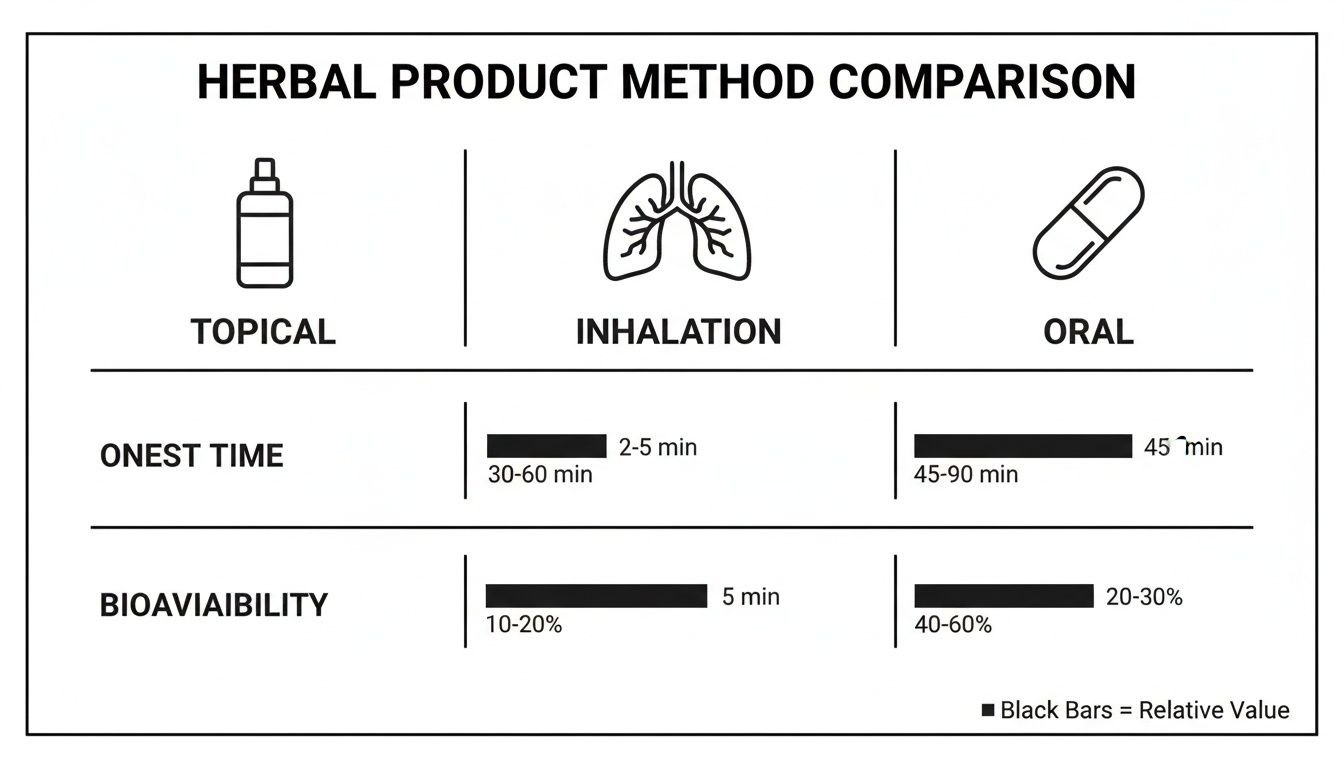
As you can see, topicals take a bit longer to kick in compared to other methods, but they offer targeted, sustained effects right where you need them most.
To put it all in perspective, let's compare the most common consumption methods side-by-side.
THC Consumption: A Quick Comparison
Each method of consuming THC offers a unique experience. This table breaks down the key differences between applying it to your skin versus inhaling or ingesting it.
| Method | Onset Time | Bioavailability | Primary Use Case |
|---|---|---|---|
| Topical | 15-90 minutes | Low (for systemic) | Localized relief for pain, inflammation, skin conditions |
| Inhalation | 1-5 minutes | High | Fast-acting relief, psychoactive effects |
| Oral (Edibles) | 30-120 minutes | Low to moderate | Long-lasting, potent systemic and psychoactive effects |
While topicals are fantastic for targeted care, methods like inhalation or edibles are designed to deliver THC throughout your entire body.
What the Science Says About Skin Absorption
For a long time, the question of whether topicals could produce more than just local effects was a hot topic of debate. Recent science has started to clear things up.
A pivotal 2023 study finally confirmed that a transdermal THC patch could successfully deliver the compound into the bloodstream. Researchers found that THC levels peaked significantly later—up to 38 hours after the patch was applied. This delay makes sense when you consider all the protective layers the THC has to get through. You can read the full research on how the skin's barriers affect absorption.
Interestingly, the study also showed that absorption rates varied quite a bit from person to person. This suggests that individual factors like skin health and even gender can influence how well a topical works. Understanding these details is crucial for anyone exploring the health benefits of topical applications, a subject we're incredibly passionate about here at RSOhelp.com. Our goal is to empower you with knowledge for your health journey.
How Your Skin Actually Absorbs Cannabinoids
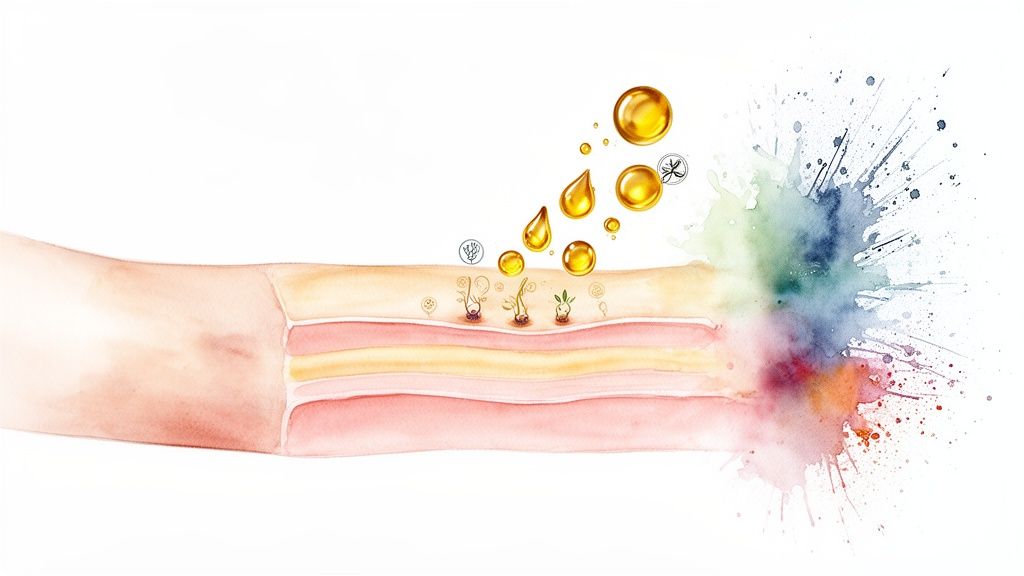
Think of your skin's outermost layer, the stratum corneum, as a tough, discerning gatekeeper. Its entire purpose is to keep things out, protecting you from the outside world. This barrier is incredibly good at its job, which makes the question of can THC be absorbed through skin a really interesting one to unpack.
The key to unlocking this puzzle is found in the molecular makeup of cannabinoids themselves. Compounds like THC are lipophilic, which is just a fancy way of saying they love fat. This is a crucial trait because the membranes of our own skin cells are also made of lipids, or fats.
It’s like trying to mix oil and water—they just won’t blend. But if you mix oil with another oil, they combine seamlessly. That's exactly what happens here. THC’s fat-loving nature allows it to buddy up with your skin's lipid layers and slowly permeate that gatekeeper, while a water-based compound would be stopped dead in its tracks.
The Role Of Skin Receptors
Once it’s past the outer defenses, THC doesn't have to go far to start making a difference. Your skin is packed with its own network of cannabinoid receptors, which are part of your body's endocannabinoid system (ECS). Specifically, CB2 receptors are found in abundance throughout the epidermis and dermis.
When you rub on a topical, THC molecules bind directly to these receptors right there in the skin and the tissue just beneath it. This direct, local interaction is what produces such powerful, targeted effects without the compound ever needing to enter your bloodstream.
This localized action is the reason you can get relief in a specific spot—like a sore knee or an aching shoulder—without feeling any of the "high." The THC is put to work precisely where you applied it.
How Product Formulation Boosts Absorption
While THC has a natural head start because it’s lipophilic, the formula of the topical product itself plays a massive role in how well it works. The effectiveness of any skin-based product hinges on the carrier oils and other ingredients it contains.
A well-formulated topical will use specific ingredients that act like a shuttle service, helping to ferry the cannabinoids deeper into the skin. Certain oils and terpenes don't just carry the THC; they can also make the skin temporarily more permeable, which dramatically improves absorption. This is why a professionally crafted product, like the ones we explore at RSOhelp.com, is often far more effective than a basic homemade infusion. We believe in providing access to information on high-quality options to support your wellness goals.
Understanding Localized vs Systemic Effects
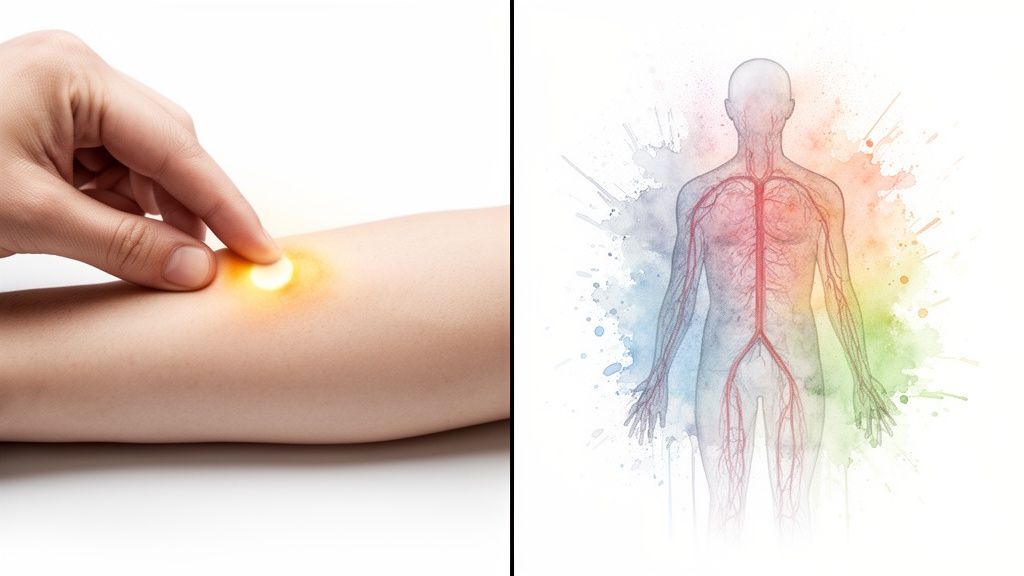
When we talk about whether THC can be absorbed through skin, we're really asking about two very different outcomes: localized and systemic effects. Think of it this way: you can spray a single plant with a mister or use a deep-root watering system for the whole garden. One targets the surface, the other goes much deeper.
A standard cannabis topical is like that mister. It provides localized relief by interacting with cannabinoid receptors in the skin and nearby tissues, right where you rub it in. Because it doesn't enter your bloodstream, you won't feel any psychoactive effects—just targeted action.
On the other hand, a transdermal product is designed to be the deep-root watering system, delivering systemic, or whole-body, effects. These advanced formulas use special enhancers to help THC actually get through the skin's layers and into the bloodstream.
It's a simple but crucial point: while all transdermal products are applied topically, not all topicals are transdermal.
How Science Validates Systemic Absorption
The idea of THC reaching your bloodstream through the skin isn't just a theory anymore. Recent research has confirmed that transdermal THC delivery is possible.
Even though absorption rates can vary wildly between people—sometimes showing a 10-fold difference—the studies found that peak THC levels remained detectable in the blood for over 12 hours. This is exciting news for those using potent, full-extract oils like RSO, as it suggests the rich blend of cannabinoids and terpenes can support effective delivery. You can discover more about these groundbreaking findings on transdermal THC.
This distinction is vital for setting expectations. Your wellness goal—whether it's soothing a sore muscle or seeking broader effects—should guide your product choice.
The potent, full-spectrum nature of RSO makes it a compelling option for those seeking a holistic approach to health. Understanding these delivery mechanisms is key to aligning your choice with your personal health objectives. For those exploring other powerful application methods, our guide to using RSO suppositories might also be worth a read.
Why RSO Stands Out for Topical Use
When you browse the shelves for cannabis topicals, you’ll find most products are made with isolated cannabinoids, like just CBD or just THC. Rick Simpson Oil, or RSO, is a completely different animal. It’s what we call a full-extract cannabis oil (FECO), which means it contains the full, unrefined profile of every compound in the original cannabis plant.
This whole-plant philosophy is where the magic happens, something known as the entourage effect.
Think of it like this: a single musician playing an instrument can be nice, but the sound of an entire symphony orchestra playing together is powerful and immersive. In RSO, you have hundreds of compounds—cannabinoids, terpenes, and flavonoids—all working in harmony, creating a result that's much greater than the sum of its parts.
This synergy is especially relevant when people ask if THC can be absorbed through skin. The answer gets a lot more interesting with RSO. Why? Because many of the terpenes naturally present in the oil can actually help improve the skin’s permeability, potentially giving cannabinoids like THC a better chance of passing through that outer barrier.
The Full-Spectrum Advantage
When you apply RSO to your skin, you’re not just getting THC. You’re getting that entire orchestra of plant compounds working together. This full-spectrum approach can deliver a much more well-rounded and potentially effective outcome compared to a simple isolate-based product.
The real strength of RSO lies in its unrefined, whole-plant nature. It doesn't try to outsmart the plant; it uses its natural complexity to the fullest potential.
Because it's such a concentrated and potent extract, the quality of your RSO is paramount. You absolutely must choose a product that has been lab-verified to be clean and pure. This means no residual solvents, pesticides, or other contaminants—things you definitely don't want on your skin.
Sourcing a clean, potent product is the only way to ensure you're getting the full, intended benefits. To get a better handle on this unique extract, you can learn more about what RSO is in our comprehensive guide. Making sure your RSO is top-tier helps you make safe, confident decisions for your wellness routine.
A Practical Guide to Applying RSO Topically
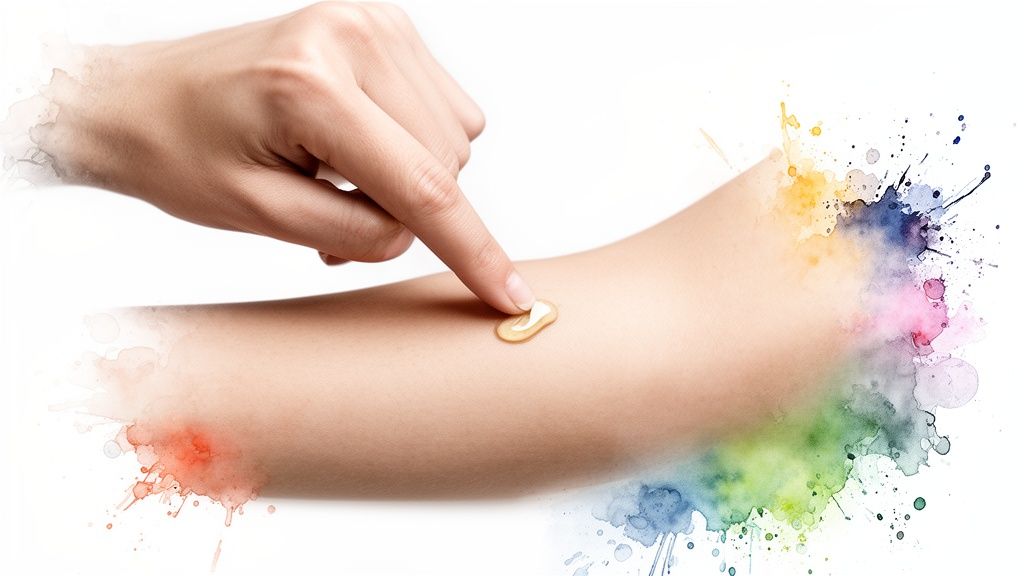
Ready to see how RSO works on your skin? The good news is that the process is simple and puts you in control. It's all about thoughtful, gradual application.
First things first: prepare the area. You'll want to apply the RSO to clean, dry skin. This little bit of prep work ensures there are no barriers, like lotions or natural oils, that could get in the way of absorption.
Next, pick your spot. Some people prefer areas where the skin is thinner—think wrists, the crooks of your elbows, or behind the knees—as this can help with absorption. Of course, you can always apply it directly to a specific spot you want to target.
Starting Your Topical Routine
When it comes to dosing RSO topically, the golden rule is "start low and go slow." This isn't a race. It's about carefully listening to your body and understanding its response.
- Initial Amount: Start with a tiny dab, about the size of a single grain of rice.
- Application: Gently rub the oil into your chosen area until it’s evenly spread.
- Observation: Now, just pay attention. See how the area feels over the next several hours and days.
This cautious approach helps you dial in the right amount for your specific needs without applying too much. Remember, patience and consistency are key. The effects of topical RSO can be subtle and might take some time to become apparent. For more in-depth advice, you can find extra context by exploring how people are using RSO for pain management.
The goal is to build a wellness routine that feels safe and responsible. By listening to your body and making slow adjustments, you can make informed decisions that truly support your health goals.
It's also interesting to see how this method stacks up. While the oral uptake of THC can be as low as 6%, specialized transdermal applications can maintain prolonged systemic levels. This effectiveness is likely why 25.1% of cannabis users in the U.S. have tried topicals in the last year.
At RSOhelp.com, our focus is always on using verified products for a safe, transparent, and effective experience.
Common Questions About Topical THC and RSO
Diving into the world of topical cannabinoids naturally brings up a lot of questions. As more people explore whether THC can be absorbed through skin, it's important to have clear, straightforward answers. We've gathered some of the most common questions we hear to help you feel more confident and informed.
Will Applying RSO to My Skin Make Me Feel High?
It's highly unlikely. For a topical to produce any kind of high, a significant amount of THC would have to hit your bloodstream. Standard topical application just doesn't work that way. Instead, it provides localized relief by interacting with cannabinoid receptors right there in your skin, with very little THC ever making it into circulation.
Even transdermal products, which are specifically designed to get into your system, release THC incredibly slowly. This gradual delivery is meant for sustained effects, not the euphoric peak you might get from other methods.
How Long Does It Take for Topical THC to Work?
This really depends on the product, your own skin, and where you're putting it. For localized benefits, many people start feeling the effects within 30 to 90 minutes.
If you're using a transdermal formula for systemic effects, it can take a few hours for the THC to build up in your bloodstream. The main thing to remember is that the release is slow and steady, so patience is key.
Your experience with topicals will be unique to you. What works for one person might be totally different for another, which is why we always recommend starting slow and paying attention to how your body responds.
Can I Use Any RSO Product on My Skin?
Quality is everything, especially for something you're putting on your body. It's crucial to use a lab-tested RSO product. You want to be absolutely sure it’s free from nasty contaminants like pesticides or leftover solvents that you definitely don't want your skin absorbing.
A full-spectrum RSO is usually the go-to because you get the complete profile of the plant's compounds. At RSOhelp.com, we always emphasize the importance of verified sourcing and looking at a product's Certificate of Analysis (COA) to confirm its purity and strength.
How Much RSO Should I Apply Topically?
There's no one-size-fits-all answer here. The best approach is to start small and see how it goes. A common starting point is to use an amount about the size of a single grain of rice, applied right to the area you're targeting.
Gently massage it into the skin and give it a few days to see how you feel before thinking about using more. Working with someone knowledgeable can help you create a personalized plan that you're comfortable with.
At RSOhelp.com, our goal is to give you clear, evidence-based guidance to help you move forward on your wellness journey with confidence. If you'd like personalized support and access to verified RSO sources, we're here to help.
Learn more and schedule your free RSO consultation at RickSimpsonOil.info