RSO stands for Rick Simpson Oil, a name that carries a lot of weight in the cannabis community. This isn't just another extract; it's a powerful, full-spectrum cannabis concentrate with a thick, almost tar-like texture and a very high concentration of cannabinoids.
It was specifically created to capture the entire profile of the cannabis plant, making it a go-to option for many people seeking specific health and wellness goals.
What Does RSO Actually Mean?
When you dig into the meaning of RSO, you’re looking at a story rooted in personal discovery and a drive to help others. Unlike many cannabis products you see on the market today, RSO wasn't developed for recreational use. It was born from a need for a focused, potent tool to support serious health goals.
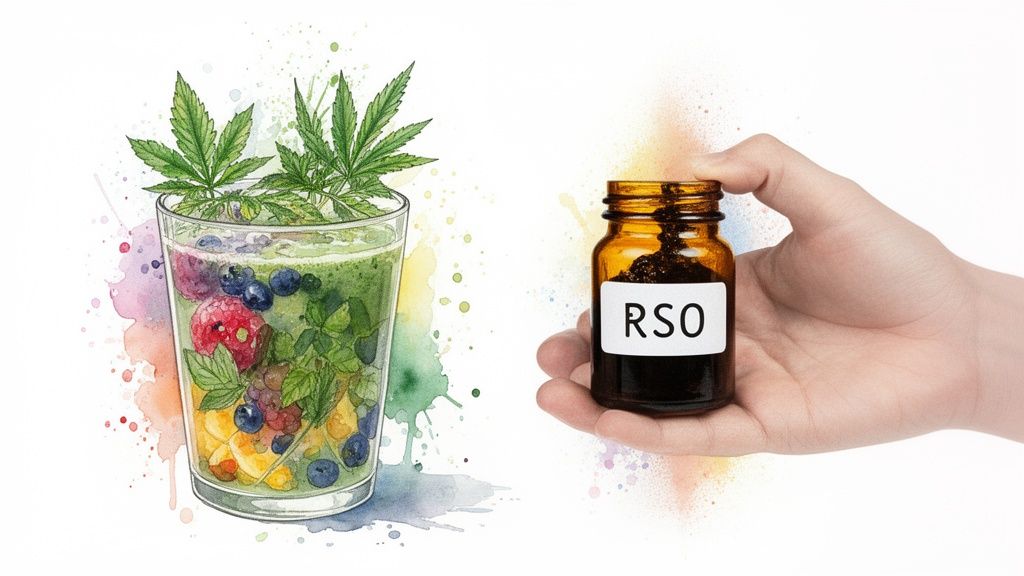
Think of it this way: RSO is like a nutrient-packed smoothie that uses the whole fruit—skin, seeds, everything—to give you the maximum benefit. An isolate, on the other hand, is like taking a single vitamin C pill. It’s just one compound, separated from everything else that makes the fruit whole. RSO is designed to deliver the complete symphony of plant compounds, all working together.
For those just getting started, this quick summary table breaks down the essentials of RSO.
RSO Quick Facts At A Glance
| Characteristic | Description |
|---|---|
| Full Name | Rick Simpson Oil |
| Type | Full-Spectrum Cannabis Extract |
| Consistency | Thick, dark, viscous, and tar-like |
| Cannabinoid Content | Very high, typically 60-90% THC, plus other cannabinoids like CBD, CBN, etc. |
| Primary Use | Supporting personal wellness goals |
| Common Consumption | Oral (ingested) or topical (applied to skin) |
| Key Feature | Aims to preserve the entire plant profile (cannabinoids, terpenes, flavonoids) |
This table gives you a snapshot, but the story behind its creation really explains its purpose.
The Origins of Rick Simpson Oil
The story of RSO starts with its creator, a Canadian activist named Rick Simpson. Back in 2003, after a serious workplace injury left him with persistent health challenges, he turned his attention to cannabis.
Drawing from what he knew about the plant, he created his own potent oil for personal use. His positive experience convinced him to share his unique full-spectrum extraction method with the world.
Driven by a belief in its potential, Simpson started giving away his oil—free of charge—to thousands of people. His work helped put RSO on the map and fueled a larger conversation within the medical marijuana market.
The Therapeutic Purpose of RSO and FECO
To really understand RSO, you have to look at its roots. Rick Simpson Oil wasn’t created for getting high; it was developed from a place of necessity for people seeking to support their well-being. Its entire purpose is to deliver the complete, potent, and unfiltered potential of the cannabis plant.
This is where you'll often hear the term Full Extract Cannabis Oil (FECO). People tend to use "RSO" and "FECO" as if they're the same thing, and they're very close. The key difference is the solvent used in the extraction process. FECO is made with food-grade alcohol (ethanol), while Rick Simpson's original method used other solvents. But at the end of the day, they share the exact same mission: to produce a true whole-plant extract. You can dive deeper into the specifics in our guide to Full Extract Cannabis Oil.
Harnessing the Entourage Effect
The philosophy behind both RSO and FECO is built on a powerful concept called the entourage effect. The idea is simple: all the compounds in the cannabis plant—not just THC and CBD, but also terpenes, flavonoids, and other minor cannabinoids—work in synergy. They’re more effective together than any single compound is on its own.
Think of it like a symphony orchestra. A lone violin might play a beautiful melody, representing an isolated compound like pure THC. But when the entire orchestra joins in—the strings, brass, woodwinds, and percussion—the result is a far richer and more profound experience.
RSO is meant to be that full orchestra. It captures every instrument, or compound, to create a combined effect that’s greater than the sum of its parts.
This synergistic power is exactly why so many people seek out RSO for their wellness journey, especially when facing major health battles. The demand for potent, full-spectrum products is growing fast. The wider hash oil market, which includes RSO, was valued at USD 3.14 billion in 2024 and is expected to climb to USD 9.23 billion by 2033. This surge shows just how much people are turning to these concentrated oils for support with chronic pain, appetite loss, and other difficult symptoms.
How RSO Stacks Up Against Other Cannabis Products
If you've spent any time looking at cannabis products, you know the options can be overwhelming. To really get a handle on what RSO is and where it fits in, it's helpful to see how it compares to more familiar choices like CBD oils, tinctures, and even edibles.
The key thing to understand about RSO is that it's a highly potent, whole-plant extract. It’s not refined or diluted. Its entire purpose is maximum potential, not casual recreational use or light wellness support. This is a critical distinction for anyone exploring RSO for a specific health concern.
I find a simple coffee analogy really helps clear things up for people.
- RSO is the unfiltered, straight-up espresso shot of the cannabis world. It’s incredibly concentrated and delivers the full, unadulterated power of the entire plant. It's potent and designed for a strong effect.
- CBD oil is more like a decaf latte. You get some of the plant's benefits, like potential relaxation or inflammation support, but without the intense psychoactive "high" from THC.
- A tincture is closer to a standard drip coffee. It’s less concentrated than RSO because it's mixed with a carrier like alcohol or MCT oil, which allows for more controlled, less intense dosing.
This comparison makes it easy to see why RSO is in a class of its own. It’s the go-to choice when serious personal health goals are on the table and less potent products just might not be enough.
RSO vs Other Cannabis Products: A Comparison
To put it all in one place, this table breaks down the key differences, helping you see where each product shines.
| Product | Primary Purpose | Potency | Key Feature |
|---|---|---|---|
| RSO | Support for serious health goals | Very High (often 60-90% THC) | Unrefined, full-plant extract capturing all compounds. |
| CBD Oil | General wellness, anxiety, and inflammation support | Low to None (non-psychoactive) | Typically contains only CBD with minimal to no THC. |
| Tincture | General wellness and controlled dosing | Low to Medium | Diluted with a carrier oil or alcohol for easier dosing. |
| Edibles | Recreational use and prolonged effects | Varies Widely | Slower onset with effects that last for several hours. |
Ultimately, choosing the right product comes down to your personal health goals. RSO stands out for its sheer potency and whole-plant philosophy, making it a unique and powerful option in the vast landscape of cannabis products.
A Step-By-Step Guide to RSO Dosing Protocols
Figuring out how to start with RSO can feel a bit daunting, but the most common approach is designed to be a slow, gentle introduction. The protocol made famous by Rick Simpson is a 90-day journey built on a simple principle: start low and go slow. This method gives your body time to adjust to the oil's incredible potency.
The process kicks off with a tiny dose, usually just the size of a half-grain of rice. You'll take this small amount three times a day, spaced out about every eight hours. This is a very deliberate starting point, designed to ease the powerful compounds into your system without being overwhelming.
The Titration Process Explained
After the first four days, you start to gradually increase your intake. The core of the protocol is to double your dose every four days until you reach the target of one full gram (or one milliliter) per day. For most people, hitting this milestone takes about a month of consistent, careful increases.
The whole idea is to build up your tolerance comfortably. This "low and slow" strategy is the key to having a positive and manageable experience, ensuring the oil works with your body, not against it.
Once you’ve successfully reached the one-gram-per-day dose, you'll maintain that level for the rest of the 90-day period. This diagram helps put RSO's strength into perspective compared to other extracts, which is exactly why this careful dosing is so important.
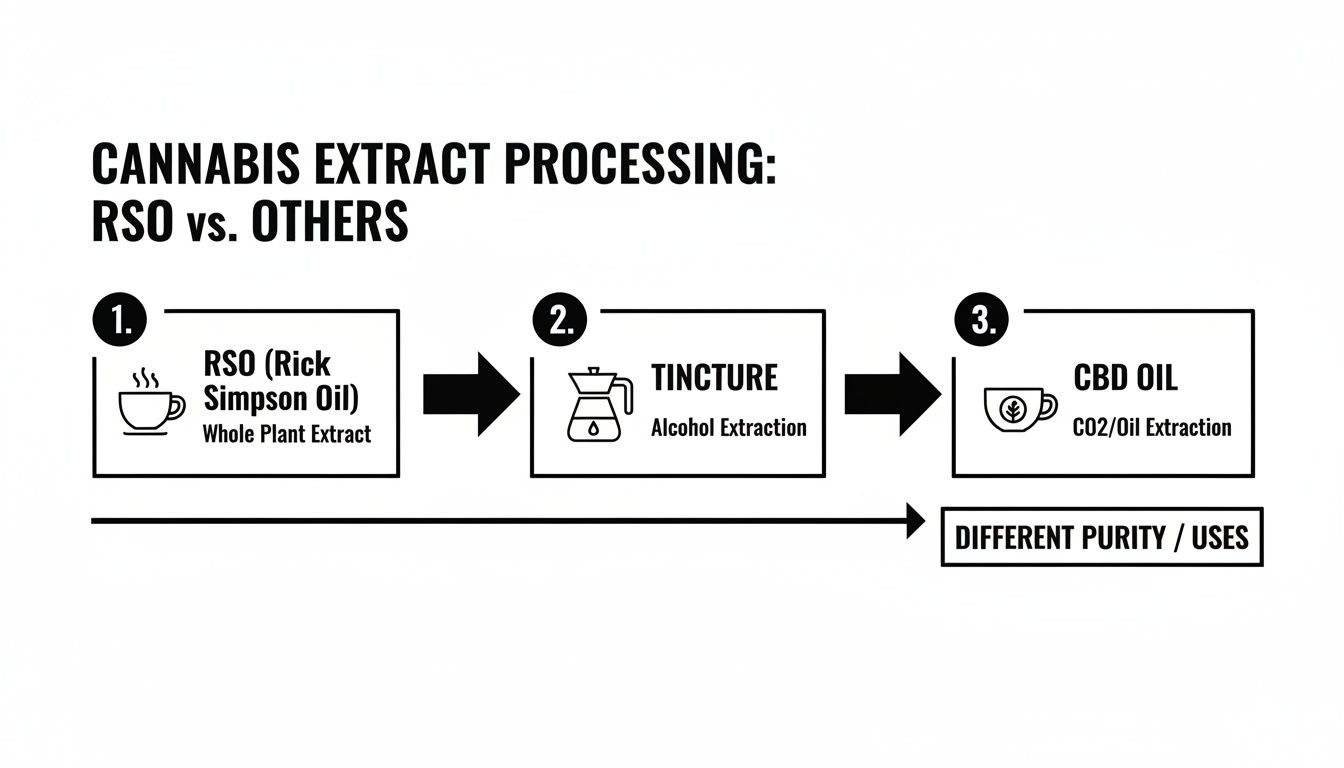
Think of RSO as the espresso shot of the cannabis world—it’s concentrated, powerful, and demands respect.
A General Guideline for Wellness
It's absolutely critical to remember that this protocol is a guideline, not a rigid set of rules. We are all different, and what works for one person might not be right for another. Your own body chemistry and wellness goals will ultimately shape your personal journey with RSO.
For help with more precise measurements, a good RSO oil dosage calculator can be an invaluable tool.
The original protocol aims for consuming a total of 60 grams over 90 days. It starts small, ramps up to about 8-9 drops per dose to hit that one-gram daily target, and is often followed by a much smaller maintenance dose. This structured approach is powerful, but listening to your body is always the most important part of the process.
Why Lab Testing and Product Quality Are Essential
When you're dealing with something as potent as RSO, you simply can't afford to guess about what's inside. The quality of the oil you use has a direct line to its effectiveness and, more importantly, your safety.
Think about it this way: RSO is an incredibly concentrated version of the cannabis plant. That means if the original plant material contained any contaminants—pesticides, heavy metals, or leftover solvents from the extraction—those impurities become concentrated right along with the cannabinoids.
The Certificate of Analysis: Your Proof of Purity
This is where a Certificate of Analysis (COA) becomes your most important tool. A COA is an official report from an independent, third-party lab that details exactly what's in the oil. It’s your only real proof that the product is clean, safe, and has the potency advertised on the label.
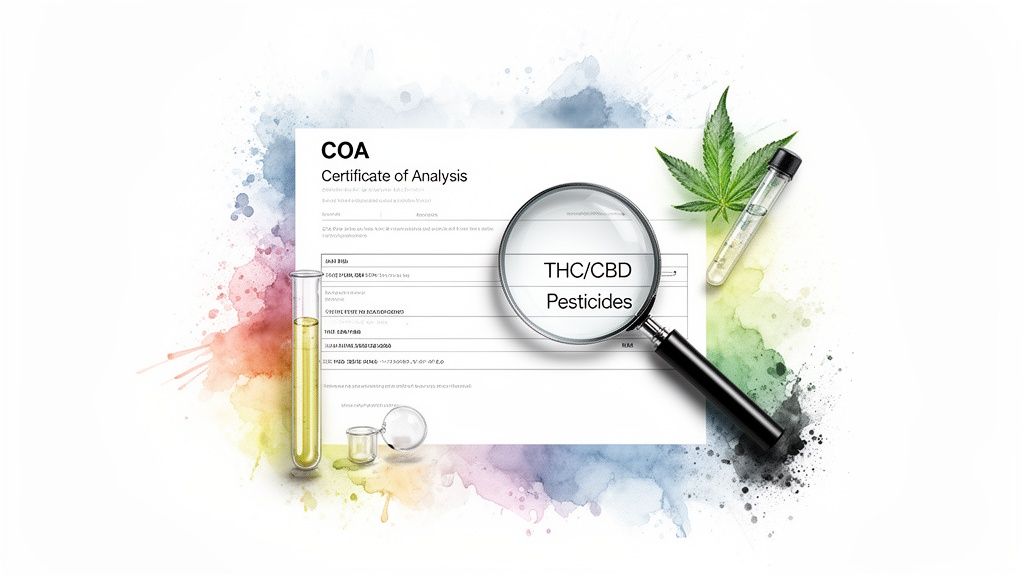
What to Look for on a COA
Any reputable producer will make their COAs readily available. When you review one, don't just glance at it—know what to look for.
A comprehensive COA should always include:
- Cannabinoid Potency: This confirms the exact percentage of THC, CBD, and other active compounds. It's how you verify you're getting the strength you paid for.
- Pesticide Screening: A crucial panel that ensures the oil is free from potentially toxic agricultural chemicals.
- Heavy Metal Analysis: Checks for dangerous contaminants like lead, mercury, and arsenic that the plant may have absorbed from the soil.
- Residual Solvent Test: Verifies that no harmful chemicals from the THC extraction oil process are left behind in the final product.
Finding a trustworthy source can feel overwhelming, which is why organizations like RSOhelp.com exist. They focus on connecting people with vetted producers who offer clean, organic, and fully tested oils, giving you the peace of mind you deserve on your health journey.
Your RSO Questions Answered
If you're just starting to explore RSO, it's completely normal to have questions. Getting to know the fundamentals is the best way to make sure your experience is a good one. Let's walk through a few of the most common questions people ask.
What Should I Expect to Feel?
RSO is incredibly potent, and its effects are driven by a high concentration of THC. Most people experience a powerful sense of relaxation and sleepiness, often accompanied by euphoria.
From a wellness standpoint, it's often sought out for significant pain relief and to kickstart a lagging appetite. The key takeaway? The effects are strong. Always start with a dose no bigger than a grain of rice to see how your body responds.
Is This the Same Thing as CBD Oil?
Not at all. RSO and CBD oil are on opposite ends of the cannabis spectrum.
RSO is a high-THC, full-plant extract that contains a complete range of cannabinoids and terpenes, which is why it has psychoactive effects. CBD oil, on the other hand, is usually derived from hemp, has virtually no THC, and won't produce a "high." They are both used for health and wellness, but they work very differently and are used for different reasons.
"Seeking out credible information is the cornerstone of using RSO safely and effectively. Your wellness journey should be built on a foundation of knowledge and support."
Good information is your best tool. Taking the time to learn from reliable sources, whether it's understanding dosage or how to choose a quality product, empowers you to make the best decisions for your health.
For one-on-one guidance and connections to trusted, lab-tested RSO producers, the team at RSOhelp.com is an excellent resource. You can get more information and connect with their experts by visiting their website at https://ricksimpsonoil.info.