
So, you’re trying to figure out how long for gummies to kick in? The short answer is usually between 30 and 90 minutes. But that’s just the beginning of the story.
Understanding the full timeline—from the first hint of an effect to the peak and eventual fade—is the key to having a consistent and enjoyable experience. Let's break down what you can expect.
The Gummy Onset Timeline Explained
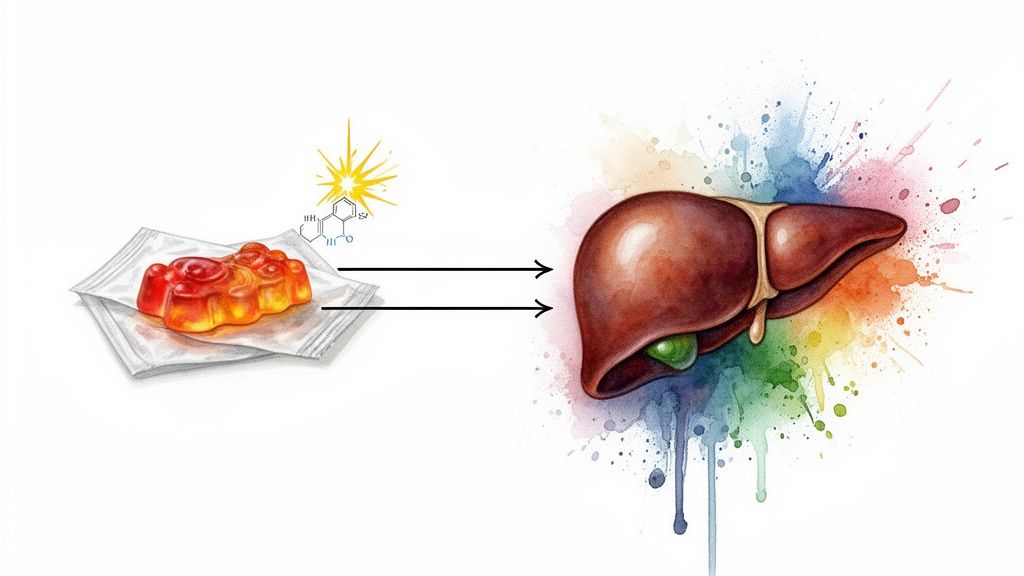
When you eat a gummy, it takes a much different path than other forms of cannabis. It has to travel through your digestive system and be processed by your liver before the active compounds hit your bloodstream. This journey is why there’s a delay, but it’s also what gives edibles their characteristically long-lasting effects.
Think of it as a slow-release capsule. Knowing the stages gives you a reliable roadmap for the hours ahead.
This visual timeline breaks down the typical progression, from the moment you take the gummy until the effects have completely worn off.
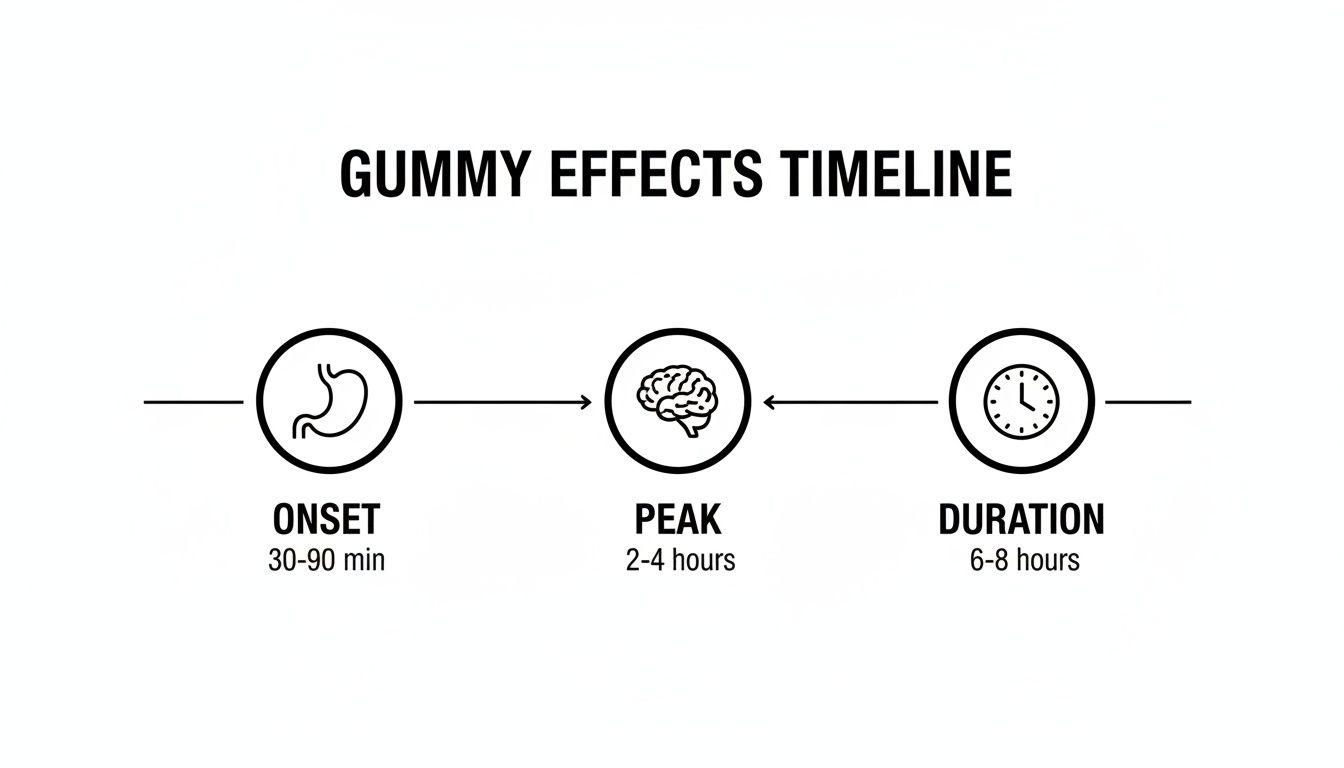
As you can see, the initial onset is just the warmup. The main event comes much later, which is why patience is your best friend when it comes to edibles.
To give you a clearer picture, here’s a table outlining the typical phases of a gummy experience.
A Typical Gummy Experience Timeline
This table outlines the average time frames for each stage of a cannabis gummy's effects, offering a clear reference for what to expect after consumption.
| Phase | Average Time Frame |
|---|---|
| Initial Onset | 30 to 90 minutes after eating |
| Peak Effects | 2 to 4 hours after eating |
| Total Duration | 6 to 8 hours from start to finish |
Keep in mind, these are just averages. Your personal timeline might look a little different depending on your metabolism, what you've eaten, and other factors we'll get into later.
Understanding Each Phase
Let's look a little closer at what's happening during each of these stages.
- Initial Onset (30 – 90 Minutes): This is the window where you'll start to feel the first subtle shifts. It’s not like flipping a switch; the effects creep in gradually.
- Peak Effects (2 – 4 Hours): The full effects build and reach their strongest point during this time. This happens well after you've eaten the gummy, which is a crucial point to remember.
- Total Duration (6 – 8+ Hours): From start to finish, the entire experience can last for quite a while. For some, especially with higher doses, the effects can linger for up to 12 hours.
The most common mistake is impatience. Thinking a gummy isn't working and taking more is a classic error. This often leads to an overwhelming experience a few hours down the line when both doses hit at once. Always wait at least two, if not four, hours before even thinking about taking more.
This delayed but extended experience is what sets edibles apart. It’s a very different profile from other concentrated products. For example, while the onset time for Rick Simpson Oil can be similar, you can learn more about how long an RSO high lasts in our detailed guide on the topic.
What’s Happening Inside Your Body? The Gummy Onset Journey
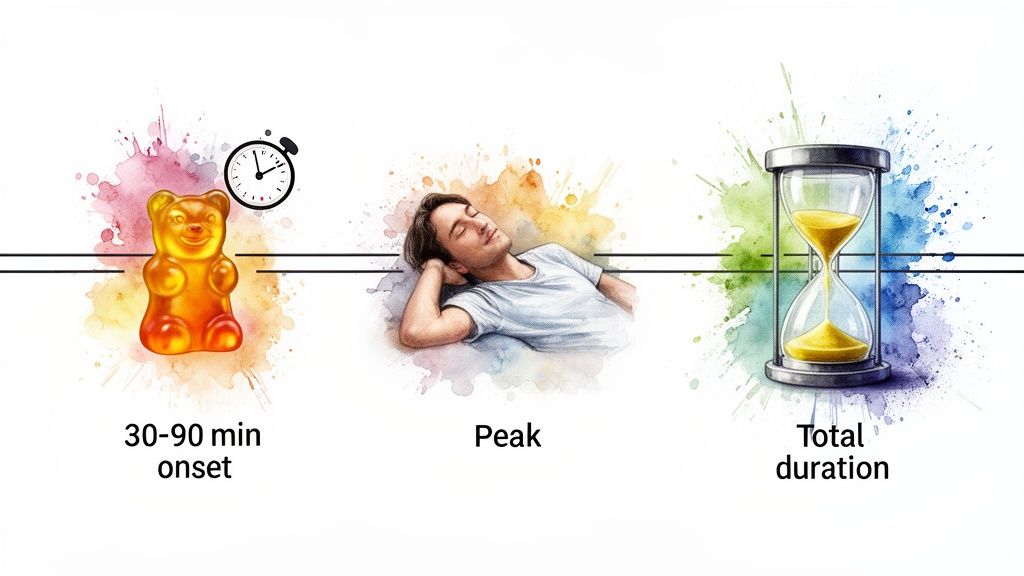
If you've ever found yourself wondering why there's no single, simple answer to how long for gummies to kick in, you're not alone. The answer is tied to the unique journey a gummy takes through your body—a route that's completely different from other consumption methods.
Think of it this way: a gummy is like a special delivery package navigating a complex shipping system. Unlike a method that drops a package right on your doorstep (like inhalation), this one has to go through sorting facilities first.
When you eat a gummy, it doesn't just magically appear in your bloodstream. It has to travel to your stomach and then your small intestine before the active compounds can even begin to be absorbed. This digestive leg of the journey is a big reason for the initial delay.
The Liver: Your Body’s Processing Plant
Once the compounds are absorbed in the small intestine, they still have one critical stop to make: your liver. It acts as the body’s main processing plant, and it’s here that a key biochemical event called first-pass metabolism takes place.
This process is the main reason for both the delayed onset and the powerful nature of edibles. Your liver’s job is to filter and break down anything you consume before it enters general circulation. And in doing so, it actually transforms the active compound from the gummy.
The liver's metabolic process isn't just a delay tactic; it fundamentally changes the molecule. A key cannabinoid gets converted into a far more potent compound. This new metabolite is known for producing a stronger, more intense, and longer-lasting experience than what you'd get from inhalation.
This biological conversion is precisely why a gummy can feel so different and more powerful. It’s not just about when it arrives; it’s about how it’s been changed along the way.
Your Gummy's Step-by-Step Path
Understanding this digestive route makes it clear why patience is your best friend when it comes to edibles. The timeline is dictated by your own biology.
Here’s a simplified breakdown of the trip:
- Ingestion & Breakdown: First, you chew and swallow the gummy. It then lands in your stomach to be broken down, a process that can take 20 to 60 minutes, sometimes longer, depending on what else is in there.
- Absorption: The active compounds move into the small intestine, where they're finally absorbed into the bloodstream.
- First-Pass Metabolism: From there, they head straight to the liver. This is the stage where the transformation occurs, adding more time to the clock.
- Systemic Circulation: Finally, the powerful metabolite is released from the liver into your main bloodstream, making its way to your brain and the rest of your body to produce its effects.
This multi-stage process is exactly why you'll rarely feel anything before the 30-minute mark and why it can often take much longer. It's a biological sequence that simply can't be rushed.
Why This Science Matters for You
Knowing what’s happening behind the scenes empowers you to use gummies more effectively and safely. Instead of getting anxious or impatient, you can relax, knowing your body is just doing its job. This is especially important if you're using gummies for health and wellness reasons, where predictable results are key.
The delayed but potent nature of edibles is what makes them unique. Understanding that a long wait is a normal part of the process is the best way to avoid the classic mistake of taking a second dose too soon. Ultimately, this knowledge helps you build a smarter, safer, and more beneficial relationship with edibles, allowing you to use them mindfully to meet your wellness goals. For those looking to dive deeper into other forms of concentrated cannabinoids for health, resources like RSOhelp.com can offer valuable insights.
Key Factors That Influence Your Experience
While we can talk about general timelines, the real question everyone asks is, "how long will it take to kick in for me?" And the honest answer is… it depends. There’s no single number because a handful of personal factors can completely change the game. Your body's unique chemistry is the biggest variable of all.
Think of these factors like dials on a control panel. Once you understand what each one does, you can start to anticipate your results with much greater accuracy. That knowledge is everything when you're aiming for a consistent and beneficial experience, especially if you're using gummies as part of a wellness routine.
Your Individual Metabolism and Body Chemistry
At the very core of your experience is your metabolism. It’s the engine running all of your body's processes. Some people just have a faster engine, allowing them to process everything from food to supplements much more quickly.
If you know you have a fast metabolism, you might feel the effects of a gummy closer to the 30-minute mark. On the flip side, someone with a slower metabolism might be waiting the full 90 minutes, or even a little longer. This is a fundamental biological trait that really sets your personal baseline.
But it goes beyond just metabolic speed. Things like the specific enzyme levels in your liver and even your body mass play a huge role. It’s the reason two people can take the exact same gummy at the same time and have completely different experiences.
The Role of Your Stomach Contents
This is probably one of the most common debates: should you take a gummy on an empty or full stomach? It’s not about one being "better" than the other—they just produce different results. Learning the difference helps you tailor the experience to your needs.
- Empty Stomach: This is your fast track. With no other food to get in the way, your body can get right to work on the gummy, often shortening the time it takes to feel the effects.
- Full Stomach: Taking a gummy after a meal, particularly a fatty one, will almost always delay the onset. Your digestive system is already busy, so the gummy has to wait in line.
A delay isn’t always a bad thing, though. Cannabinoids are fat-soluble, which means they bind to fats. Taking a gummy with a fatty meal can actually boost its overall absorption, potentially leading to a stronger, longer-lasting effect, even if it takes more time to get started.
This dynamic is why timing is so crucial for therapeutic use. Studies show that taking gummies with a high-fat meal can both increase bioavailability and delay onset, highlighting how much control you have over the experience simply by planning around your meals. You can read more about these dose-dependent effects to understand the science further.
Dosage Potency and Personal Tolerance
Finally, let's talk about the two factors you have the most control over: the gummy itself and your history with it. Nailing these down is critical for consistency.
First is dosage and potency. A gummy with 2.5 mg of an active ingredient is going to feel much milder—and may seem to take longer to notice—than one with 10 mg. Higher doses don't just feel stronger; they're also less subtle, so you tend to notice them "kicking in" more distinctly.
The second piece of the puzzle is your personal tolerance. If you use gummies regularly, your body adapts. Over time, you may find you need a little more to achieve the same effects you felt initially. A beginner taking a 5 mg gummy will likely have a far more noticeable experience than a seasoned user taking the same amount.
Understanding how these variables—your biology, your food, the gummy's strength, and your personal tolerance—all work together is the key. It's how you unlock a predictable and effective experience every time. For anyone looking into more potent options for specific health goals, this foundational knowledge is even more critical. Resources like RSOhelp.com offer expert guidance for individuals aiming to build a precise and supportive wellness plan.
A Practical Guide to Safe and Mindful Dosing
When it comes to edibles, there's one piece of advice that stands the test of time: start low and go slow. This isn't just a catchy phrase; it's the most reliable principle for having a positive, predictable, and comfortable experience. Think of it as a framework for wellness that puts your safety first.
So, what does that look like in practice? If you're new to gummies or know you have a low tolerance, a 2.5mg to 5mg dose is a very sensible starting point. This small amount is just enough to let you dip your toes in the water and see how your body responds without any risk of feeling overwhelmed.
But the most important part of this process isn't just the starting dose—it's what you do next. You have to wait. Patience isn't just a virtue here; it's an absolute necessity.
The Art of Waiting
The answer to "how long for gummies to kick in?" can be anywhere from 30 minutes to 2 hours, and sometimes even longer. This delayed onset is the number one reason people have a bad time—impatience leads them to take more too soon.
It’s a well-known issue. Public health guidance consistently points out that inexperienced users often re-dose prematurely because the effects can take a while to appear and even longer to peak. That’s why harm-reduction guidelines advise starting with 2.5–10 mg and waiting at least 2 to 4 hours to fully assess the effects before even thinking about taking more.
This waiting period is non-negotiable. It allows your body enough time to digest the gummy, metabolize the cannabinoids, and let the full effects unfold.
The Classic Mistake: An Impatient Redose
Let’s walk through a common scenario. Say you take a 5mg gummy at 7 PM, hoping to feel relaxed by 8 PM. When 8:30 PM rolls around and you feel next to nothing, you might assume it didn't work and pop another 5mg piece.
Here’s how that decision usually plays out:
- 9:00 PM: The first gummy finally kicks in. You start to feel the gentle, pleasant effects you were hoping for.
- 10:00 PM: Right as that first dose is hitting its stride, the second gummy starts to make its presence known.
- 11:00 PM: Now, both doses are fully active. The combined 10mg is far stronger than you intended, potentially turning what should have been a relaxing evening into several hours of discomfort.
This mistake, often called "dose stacking," is incredibly common. By simply waiting until at least 11 PM (a full four hours after the first dose), you would have had a crystal-clear picture of what 5mg felt like and could have made a much smarter decision.
Your Golden Rule: Always wait a minimum of four hours before considering a second dose. This one simple habit prevents nearly every common dosing error and keeps you firmly in the driver's seat of your experience.
Finding Your Sweet Spot
Finding your ideal dose is a process called titration—making small, careful adjustments over time. It’s a journey of self-discovery, not a race to the finish line.
Begin with that low dose (say, 2.5mg) and try it a few different times to see how your body consistently reacts. If you find the effects are a bit too mild for your needs, you can slowly increase the amount in your next session—perhaps to 3mg or 4mg.
Keeping a simple journal to track your dose, the time you took it, and how you felt can be an incredibly helpful tool. For a more structured approach, you can use our guide that includes the best edible dosage calculator to help you find a more personalized starting point. This patient, methodical approach takes the guesswork out of the equation and helps you build confidence.
Gummies vs. Potent Extracts: It’s Not an Apples-to-Apples Comparison

When we talk about how long for gummies to kick in, we're really talking about the body's digestive timeline. But it's a huge mistake to lump all oral cannabis products into the same category. On one end of the spectrum, you have familiar wellness gummies. On the other, you have highly concentrated extracts like Rick Simpson Oil (RSO).
They might both go through your digestive system, but that’s where the similarities end. Their purpose, formulation, and how you use them are completely different.
Think of standard gummies as your entry point—they’re designed for convenience and ease of use. You’ll find them in predictable, pre-measured doses, usually somewhere between 2.5mg to 10mg each. This makes them a great, straightforward choice for someone looking for mild daily support. Most are made with cannabis distillates or isolates, which target specific cannabinoids but don't include all the other compounds from the plant.
RSO, however, is in another league entirely. It’s a potent, full-spectrum extract created for serious therapeutic use where high potency and a complete plant profile are non-negotiable. With RSO, it's not about taste or convenience; it’s about delivering a powerful, comprehensive dose of cannabinoids and terpenes for a specific health goal.
Purpose and Formulation: Why They're So Different
At its core, the difference is all about intent. A gummy is like taking a daily vitamin—it’s a simple supplement to support your overall routine. RSO is much more like a specialized therapeutic compound, used with precision and careful guidance to address significant health challenges.
You can see this difference in how they're made:
- Gummies: Typically use an isolate or distillate to create consistent, predictable effects.
- RSO: Is a full-spectrum extract, meaning it keeps the entire profile of cannabinoids, terpenes, and other natural plant compounds intact.
This full-spectrum approach is key. It’s what creates the "entourage effect," where all the compounds work together synergistically. Many believe this synergy produces a far more profound therapeutic benefit, which is exactly why RSO is the go-to for many intensive health regimens.
RSO is not something you use casually. It’s an incredibly potent product that demands respect and a solid understanding of how it works. Dosing is meticulous, often starting with a tiny amount the size of a grain of rice, which really puts its concentration into perspective when you compare it to a whole gummy.
For anyone on a serious wellness path, this distinction is critical. A standard wellness gummy simply can't do the job of a targeted, high-potency extract like RSO. If you're aiming for a more powerful and comprehensive result, you need to look at specialized resources for guidance.
Gummies vs. RSO At a Glance
To make the distinction crystal clear, let's put them side-by-side. This table really highlights the unique roles these two products play, helping you see which tool is right for the job.
| Characteristic | Cannabis Gummies | Rick Simpson Oil (RSO) |
|---|---|---|
| Typical Potency | Low to Moderate (2.5-10mg per piece) | Very High (Often 60-90% cannabinoids) |
| Formulation | Often isolate or distillate | Full-Spectrum Extract (FECO) |
| Primary Use Case | General wellness, mild symptoms | Serious, targeted therapeutic protocols |
| Dosing Method | Standardized, pre-dosed pieces | Precise measurement (e.g., grain of rice) |
| Onset Time | Similar oral route (30-90 mins) | Similar oral route (30-90 mins), but can vary |
Knowing these key differences empowers you to make smarter, safer choices for your health. While both gummies and RSO follow a similar digestive timeline, their applications couldn't be more different.
To dive even deeper, check out our comprehensive guide on RSO vs. edibles. Arming yourself with this knowledge helps ensure you're choosing the right product to meet your wellness goals safely and effectively.
Common Questions About Gummy Onset and Effects
Even when you know the science, practical questions always pop up. When you're trying to figure out how long for gummies to kick in, it's only natural to wonder about specific situations. Let's walk through some of the most common questions I hear, with straightforward answers to help you feel more confident and in control.
Think of this as your go-to guide for troubleshooting your gummy experience. Each answer builds on the safety-first principles we've discussed, making sure you have the insight to make smart, informed choices.
Can I Make Gummies Kick In Faster?
This is easily the most asked question, and the honest answer is no, not really. You can't fundamentally speed up your digestive system. A gummy has a journey to take through your stomach and liver, and that timeline is set by your unique biology. Trying to rush it usually backfires and leads to unpredictable results.
That said, some people find that taking a gummy with a warm drink like tea can help it break down a little faster in the stomach. Staying well-hydrated is also a good idea, as water supports all your metabolic functions. But these are minor tweaks at best. The most effective strategy isn't about speed; it's about planning.
Give your body the time it needs—that 30 to 90 minute window is there for a reason. By planning your dose an hour or two before you want to feel the effects, you work with your body's natural rhythm instead of fighting it. Shifting your mindset from "rushing" to "planning" is the real key to a consistent experience.
What Should I Do If I Don't Feel Anything After Two Hours?
Waiting and feeling nothing can be frustrating, but it's a completely normal part of the process for many people. Your metabolism, what you ate that day, or even just your stress levels can all extend that onset time. The most critical thing to do in this situation is simple: wait longer.
The biggest mistake you can make is to assume the gummy didn't work and take another one. This is the classic recipe for an overwhelming experience a few hours down the line. Remember, the effects can be slow to build, and you might not feel the peak until the four-hour mark.
If you find yourself waiting, just run through this mental checklist:
- Do Not Redose: This is the golden rule. Don't take another gummy.
- Stay Hydrated: Have a glass of water.
- Be Patient: Remind yourself that a delayed onset is normal and okay.
- Assess After Four Hours: Only after a full four hours should you even start to consider if the initial dose was too low for you.
This patient approach is the cornerstone of using gummies safely and effectively. It ensures you never accidentally "stack" doses and end up with far more intense effects than you bargained for.
How Is Gummy Onset Different From Tinctures?
Understanding the difference between gummies and tinctures is all about choosing the right tool for the job. While you consume both, the way they enter your system is totally different, and that changes everything when it comes to timing.
A gummy has to be fully digested. It travels down to your stomach and then gets processed by your liver before the cannabinoids finally enter your bloodstream. That entire digestive journey is what creates the long delay of 30-90 minutes.
A tincture, on the other hand, is designed for sublingual administration—you hold it under your tongue. The tissue there is full of tiny capillaries that absorb the cannabinoids directly into your bloodstream. This route completely bypasses the digestive system and the liver's "first-pass" effect. The result is a much quicker onset, often within 15 to 45 minutes, making tinctures a great option when you need faster relief.
Why Did The Same Gummy Affect Me Differently on Different Days?
This is an incredibly common experience that can leave people feeling confused. You take the exact same dose from the very same package, but the outcome feels completely different from one day to the next. This isn't a sign of an inconsistent product; it's a perfect illustration of how dynamic your own body is.
Your internal environment is always in flux, and these daily shifts directly impact how you process a gummy.
A few key factors are usually at play:
- Diet: What you ate that day—especially the fat content of your meals—can change both the onset time and the intensity.
- Hydration: Being dehydrated can slow down your metabolism, potentially delaying the effects.
- Stress Levels: Your hormones, particularly stress hormones like cortisol, can influence how your body responds to cannabinoids.
- Sleep Quality: A bad night's sleep can affect everything from your metabolic rate to your overall sensitivity.
This is exactly why building a consistent routine is so helpful. By taking your gummy at roughly the same time and under similar conditions (like after a similar type of meal), you can minimize these variables and work toward a more predictable and reliable outcome.
Navigating the world of cannabis wellness requires reliable information and trusted guidance. At RSOhelp.com, we are dedicated to providing clear, practical resources to help you make safe and informed decisions on your health journey. For those exploring potent, full-spectrum options, our expert guides and confidential RSO consultations can offer the support you need. Learn more at ricksimpsonoil.info.