Let's cut right to the chase: yes, you can absolutely test positive on a drug test from using hemp products. It’s a hard truth, but an important one for your health journey.
Even though hemp is legally defined by its low THC content, that doesn't mean it has no THC. If you use hemp products regularly, especially full-spectrum ones, that trace amount of THC can build up in your system over time. Eventually, it can be enough to cross the threshold on a standard drug screen.
How Hemp Can Trigger a Positive Drug Test
To understand how a perfectly legal product can cause such a major problem, you have to know what drug tests are actually looking for. They aren't screening for hemp or CBD. They are designed to detect one thing: THC and its metabolites.
While federally legal hemp must contain less than 0.3% THC by dry weight, that small percentage isn't zero.
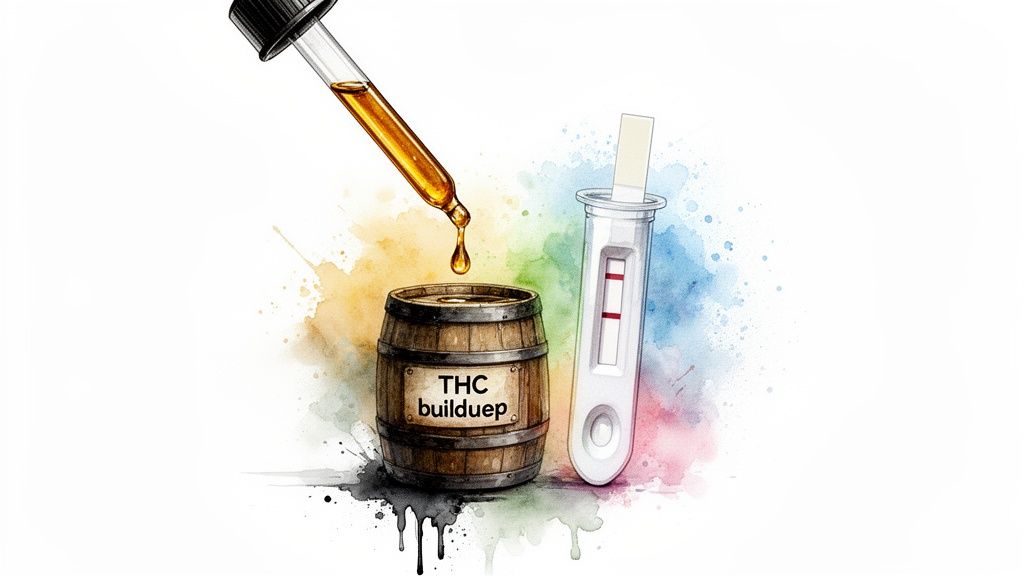
Think of it like a rain barrel collecting water one drop at a time. A single drop seems like nothing. But after a few steady weeks of dripping, that barrel can easily overflow. Your body handles the trace THC from hemp products in a very similar way. Each dose adds a tiny amount of THC, which gets stored in your body's fat cells. Use it consistently, and those tiny amounts accumulate until they're high enough for a sensitive drug test to flag.
The Science Behind the Risk
This isn't just a theory; it’s a well-documented risk. Products that are fully compliant with federal guidelines can still put you in a tough spot.
For instance, one recent study found that after just four weeks of daily use, 50% of participants tested positive for THC metabolites. The surprising part? The product they used contained only 0.02% THC—that's more than 10 times lower than the federal legal limit. You can read the full research about these findings for yourself.
This really drives home a critical point for anyone who relies on hemp for their health and wellness. Several factors come into play:
- Product Type Matters: Full-spectrum products, which are celebrated for containing all the plant's natural compounds, carry the highest risk because they inherently include trace THC.
- Consistency is Key: Using a product every day or multiple times a week dramatically increases the odds of accumulation compared to just using it once in a while.
- Dosage Plays a Role: Taking larger doses means you're putting more THC into your system with each use, which naturally speeds up the buildup process.
To help you quickly gauge your situation, here’s a simple breakdown of the factors at play.
Hemp Drug Test Risk Factors at a Glance
This table summarizes the variables that can increase or decrease your likelihood of testing positive from a hemp product.
| Factor | Low Risk | High Risk |
|---|---|---|
| Product Type | Isolate or Broad-Spectrum (THC-free) | Full-Spectrum (contains trace THC) |
| Frequency of Use | Infrequent, occasional use (once a week or less) | Daily or multiple times per day |
| Dosage | Low daily dose (e.g., under 20mg of CBD) | High daily dose (e.g., over 100mg of CBD) |
| Body Composition | Lower body fat percentage | Higher body fat percentage (THC is fat-soluble) |
| Metabolism | Faster metabolism | Slower metabolism |
| Product Vetting | Verified THC-free with a recent Certificate of Analysis (COA) | Unverified or poorly labeled product without a COA |
Understanding these nuances is crucial, especially if you're on a dedicated therapeutic regimen. The key takeaway here is simple but vital: "legal" does not mean "risk-free" when it comes to passing a drug test.
Why the Line Between Hemp and Marijuana Is a Big Deal for Drug Tests
To understand how a perfectly legal wellness product could put your job on the line, we need to talk about the difference between hemp and marijuana. This isn't just a technical detail—it’s the absolute heart of the matter when it comes to drug testing.
At their core, both plants are the same species: Cannabis sativa. Federal guidelines, however, draw a very sharp distinction based on the concentration of a single, well-known molecule: delta-9 tetrahydrocannabinol, or THC. That's the compound responsible for the "high" associated with marijuana.
Think of it like the difference between a sweet pepper and a habanero. Both are peppers, but one has a kick and the other doesn't. Hemp and marijuana are separated by their chemical kick. Federally legal hemp is simply any Cannabis sativa plant containing 0.3% or less THC by dry weight. Anything over that number is classified as marijuana.
That tiny percentage is everything. It's what separates a legal agricultural crop from a federally controlled substance. But this legal line creates a huge—and potentially career-ending—misconception: people often think "legal hemp" means "100% THC-free." That’s just not the case.
Know What's in Your Bottle: Your Product Options
The risk of testing positive almost always boils down to which type of hemp product you're using. To navigate the market safely, you have to know what's actually inside that tincture or capsule. Hemp extracts generally come in three main varieties, and each one carries a different level of risk.
-
Full-Spectrum: This is the whole-plant extract. It gives you all the cannabinoids, terpenes, and other compounds from the hemp plant, working together. That includes CBD, minor cannabinoids like CBG and CBN, and—this is the important part—trace amounts of THC, right up to that legal 0.3% limit.
-
Broad-Spectrum: This version starts out as full-spectrum but goes through one extra step: the THC is specifically removed. You still get a rich mix of cannabinoids and terpenes, but without the compound that drug tests are looking for.
-
Isolate: Just like the name implies, this is one single cannabinoid—usually CBD—isolated from everything else. All other plant compounds, including any trace of THC, are stripped away, leaving a pure crystalline powder that's then mixed into a product.
For anyone who has to take a drug test, full-spectrum products are the riskiest choice by far. Even that small, legal amount of THC can build up in your body over time, especially with daily use. Eventually, it can be enough to cross the threshold for a positive test. This is exactly why understanding the difference between full-spectrum vs broad-spectrum products is the most important first step you can take.
Here’s the key takeaway: A product being legal has absolutely nothing to do with whether you’ll pass a drug test. "Hemp" means low THC, not zero THC.
Knowing this puts you back in control, letting you choose products that align with your wellness goals without jeopardizing your career. Our goal at RSOhelp.com is to give you the information you need to make smart, safe decisions on your path to better health.
How Drug Tests Actually Detect THC
To really understand why a perfectly legal hemp product could make you test positive, we need to get into what these tests are actually looking for. They aren't designed to find CBD or hemp. Their one and only job is to detect THC—or, more accurately, the byproducts your body creates after you've consumed it.
The way each test works is a little different, and those differences are what determine your personal risk. It's important to remember that a test designed to spot recent, active impairment is a completely different beast from one that's looking for past, indirect use. Getting a handle on this is the first step.
This timeline helps put the relationship between hemp and marijuana into perspective. They both come from the same plant, Cannabis sativa, and for a long time, there was no legal distinction.
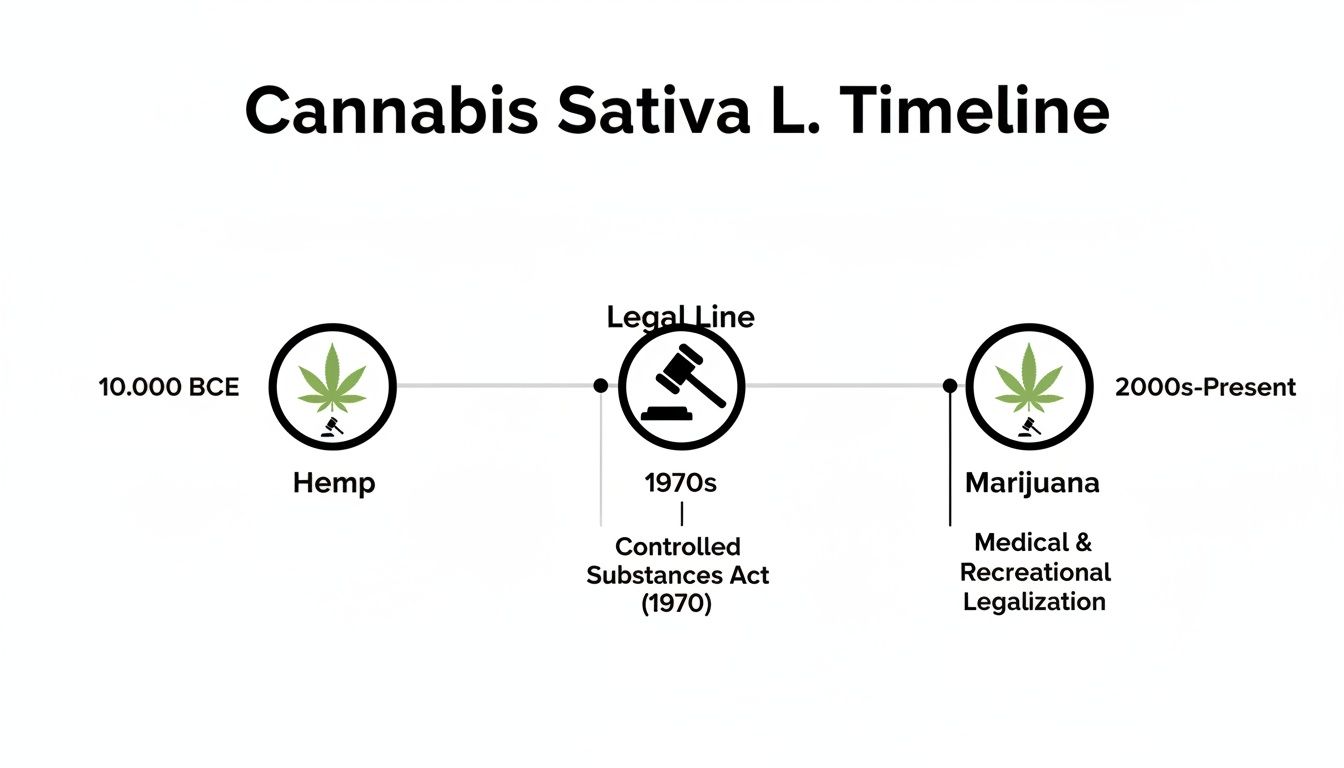
The key thing to see here is that the only real wall between hemp and marijuana is a legal one based on THC levels, not some fundamental biological difference.
The Science Behind Common Screening Methods
Most employers use urine tests, but you might also run into saliva, hair, or blood tests. Each one targets a different marker and has its own "detection window"—the length of time it can "see" THC after you've used it.
-
Urine Tests: This is the big one. It doesn’t actually look for the THC that causes impairment (Δ9-THC). Instead, it’s hunting for a metabolite called THC-COOH, which is what’s left over after your body breaks the THC down. Because this metabolite gets stored in body fat, it can hang around for days or even weeks, which is why a urine test indicates past use, not whether you're impaired right now.
-
Saliva (Oral Fluid) Tests: These are becoming more common for on-the-spot workplace testing. The reason is simple: they detect active Δ9-THC itself. This means they're looking for very recent use, usually within the last 24 to 48 hours.
-
Hair Follicle Tests: If you want to look way back, this is the test. Hair tests have the longest detection window, sometimes spotting use up to 90 days in the past. Like urine tests, they also look for the THC-COOH metabolite, which gets trapped in the hair shaft as it grows.
-
Blood Tests: These are less common for routine employment screening. Blood tests measure active Δ9-THC and have a very short window—typically just a few hours. They're usually saved for situations where it's critical to determine if someone is impaired at that exact moment.
Why Cutoff Levels Are So Important
Every drug test has a specific cutoff level. This is the minimum amount of a substance that needs to be present to trigger a positive result. It’s not a zero-tolerance system. Think of it like a motion detector that only goes off if something substantial crosses its path, ignoring a fly buzzing by.
For example, a standard urine test might have an initial screening cutoff of 50 nanograms per milliliter (ng/mL) for THC-COOH. If your sample comes in below that, you’re in the clear—it’s a negative. But if it’s over 50 ng/mL, the sample is flagged for a second, more sensitive confirmation test, which often has a lower cutoff of 15 ng/mL.
The real danger for hemp users isn't a single dose. It's accumulation. While one serving of a full-spectrum CBD oil is unlikely to push you over the limit, taking it every day can cause THC-COOH to slowly build up in your system until it eventually crosses that 50 ng/mL threshold.
Saliva tests are a different story; they are extremely sensitive to even trace amounts of active THC. Because full-spectrum products legally contain 0.3% THC, they will introduce detectable Δ9-THC into your mouth. One study found modern oral fluid tests could detect THC for over 22 hours after exposure, showing just how risky it can be for anyone facing an instant workplace test.
Getting a firm grasp on the science—what these tests look for and how sensitive they are—is absolutely crucial. It's also vital to understand that not all THC is the same; our guide on the differences between THCA and delta-9 can help clear that up.
Personal Factors That Influence Your Test Results
Drug testing isn't a one-size-fits-all equation. The final result depends heavily on your unique biology and habits, which can dramatically speed up or slow down how quickly your body accumulates THC metabolites.
Think of it like this: your body is its own unique processing plant. Some run at high efficiency, clearing substances out quickly. Others are more methodical, holding onto compounds for longer. Understanding how your personal system operates is key to knowing your real risk.
It's entirely possible for two people to take the exact same dose of a full-spectrum hemp product, yet one tests positive while the other remains in the clear. This isn't just random chance—it's a direct result of individual differences.
Your Metabolism and Body Composition
One of the biggest players here is your metabolism—the speed at which your body processes everything you consume. Someone with a naturally faster metabolic rate will break down and eliminate THC metabolites far more quickly than a person with a slower metabolism. Your age, genetics, and how active you are all have a major say in this.
Just as important is your body fat percentage. THC and its byproducts are "lipophilic," a fancy way of saying they are drawn to fat. They bind to and get stored in your body's fat cells.
This means that someone with a higher body mass index (BMI) or more body fat has more "storage units" for THC to settle into. Over time, these fat cells slowly leak the stored metabolites back into your bloodstream, which is why THC can hang around for weeks or even months in some people.
On the flip side, a person with a leaner build and a zippy metabolism has less storage space and clears these compounds much faster, significantly lowering their risk.
Frequency and Dosage of Hemp Use
How often you use hemp products and the size of your dose are probably the most straightforward factors. Taking a full-spectrum oil every single day, especially for therapeutic reasons, carries a much greater risk than using it only now and then. Every dose adds to the cumulative buildup in your system.
- Low-Risk User: Imagine someone with a fast metabolism who takes a small dose of full-spectrum hemp oil once or twice a week.
- High-Risk User: Now picture an individual with a higher BMI who relies on a large daily dose of a potent extract to manage their wellness.
This is exactly why knowing your own usage pattern is so important. A foundational study showed that a single, low-dose exposure might only be detectable for 1-5 days. However, for chronic users, that window can stretch to 21 days or more. You can explore the marijuana detection window research to see the data behind these timelines.
For anyone using concentrated extracts on their health journey, these personal factors aren't just minor details—they're central to making informed choices. By understanding your own body and habits, you can better manage your wellness routine and finally get a clear answer to the question, "does hemp show up on a drug test?" The guidance at RSOhelp.com is all about empowering you with this kind of practical knowledge.
How to Minimize Your Risk with Hemp Products
Knowing the risks is one thing, but actively protecting yourself is what really matters. Thankfully, a few smart strategies can dramatically lower your chances of a positive test. It all boils down to being a proactive and educated consumer.
The most important rule? Demand complete transparency. Never just trust a product’s label—empower yourself with objective data from a third-party lab.
Demand a Certificate of Analysis
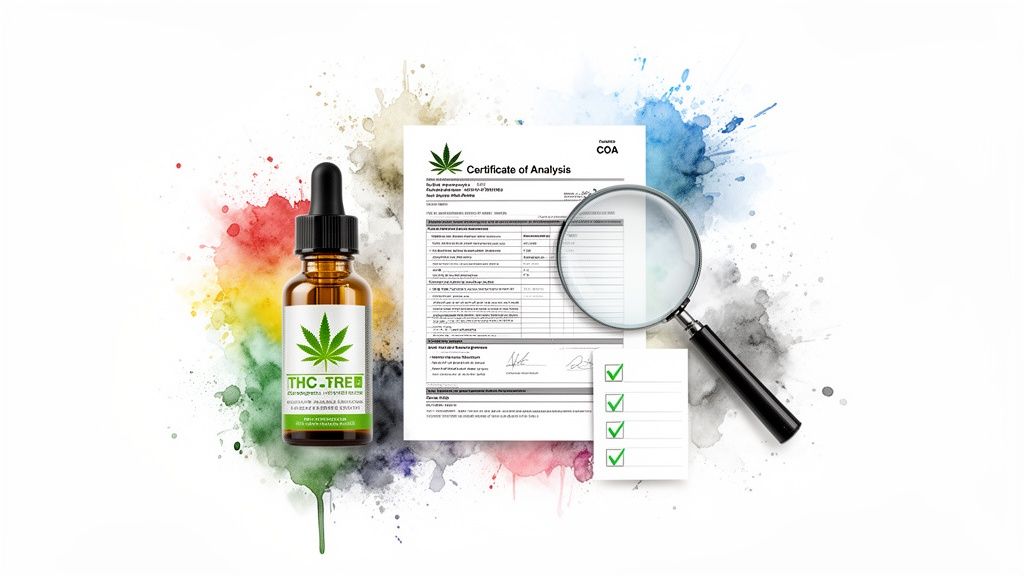
A Certificate of Analysis (COA) is your secret weapon. It’s a document from an accredited lab that breaks down a product’s exact chemical profile. Any reputable company will have these readily available, often right on their website's product page.
When you pull up a COA, scan for the cannabinoid potency section and find the line for Delta-9 THC. The magic letters you're looking for are "ND," for "Non-Detect." This is the best possible proof that a product is truly THC-free and carries the absolute lowest risk.
A current, comprehensive COA isn't just a "nice to have"—it's non-negotiable. If a brand can't provide one or the report is old, see it as a major red flag and walk away.
Beyond THC, a COA is also your window into product safety. It should confirm the absence of nasty contaminants like:
- Heavy metals (lead, arsenic, etc.)
- Pesticides
- Residual solvents left over from extraction
- Mold and mildew
Getting into the habit of checking these documents is the single best way to ensure you’re using a product that is clean, safe, and compliant.
Choose Your Product Type Wisely
If drug testing is even a remote possibility for you, the type of hemp product you use is critical. Your choice directly maps to your level of risk.
- Lowest Risk (Safest Option): Look for products made with CBD Isolate. This is the purest form of CBD, containing only the cannabidiol molecule. When verified by a COA, it should have zero THC.
- Low Risk: Broad-spectrum products are a solid middle ground. They provide a range of cannabinoids and terpenes for a potential "entourage effect," but the THC has been specifically removed.
- Highest Risk: Full-spectrum products contain every compound from the plant, including the legally allowed trace amount of THC (up to 0.3%). If you're subject to testing, these should be avoided completely. Regular use is the most common reason people test positive while using legal hemp products.
Calculate Your Potential THC Intake
Some people feel they get the most therapeutic benefit from full-spectrum products and are willing to accept the risk. If that's you, it's crucial to understand your daily THC exposure. A little bit of math can give you a rough estimate.
For instance, if a product is 0.2% THC by weight, that means there are 2 milligrams of THC in every gram of oil. If you take half a gram daily, you’re consuming about 1 mg of THC. That might sound insignificant, but with consistent use, those THC metabolites start to build up in your body’s fat cells.
This slow accumulation is exactly what drug tests are designed to find. Understanding your cumulative dose helps clarify how even a legal product can cause a problem over time.
Ultimately, knowledge is your best defense. When you need help finding verified, lab-tested products that fit your health goals and personal situation, RSOhelp.com provides educational resources to help you make decisions with confidence. By demanding transparency and choosing the right product type, you can navigate the world of hemp and finally get a clear, negative answer to the question, "does hemp show up on a drug test?"
Navigating Concentrated Extracts Like RSO
While even standard hemp oils can be tricky, the game changes completely when you're dealing with highly concentrated extracts. Products like Rick Simpson Oil (RSO) and Full Extract Cannabis Oil (FECO) are in a different league entirely—they're engineered for potency, which creates a significant and unique risk for anyone facing a drug test.
These oils are made by condensing the plant’s entire chemical profile into a thick, powerful concentrate. Even if the starting material is compliant hemp, the process amplifies everything. Think of it like making a sauce reduction: you simmer a large pot of lightly seasoned broth for hours, and what's left is a small amount of intensely flavorful liquid. The same thing happens here, but with cannabinoids, and the final oil can have a much higher density of THC than any standard tincture.
The Inevitable Risk of Therapeutic Protocols
This gets even more complicated for people using these extracts to meet specific health goals. Therapeutic protocols rarely involve a small, one-off dose. Instead, they often require taking consistent, elevated amounts over weeks or months. This isn't just casual use; it's a dedicated regimen.
When you mix a concentrated product with a consistent, high-dose schedule, THC accumulation isn't just a possibility—it becomes a near certainty. The slow, gradual buildup you might see with a regular full-spectrum product gets put on hyperdrive. For anyone following a serious RSO or FECO protocol, a positive drug test is an almost unavoidable outcome.
This isn't about fear-mongering. It's about empowering you with the full picture so you can make critical health decisions with your eyes wide open to all the potential consequences.
Making Informed Health Decisions
Our mission at RSOhelp.com is to provide this kind of critical education, helping you understand exactly what you're putting into your body. Concentrated extracts offer unique properties, but you simply can't ignore how they interact with drug screening.
Knowing these facts ahead of time lets you plan. Maybe that means having an honest conversation with your employer, or maybe it just means accepting the trade-offs involved in your wellness journey. For many, the health benefits far outweigh the testing risks, but that has to be a conscious and informed choice. The methods for creating these potent oils are quite complex, and if you're curious about the science, learning about the specifics of THC extraction for oil can offer a deeper understanding of why they are so concentrated.
Ultimately, for users of potent extracts like RSO, the question of "does hemp show up on a drug test" shifts to a firm "yes." By arming yourself with this knowledge, you can pursue your health goals with confidence and clarity, fully aware of how your choices might ripple into other areas of your life.
Common Questions About Hemp and Drug Tests
It’s completely normal to have questions when you’re using hemp products, especially if you have a drug test coming up. Let's clear up some of the most common concerns so you can feel confident and safe.
Will Taking CBD Oil Make Me Fail a Drug Test?
That really comes down to which type of CBD oil you're using. If it's a full-spectrum oil, the answer is yes, you absolutely could test positive. These products contain small, legal amounts of THC, which can build up in your system over time with consistent use.
Your safest bet is to stick with broad-spectrum or CBD isolate products. These have been specifically refined to remove all detectable THC. But don't just take the label's word for it—always check the third-party lab report, or Certificate of Analysis (COA), to be sure.
How Long Does THC From Hemp Stay in My System?
There's no one-size-fits-all answer here. How long THC hangs around depends on a few things.
- Type of Test: Saliva tests have a pretty short window, usually just 24-48 hours. Urine tests, on the other hand, can detect THC for much longer.
- Your Own Body: Your metabolism, body fat, how much you take, and how often you use it are all major factors.
- How Often You Use It: If you only used a full-spectrum product once, it might clear out of your urine in a few days. But if you’re a daily user, it could easily be detectable for 30 days or even longer.
When in doubt, it’s always best to play it safe and assume a long detection window if a test is on the horizon.
Can I Trust a Hemp Product Labeled THC-Free?
While most companies are honest, you can't rely on the label alone. The hemp industry isn't tightly regulated, which means mistakes and mislabeling happen more often than you'd think.
The only real proof you have is a recent Certificate of Analysis (COA) from a credible, third-party lab. Look for a result that says "ND" (Non-Detect) for THC.
This isn't a step you want to skip if you're concerned about testing. Reputable educational sources, like the ones found on RSOhelp.com, always stress the importance of this kind of transparency. By demanding and reviewing lab reports, you're taking control and can confidently answer the question, "does hemp show up on a drug test?"
If you're trying to make the most informed health decisions, RSOhelp.com provides clear, evidence-based guidance. We also offer confidential consultations to help connect you with verified sources for properly lab-tested products. You can build your knowledge and confidence by exploring our resources at https://ricksimpsonoil.info.