When people ask, "what's full spectrum THC," I often use the analogy of a symphony orchestra versus a solo violinist. A single violin can be beautiful, of course. But the rich, layered, and powerful experience you get from the entire orchestra playing together? That’s a whole different level.
Full spectrum THC is the entire orchestra—a whole-plant extract that brings together all the natural compounds, working in perfect harmony.
Decoding the Whole Plant Philosophy

At its heart, the term "full spectrum" means the extract keeps the plant's original chemical blueprint intact. Instead of stripping out and isolating one specific compound like THC, this method carefully preserves the entire cast of characters, ensuring nothing important gets left behind.
This "whole plant" philosophy is the key to understanding its true potential. It's not just about THC. It's about the powerful synergy created when all the plant's components are present and working as a team. This concept is particularly vital for those seeking comprehensive support, especially individuals using products like Rick Simpson Oil (RSO). You can dive deeper into how this applies to RSO in our guide to full extract cannabis oil.
The Key Players in the Ensemble
To really get what makes a full spectrum extract special, you have to meet the main performers in this botanical orchestra. Each group of compounds has a distinct and crucial role to play in the final effect.
Here’s a quick rundown of who’s on stage:
- Cannabinoids: These are the headliners. While THC is the most famous psychoactive one, a true full spectrum product contains dozens of others—like CBD, CBG, and CBN—each bringing its own unique properties to the mix.
- Terpenes: These are the aromatic compounds responsible for the plant's distinct smells, from citrus and pine to earthy and floral. But they do much more than just provide fragrance; terpenes actively interact with cannabinoids to shape and steer the extract's effects.
- Flavonoids: Found all over the plant kingdom, flavonoids influence the plant's color and add another layer of beneficial properties, contributing to the overall complexity and efficacy of the final product.
The big idea behind full spectrum is that these compounds work better together than they do in isolation. This teamwork, widely known as the "entourage effect," is precisely why so many people find whole-plant extracts far more effective than products made with isolated compounds.
Why This Matters for Your Wellness Journey
Grasping the complete nature of a full spectrum product is essential for making smart, informed decisions about your health. The presence of all these natural compounds creates a balanced, robust profile that isolated THC just can't match on its own.
This holistic approach is gaining serious momentum, mirroring a wider cultural shift towards natural, whole-plant wellness. The global market for cannabis concentrates, where full spectrum THC products are a major player, is expected to surge from USD 1.6 billion in 2025 to USD 6.8 billion by 2035. This trend clearly shows that consumers are increasingly seeking out the comprehensive benefits these extracts offer.
By preserving the plant's natural intelligence, full spectrum THC offers a way to experience cannabis in its most authentic form. This foundational knowledge is your starting point for understanding the science and practical applications we'll explore next.
The Entourage Effect: Why the Whole Plant Matters
If you think of full spectrum THC as an orchestra, then the entourage effect is the rich, powerful music it creates. This isn't just a catchy marketing term; it's the core reason the whole cannabis plant often works far better than any of its parts in isolation. It’s a natural synergy that completely changes how we approach cannabis for wellness.
Imagine THC as the lead singer in a band. That voice is strong, defining the main melody and carrying the song. But without the rest of the band—the bass player, the drummer, the guitarist—the performance would feel empty and one-dimensional. The full, soul-stirring sound only happens when everyone plays together.
That’s exactly what’s happening inside a full spectrum extract. All the different compounds from the original plant are working in concert, amplifying each other’s strengths and balancing out potential weaknesses. The result is a more complete and nuanced experience than any single cannabinoid could ever deliver on its own.
The Team Behind the Power
The entourage effect is all about teamwork. It’s a dynamic interplay between different plant compounds, where each one has a specific role that contributes to the final outcome.
- Cannabinoids as the Backup Singers: While THC is the star, other cannabinoids like Cannabidiol (CBD) play a crucial supporting role. For example, CBD is well-known for its ability to temper some of THC’s more intense psychoactive effects, helping to create a smoother, more manageable experience.
- Terpenes as the Instrumentalists: Terpenes are the aromatic oils that give cannabis its signature smells, from earthy pine to zesty lemon. But they do more than smell good. Like the instruments in a band, they set the mood and tone of the experience, potentially influencing everything from deep relaxation to sharp focus.
The entourage effect describes the powerful synergy where cannabinoids, terpenes, and other plant compounds work together, creating a more comprehensive and balanced effect than any isolated component could deliver alone. This principle is fundamental to the value of full spectrum products.
How Terpenes Shape Your Experience
Terpenes are much more than just aroma and flavor—they actively steer the effects of THC. Think about how different instruments can change the entire feel of a song. A gentle flute creates a calm, serene mood, while a blaring trumpet can feel uplifting and energetic. Terpenes work in a very similar way with cannabinoids.
Take myrcene, a terpene with a musky, earthy scent. It’s often associated with relaxing, sedative effects. When myrcene is present in a full spectrum product, it can amplify the calming properties of THC. On the other hand, limonene, with its bright citrus aroma, is often linked to elevated mood and stress relief. It can guide the THC experience in a more uplifting, cheerful direction.
This interaction is precisely why two different cannabis strains with the exact same THC percentage can feel completely different. Each strain’s unique terpene profile acts like a conductor, guiding the final performance and tailoring the experience.
The Real-World Impact on Wellness
For anyone seeking tangible health support—especially people using RSO and other whole-plant medicines—understanding this synergy is everything. And the market is catching on. Full spectrum THC products are a massive driver in a global cannabis market projected to hit USD 63.75 billion by 2025.
Why the incredible growth? Because the entourage effect gets results. The complex interplay between THC, minor cannabinoids, and terpenes is widely believed to produce more effective, well-rounded outcomes. This is especially true in the medical cannabis field, where revenues are expected to reach USD 21.04 billion in 2025, largely thanks to the superior therapeutic potential seen when the whole plant is used. You can find more data on these market trends and what they mean for consumers at CannabisMDTelemed.com.
This whole-plant philosophy isn't just about getting a "stronger" effect. It's about achieving a smarter, more balanced, and holistic one. By keeping the entire botanical team together, full spectrum THC gives you a chance to experience the plant just as nature designed it.
Comparing Full Spectrum, Broad Spectrum, and Isolate
Walking into the world of cannabis extracts can feel overwhelming, a bit like navigating a new city without a map. You hear terms like "full spectrum," "broad spectrum," and "isolate" thrown around, but what do they actually mean?
Let's break it down with a simple analogy: think of a fresh orange.
A full spectrum extract is like eating the entire orange—you get the juicy flesh, the vitamins, the fiber from the pulp, and the aromatic oils from the peel. You’re getting the complete, natural package, just as nature intended.
Broad spectrum is like drinking a high-quality, pulp-free orange juice. Most of the good stuff is still there—the flavor and the vitamins—but a key component (in this case, THC) has been specifically filtered out.
Finally, an isolate is like a pure vitamin C tablet derived from that orange. It’s a single, concentrated compound, completely separated from everything else.
Each of these serves a very different purpose. Understanding the distinctions is the first step in finding the product that aligns with your specific goals.
The Full Spectrum Advantage
A true full spectrum extract is prized because it contains the complete profile of compounds from the cannabis plant. This isn't just about THC; it includes a whole host of minor cannabinoids like CBG and CBN, plus the aromatic terpenes and flavonoids that give each strain its unique character.
The real magic here is the synergy known as the entourage effect. All these different compounds work together, enhancing and balancing one another to produce a more profound and well-rounded result than any single compound could on its own. For anyone seeking comprehensive support, this whole-plant approach is almost always the most effective path. If you're curious about how other cannabinoids fit into this picture, our detailed comparison of CBG vs THC offers more insight.
This concept map really helps visualize how THC, sitting at the center, interacts with other vital compounds to create that synergistic effect.
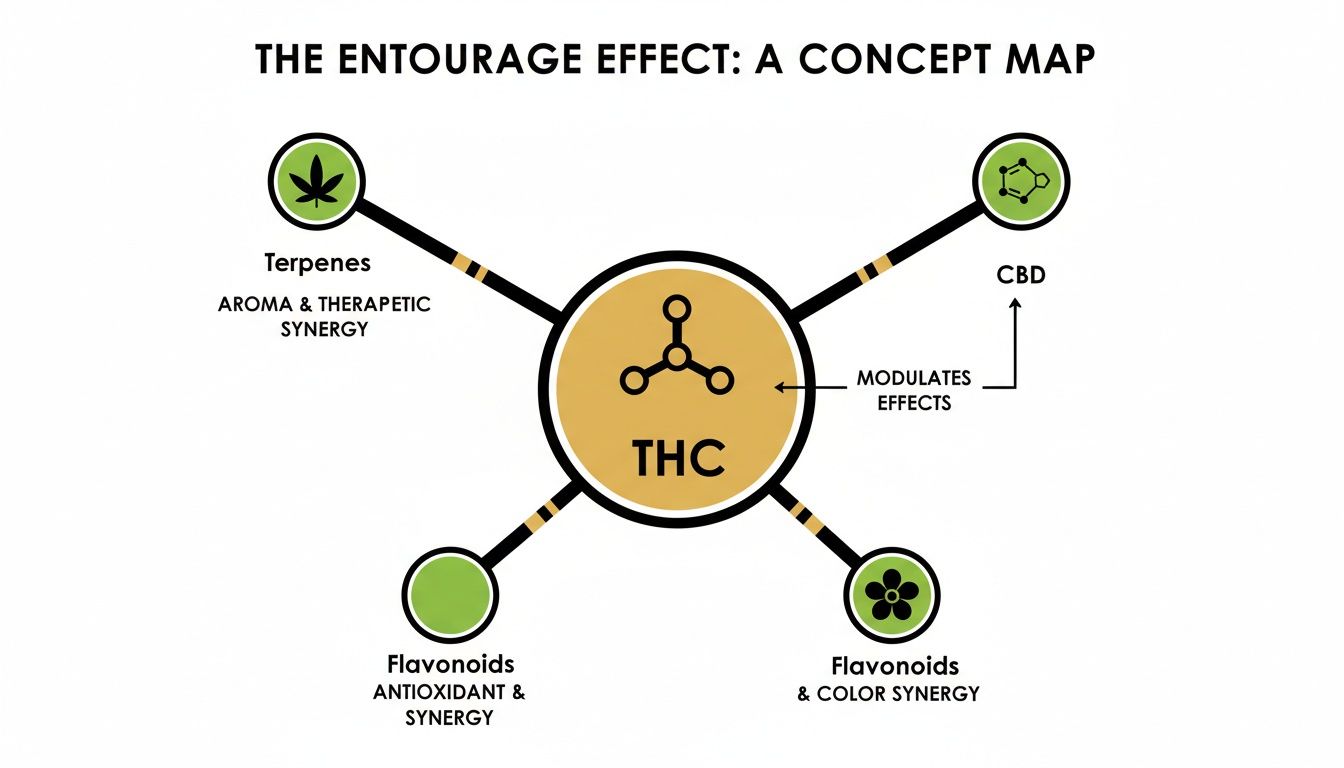
It’s a perfect illustration of how the power of a full spectrum product comes from the intricate teamwork of the entire plant profile, not just a single molecule.
Understanding Broad Spectrum
Broad spectrum products offer a compelling middle ground. They start their life as full spectrum extracts but then go through an extra processing step to remove all detectable THC.
This makes them a go-to choice for people who want the benefits of a diverse range of cannabinoids and terpenes but need to avoid the psychoactive effects of THC for personal or professional reasons.
While broad spectrum keeps much of the plant's goodness, the absence of THC fundamentally alters the entourage effect. It’s like an orchestra playing a symphony without its lead conductor—the music is still beautiful, but it's missing a crucial element that guides the entire performance.
Choosing between full spectrum, broad spectrum, and isolate isn't about which one is "best"—it's about which one is best for you. Full spectrum offers the complete plant synergy, broad spectrum provides a THC-free team of compounds, and isolate delivers a single, targeted cannabinoid.
The Role of Isolate
Isolate is the most refined form you can get. It’s a single cannabinoid, typically THC or CBD, purified to its crystalline form, often reaching an incredible 99% purity.
During this process, everything else—terpenes, flavonoids, and other cannabinoids—is completely stripped away. This precision makes isolates valuable for applications where a very specific, high-potency dose of a single compound is needed.
The trade-off, of course, is the complete loss of the entourage effect. In fact, some studies suggest that full spectrum extracts can be more effective at lower doses precisely because of this synergistic teamwork. Isolates give you strength through purity, but full spectrum delivers strength through unity.
Detailed Cannabinoid and Terpene Profile Comparison
To make it even clearer, this table breaks down what you can typically expect to find (or not find) in each type of extract.
| Compound Type | Full Spectrum | Broad Spectrum | Isolate |
|---|---|---|---|
| THC | Present | Non-Detectable | Only if it's a THC isolate |
| CBD | Present (amount varies by strain) | Present (often the primary cannabinoid) | Only if it's a CBD isolate |
| Minor Cannabinoids (CBG, CBN, etc.) | Present | Present | Absent |
| Terpenes | Present | Often present, but may be reduced | Absent |
| Flavonoids | Present | Often present, but may be reduced | Absent |
As you can see, the journey from full spectrum to isolate is one of subtraction. Each step removes more of the plant's natural compounds, moving from a complex, holistic profile to a single, pure molecule.
Why Full Spectrum Is Essential for RSO Users
If you're looking into Rick Simpson Oil (RSO) for serious wellness support, "full spectrum" isn't just a buzzword—it's the whole point. The entire philosophy behind RSO is built on a single, powerful idea: capturing the complete, unadulterated power of the cannabis plant. An extract that’s missing pieces of that puzzle simply isn't true RSO.
This commitment to the whole plant is what makes RSO so different from many other cannabis products. It’s not about isolating one compound. It's about delivering the entire symphony of cannabinoids, terpenes, and flavonoids as they exist in nature, all working together. This synergy, what we call the entourage effect, is the engine that drives the profound results RSO users count on.
The Whole-Plant Principle of RSO
By its very definition, authentic RSO is a full spectrum THC product. The original method was designed specifically to preserve as much of the plant's natural chemical profile as possible. Stripping out other compounds to isolate THC would go against the very principle that gives RSO its reputation.
When you use a true full spectrum extract, you're getting a product that mirrors the plant it came from. This means you get a high concentration of THC, but you also get:
- Minor Cannabinoids: Compounds like CBG, CBN, and CBC bring their own unique benefits to the table, adding layers of support that THC alone just can't offer.
- A Rich Terpene Profile: These aromatic compounds do more than just provide flavor and scent. They interact directly with cannabinoids to help steer the effects, perhaps promoting a sense of calm or focus.
- Essential Flavonoids and Plant Matter: Other natural compounds contribute to the oil's complexity, making sure the final product is a genuine reflection of the original plant.
At its core, RSO is the ultimate expression of the entourage effect. Its power doesn't come from one superstar molecule, but from the intricate teamwork of all its natural compounds working in harmony.
This whole-plant approach is precisely why RSO is held in such high regard. It's a concentrated dose of the plant's natural intelligence. Anything less than full spectrum is a completely different product.
Why Synergy Matters for Serious Support
When people turn to RSO, they are often looking for a level of support that goes far beyond what typical cannabis products can provide. The complete, concentrated profile of a full spectrum extract is designed to deliver just that. The interplay between all the compounds is believed to create a more powerful and balanced effect than an equivalent dose of isolated THC could ever achieve.
Think of it this way: each compound helps to shape and guide the others. For example, certain terpenes and minor cannabinoids can help smooth out the intense psychoactive experience of a high-THC oil, making the effects more manageable and well-rounded. That kind of balance is absolutely crucial for anyone incorporating RSO into a consistent daily routine.
The demand for potent, whole-plant extracts is growing fast. The medicinal cannabis market is projected to hit USD 23.93 billion in 2025, and concentrates like RSO already make up 26.9% of all sales. THC is expected to lead the charge, capturing 57.3% of that market, largely because its potent, fast-acting properties are maximized in full spectrum formulas. You can dig deeper into these trends in this market analysis from Coherent Market Insights.
RSOhelp.com and Our Commitment to Purity
Here at RSOhelp.com, our entire educational mission is built around this whole-plant philosophy. We stress the importance of full spectrum because we know it’s the only way to unlock the true potential of RSO. Any product labeled "RSO" that isn't full spectrum is missing the very essence of what makes it work. We are dedicated to providing information that supports your health journey.
For anyone using RSO, this makes checking a product’s lab report non-negotiable. You have to confirm that you’re getting an extract with a complete range of cannabinoids and terpenes. This is the only way to ensure you receive the powerful, synergistic benefits that have made RSO a cornerstone for so many people on their health journeys. Without the full spectrum, you're only getting part of the story.
How to Read a Certificate of Analysis for Your Product
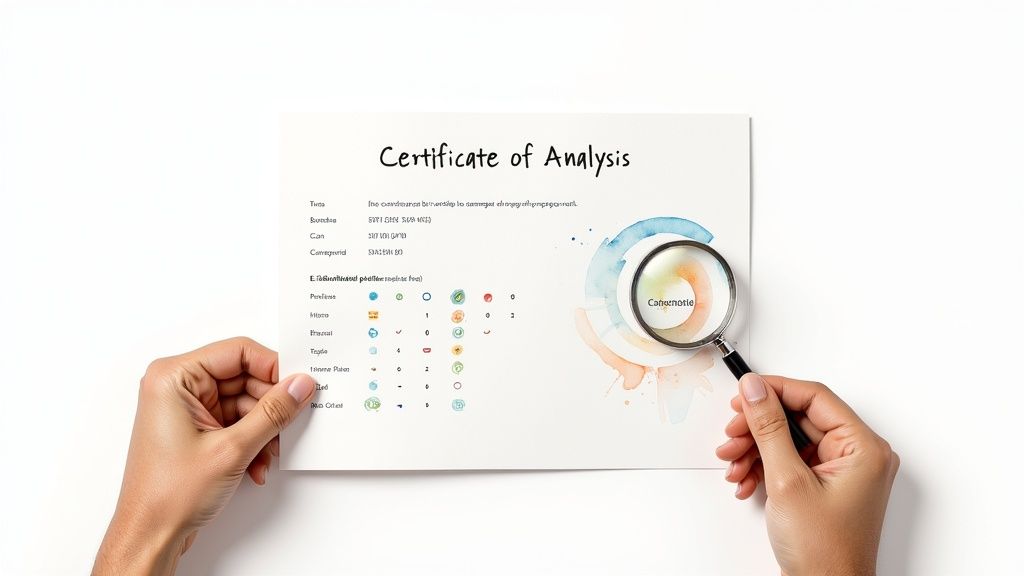
When you’re putting something into your body for health and wellness, you have to know exactly what’s in it. That’s where a Certificate of Analysis (COA) comes in—it's your single most important tool for verifying a product's integrity.
Think of a COA as a product's official report card, issued by an unbiased, third-party lab. It verifies everything from potency and purity to safety. Learning to read one is the best way to empower yourself and ensure the full spectrum THC product you’re buying is the real deal. It’s your guarantee that what's on the label is actually in the bottle.
Key Sections of a COA
While the exact layout can differ from lab to lab, every legitimate COA will have a few non-negotiable sections. The first thing I always check is the header. It should clearly list the lab’s name, the company that ordered the test, the product name, and—most importantly—a unique batch number that matches the one on your product’s packaging.
Once you’ve confirmed you're looking at the right report, it's time to dig into the details. This is where you find out if the product truly lives up to its "full spectrum" claim.
As you can see in this example, the report breaks down cannabinoid potency on the left and gives a clear "Pass" for crucial safety tests on the right. This is the kind of transparency you should demand.
Analyzing Cannabinoid and Terpene Profiles
The cannabinoid profile is the heart and soul of the COA. If a product is labeled "full spectrum THC," you should see a healthy percentage of THC right alongside a nice mix of other cannabinoids.
- THC Potency: Check the total THC, usually shown as a percentage or in milligrams. This number tells you the product's actual strength.
- Minor Cannabinoids: The presence of compounds like CBD, CBG, and CBN is your proof that it’s a genuine full spectrum extract, not an isolate.
- Terpene Analysis: A high-quality report will also include a terpene profile. Seeing a list of terpenes like Myrcene, Limonene, or Linalool confirms the extract has the aromatic compounds that drive the entourage effect.
Verifying a diverse cannabinoid and terpene profile is non-negotiable. This data proves that the extract contains the whole-plant synergy necessary for the comprehensive effects associated with high-quality full spectrum THC oil.
The methods used to create these extracts are quite sophisticated. If you're curious about the science behind it, our guide on THC extraction for oil walks through how these delicate compounds are preserved.
Confirming Safety and Purity
Finally, a complete COA must include a full safety screening. This section is your assurance that the product is free from nasty contaminants that could do more harm than good.
Always look for these four tests:
- Pesticides: Confirms the starting material was clean and free of agricultural chemicals.
- Heavy Metals: Screens for toxic metals like lead, arsenic, and mercury.
- Residual Solvents: Makes sure no harmful chemicals from the extraction process were left behind.
- Microbials: Checks for bacteria, mold, and yeast.
For every single one of these tests, the result should be "Pass" or "ND" (None Detected). Anything else is a serious red flag. Once you get the hang of reading a COA, you can shop with the confidence that you’re choosing products that are both effective and genuinely safe.
Finding Your Way: A Guide to Dosing and Product Selection
Figuring out how to use any full spectrum THC product is a very personal journey. There’s no magic number or universal dose that works for everyone. The real key is to be patient, pay attention to your own body, and find what feels right for you.
The best advice I can give, and it’s a golden rule in this space, is to "start low and go slow." This means beginning with a tiny dose—think the size of a single grain of rice if you're using a potent oil—and giving it time.
From there, you can slowly increase the amount over days or even weeks. This gentle approach lets your body get used to it and helps you pinpoint your ideal dose without ever feeling like you’ve taken too much.
Choosing the Right Product Format
Full spectrum THC isn’t a one-size-fits-all product. It comes in different forms, and the best one for you will really depend on your goals and daily routine. Each format works a bit differently, affecting how quickly you’ll feel it and how long the effects will stick around.
- Oils and Tinctures: These are taken by placing drops under your tongue, where they get absorbed right into your bloodstream. It's a popular method because it works relatively quickly, usually within 15 to 45 minutes, and the effects can last for several hours.
- Capsules: If you value consistency and hate measuring, capsules are a great choice. You get the exact same dose every single time. Just know that they take longer to kick in—often an hour or more—because they have to go through your digestive system first. The trade-off is that the effects might last a bit longer.
Responsible use is all about self-awareness. When you start with a tiny amount and really listen to your body's response, you empower yourself to make smart choices that support your wellness goals.
Listening to Your Body and Tracking Your Progress
As you start to figure out your dose, I highly recommend keeping a simple journal. Just jot down how much you took, what time you took it, and how you felt. Over time, this log becomes an invaluable tool, helping you spot patterns and adjust your dose with real confidence.
This idea of mindful tracking is at the heart of what we teach at RSOhelp.com. We believe that knowledge is power. When you understand how these products work and learn to interpret your body’s signals, you're not just a passive user—you're in the driver's seat of your own health journey.
Your Full Spectrum THC Questions, Answered
Let's finish up by tackling some of the most common questions that come up when people start exploring full spectrum THC. Think of this as a quick-reference guide to clear up any final details.
Will Full Spectrum THC Make Me Feel High?
In a word, yes. Any product labeled "Full Spectrum THC" is made from the cannabis plant and contains enough THC to produce psychoactive effects. How intense that experience is will depend on the product's strength, how much you take, and your own personal tolerance.
That said, many people find the experience feels noticeably different from using a product with only THC. The mix of other cannabinoids and terpenes often creates a more balanced, well-rounded feeling—that’s the entourage effect in action.
Is Full Spectrum THC Legal?
This is a big one, and the answer completely depends on your location. In states or countries with adult-use programs, you can typically find these products at licensed dispensaries.
Because they contain THC levels far higher than the federal limit for hemp, they are not available everywhere. You should check the specific laws in your area before buying or using any full spectrum THC product. Staying informed is the only way to make safe choices for your health.
Quick Tip: The source plant and THC content are everything. While full spectrum CBD and full spectrum THC both offer the entourage effect, their main cannabinoid and psychoactive potential are completely different.
What Is the Difference Between Full Spectrum THC and Full Spectrum CBD?
This is a critical point to understand, and it all comes down to the dominant cannabinoid and the plant it's sourced from.
- Full Spectrum THC: This comes from a THC-dominant cannabis plant. Its goal is to deliver THC's effects, enhanced by the full profile of other natural plant compounds. It is psychoactive.
- Full Spectrum CBD: This is extracted from the hemp plant. It may have trace amounts of THC, which isn't enough to cause a high. Its focus is on providing the benefits of CBD along with other non-intoxicating compounds.
Even though both are called "full spectrum," their effects and legal status are worlds apart.
At RSOhelp.com, our mission is to give you clear, trustworthy information for your wellness journey. If you need personalized guidance or want to connect with reliable sources for high-quality, lab-tested RSO, we invite you to check out our free consultations and resources.